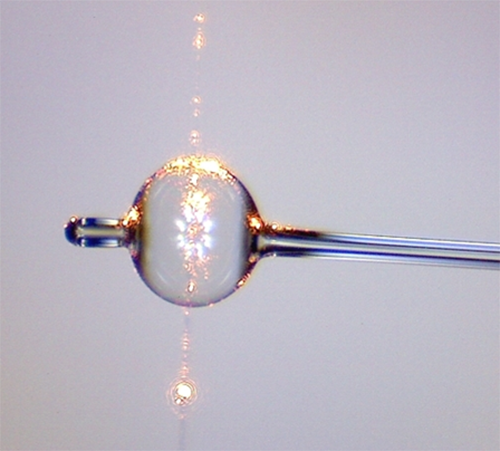
An example of a microbubble resonator with an optical fiber running vertically next to it to excite the mode.
When measuring the duration of high-speed physical phenomena, a good stopwatch can only get you so far, and while oscilloscopes can pick up electrical signals with frequencies of a few GHz, measuring incredibly fast optical phenomena requires something more — a system called an optical frequency comb. Normal lasers are monochromatic sources only containing a single frequency of light; in contrast, frequency combs contain many frequencies, equally spaced in the frequency domain, which look very much like the teeth of a comb. Frequency combs are used extensively as a type of “optical ruler” since they can measure rapidly varying signals by interfering the “teeth” of the frequency combs with the signal they want to measure, which consequently converts those signals into more manageable radio frequency signals.
Researchers in the Light-Matter Interactions Unit at the Okinawa Institute of Science and Technology Graduate University, along with collaborators in Washington University, published a paper recently in Optics Letters in which they outline how they created a frequency comb in the visible spectrum. They accomplished this by combining a phenomenon known as four-wave mixing with a low-cost, low-power device called a micro-bubble resonator (MBR). MBRs are a type of whispering gallery mode resonator (WGMR), and until now, only infrared frequency combs have been produced directly using four-wave mixing in WGMRs. Moving the operating wavelength of these devices into the visible regime has enormous benefits since an “optical ruler” is often sought after for light that can be observed by the human eye. The MBR device could be very useful in medical science where high precision frequency measurements are required, such as medical CT scans, where optical frequency combs are an excellent candidate. Presently optical frequency combs are generated using hefty femtosecond laser systems that require a lot of space and consume many watts of power, or using other large mode-locked laser systems. The proposed MBR, in contrast, is microns in size and only requires a low-power laser to pump the device since the tiny volume of the resonator mean that small input powers correspond to extremely high circulating intensities, a requirement for non-linear processes to occur.
A classical whispering gallery — the phenomena which allows this device to operate — is an acoustic effect. The dome of St. Paul’s cathedral in London is a famous example of a whispering gallery. In a circular enclosure, sound waves propagate along the inner walls with little loss, allowing one to hear whispers muttered near the wall a great distance away along the wall. Optically, the researchers replicate this effect by causing light to ‘bounce’ along the walls of a circular cavity, in this case a micro-bubble resonator. The group managed to fabricate a micro bubble resonator with a wall thickness of 1.4 microns — about 60 times thinner than a human hair — and an overall diameter of 120 microns. Using this device, they succeeded in producing an optical frequency comb with a central red wavelength of 765 nanometers, coinciding exactly with the predicted results.
The authors of the paper created MBRs by tapering thin glass capillaries down to a few tens of microns in diameter, blocking one of their openings and then pumping gas into the tubes. Heating an area of the glass using a CO2 laser forms a tiny bubble due to the balance between the gas pressure within the capillary and the surface tension of the molten glass, much like how glass blowers produce beautiful glass vases. Unlike typical solid resonators without thin walls, the researchers can control the wall thickness precisely allowing an extra degree of freedom. This crucial difference allowed the researchers to tune the central frequency of device to the visible regime.
Dr. Yong Yang, the primary author of this paper, looks forward to pushing the limits of the device with even thinner wall dimensions and hopes to expand the range of this device to eventually span the gap between the lower wavelength blue light all the way to the near infrared region. “I’m excited about the microbubble resonator since its unique geometry gives us so much more control over the dispersive properties and will ultimately help us to further push the boundaries of this device,” says Yang.
Ultimately, this work could provide researchers with a tool that is a low-cost, low power and compact alternative to the commercially available frequency combs today. What better way to measure light than to use light?