Research & Development World

  • R&D World Home
  • Topics
    • Aerospace
    • Automotive
    • Biotech
    • Careers
    • Chemistry
    • Environment
    • Energy
    • Life Science
    • Material Science
    • R&D Management
    • Physics
  • Technology
    • 3D Printing
    • A.I./Robotics
    • Software
    • Battery Technology
    • Controlled Environments
      • Cleanrooms
      • Graphene
      • Lasers
      • Regulations/Standards
      • Sensors
    • Imaging
    • Nanotechnology
    • Scientific Computing
      • Big Data
      • HPC/Supercomputing
      • Informatics
      • Security
    • Semiconductors
  • R&D Market Pulse
  • R&D 100
    • 2025 R&D 100 Award Winners
    • 2025 Professional Award Winners
    • 2025 Special Recognition Winners
    • R&D 100 Awards Event
    • R&D 100 Submissions
    • Winner Archive
  • Resources
    • Research Reports
    • Digital Issues
    • Educational Assets
    • Subscribe
    • Video
    • Webinars
    • Content submission guidelines for R&D World
  • Global Funding Forecast
  • Top Labs
  • Advertise
  • SUBSCRIBE

Medical Device Infections Slow Thanks to New Discovery

By Trinity College Dublin | March 21, 2017

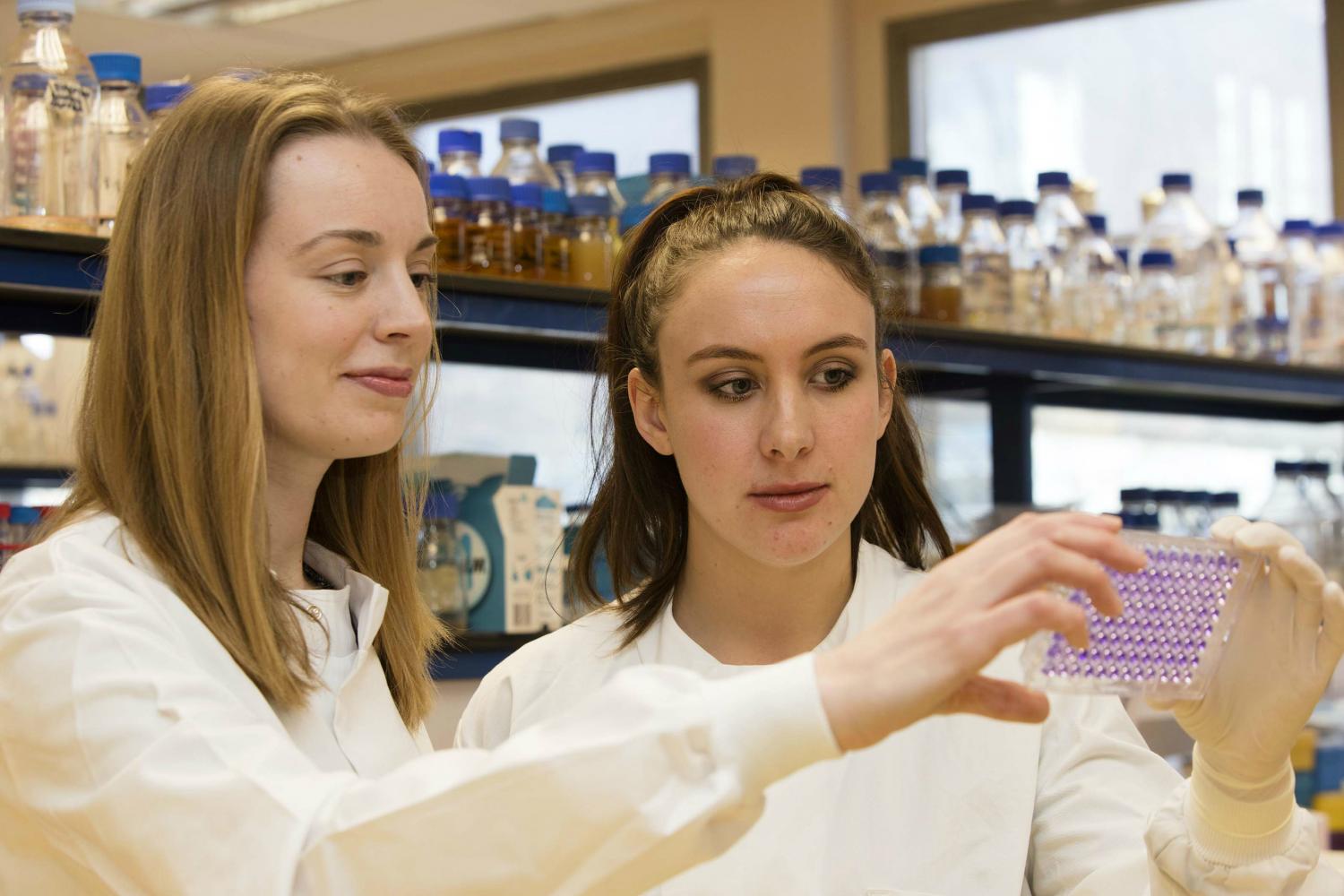
Dr. Joan Geoghegan and Leanne Hayes in the lab. Image: Trinity College Dublin

Trinity College Dublin

Microbiologists at Trinity College Dublin have discovered a new way to prevent bacteria from growing on medical devices such as hip replacements or heart valves implanted in the human body. The discovery is a step towards developing new preventive strategies that could have a direct impact on the recovery of patients in the immediate aftermath of a surgical operation.

Medical devices are routinely used in modern medicine to prevent and treat illness and disease but their use is compromised when an accumulation of bacteria called “biofilms” attach to the device surface after it is implanted in the human body. Communities of these bacteria called “staphylococci” growing on catheters, heart valves and artificial joints avoid being killed by antibiotics and the human immune system, meaning that the removal and replacement of the medical device is usually necessary. Each incident of biofilm infection costs €50,000 to €90,000 to the healthcare system.

The research team, led by Dr. Joan Geoghegan, Assistant Professor of Microbiology at Trinity’s School of Genetics and Microbiology, is studying new ways to prevent medical device-related infection. A recent breakthrough published in the prestigious journal Proceedings of the National Academy of Sciences shows that it is possible to prevent communities of staphylococci from forming by targeting the linkages that hold the bacteria together.

In collaboration with atomic force microscopy expert Professor Yves Dufrêne and his team at the Université Catholique de Louvain, Leanne Hays, PhD student in Trinity’s Department of Microbiology, has found that it is possible to stop bacteria from attaching to surfaces and to each other using a small blocking molecule. The target of the molecule was a protein attached to the surface of the bacteria called SdrC. In laboratory experiments the blocking molecule prevented the SdrC protein from recognizing other bacteria and stopped the staphylococci from growing as biofilm communities.

Geoghegan says, “These new findings show that it is possible to stop bacteria from building communities using molecules that specifically target proteins attached to the surface of the bacteria. This exciting breakthrough will inform the design of new, targeted approaches to prevent biofilm formation by staphylococci and reduce the incidence of medical device-related infection. “

Source: Trinity College Dublin
Related Articles Read More >

We are still likely years away from a hantavirus vaccine
Artemis II experiment uses organ chips to prepare for long-duration missions
New brain-computer interface allows monkeys to navigate 3D virtual reality
Researchers develop immune-capable cervix-on-a-chip to advance STI research
rd newsletter
EXPAND YOUR KNOWLEDGE AND STAY CONNECTED
Get the latest info on technologies, trends, and strategies in Research & Development.

R&D World Digital Issues

Fall 2025 issue

Browse the most current issue of R&D World and back issues in an easy to use high quality format. Clip, share and download with the leading R&D magazine today.

R&D 100 Awards
Research & Development World
  • Subscribe to R&D World Magazine
  • Sign up for R&D World’s newsletter
  • Contact Us
  • About Us
  • Drug Discovery & Development
  • Pharmaceutical Processing
  • Global Funding Forecast

Copyright © 2026 WTWH Media LLC. All Rights Reserved. The material on this site may not be reproduced, distributed, transmitted, cached or otherwise used, except with the prior written permission of WTWH Media
Privacy Policy | Advertising | About Us

Search R&D World

  • R&D World Home
  • Topics
    • Aerospace
    • Automotive
    • Biotech
    • Careers
    • Chemistry
    • Environment
    • Energy
    • Life Science
    • Material Science
    • R&D Management
    • Physics
  • Technology
    • 3D Printing
    • A.I./Robotics
    • Software
    • Battery Technology
    • Controlled Environments
      • Cleanrooms
      • Graphene
      • Lasers
      • Regulations/Standards
      • Sensors
    • Imaging
    • Nanotechnology
    • Scientific Computing
      • Big Data
      • HPC/Supercomputing
      • Informatics
      • Security
    • Semiconductors
  • R&D Market Pulse
  • R&D 100
    • 2025 R&D 100 Award Winners
    • 2025 Professional Award Winners
    • 2025 Special Recognition Winners
    • R&D 100 Awards Event
    • R&D 100 Submissions
    • Winner Archive
  • Resources
    • Research Reports
    • Digital Issues
    • Educational Assets
    • Subscribe
    • Video
    • Webinars
    • Content submission guidelines for R&D World
  • Global Funding Forecast
  • Top Labs
  • Advertise
  • SUBSCRIBE