A marketing banner for Meta’s latest model
Meta’s latest AI model, Muse Spark, has put the company back in frontier AI territor after its prior model, Llama 4 series became a credibility headache for Meta thanks to allegations of benchmark manipulation. While Meta initially denied the claims after the model was launched in April 2025, the former Meta exec Yann LeCun told Financial Times earlier this year that the benchmarks were “fudged a little bit.”
Muse Spark is thus something of a reset. The model is the first under the leadership of Alexandr Wang, Meta’s new chief AI officer and head of its Superintelligence Labs division. Muse Spark looks credible enough to reinsert the company into the top tier of the AI conversation, even if it is not the clear frontier leader. As of April 14, 2026, the independent leaderboard from Artificial Analysis pegged Muse Spark behind Gemini 3.1 Pro Preview, GPT-5.4, GPT-5.3 Codex and Claude Opus 4.6. Meta’s announcement has Muse Spark leading in several benchmarks.
First model under Alexandr Wang

Alexandr Wang (Meta)
“What Mark Zuckerberg bought with Alexandr Wang was expertise, data, and strategic knowledge of what the other labs are doing,” said Simon Koser, chief product officer at Tzafon, a research lab founded by former DeepMind researchers and quant traders. Wang spent a decade at Scale AI working with virtually every major AI lab, giving him an unusual vantage point on where the field was heading.
“The most impressive thing I’ve seen from Muse Spark is the multimodality,” Koser said. “It expands what the model can do and how valuable it is for end users.” Meta says Muse Spark was built from the ground up to integrate visual information across tools and domains, citing strong performance on visual STEM, entity recognition, and localization. The company points to applications like generating minigames on demand or annotating photos of a broken appliance to walk users through a fix.
A closed model from the developer of Llama
One of the more revealing parts of the Muse Spark launch is the product strategy. Rather than broadly opening Muse Spark as a developer platform, Meta is offering only a limited private API preview while pushing the model through its own consumer surfaces. The model itself is closed.
“This is a huge deviation from Meta’s previous strategy,” Koser said. “They built Llama around open source, and they haven’t open-sourced this model.”

Simon Koser
That shift, from open weights to closed consumer product, puts Meta on a path the other frontier labs have already tested. It also follows a playbook that OpenAI has tested. OpenAI tried to turn ChatGPT into a shopping destination, but stumbled. It also launched a TikTok-style video site powered by its Sora 2 model and is now pulling the plug on it.
Consumer dimensions
Meta is pushing forward in both shopping and AI-generated horizontal-scrolling video app called Vibes. What failed for OpenAI was trying to become a social media company by building conversion infrastructure from scratch. What Meta is doing with Muse Spark is the inverse: layering a reasoning engine on top of what it already is. Meta can ship a Shopping toggle on day one because the conversion infrastructure is already there.
In addition, Meta is offering consumers a lot of inference for free. The new Contemplation feature, although it is rate-limited, uses 16 agents reasoning in parallel. By the sake of comparison, xAI’s $300 per month Heavy tier also offers 16 agents reasoning in parallel, albeit with generous rate limits.

Will Adams
“A lot of these consumer products, like Muse, are released for free for a reason,” said Will Adams, president of secure AI workspace firm pipIQ. “You’re the product.”
Tethering to user identity
Adams said the key difference between Muse Spark and rival chatbots is that it is tethered to a user’s Meta identity. “It’s not just me interacting with this chatbot,” he said. “It is now me and my entire social graph, my behavior, the entire digital map of my life… who I’ve interacted with, the groups that I follow, and potentially even the biases that the algorithms feed us.”
“This very much looks like a straight consumer play to gather more consumer data and then turn around and monetize it,” Adams said.
The distribution choice tracks with where Meta makes its money. Emarketer projects Meta’s global net ad revenues will reach $243.46 billion in 2026, overtaking Google’s $239.54 billion for the first time, with growth accelerating to 24.1% this year. Muse Spark’s interface hints at how that engine extends into AI: alongside Thinking and Contemplating modes, the model sits behind a Shopping toggle for “product discovery.” For a company whose ad infrastructure has drawn scrutiny going back to Cambridge Analytica and, more recently, to loosely policed scam ads across its platforms, according to Reuters, a personal superintelligence that pulls in health data, food choices and home environments is a substantial expansion of what Meta knows about its users.
Meta has already described how that AI-to-ads pipeline works for non-sensitive topics. In its October 2025 announcement on AI-driven recommendations, the company said that if someone chats with Meta AI about hiking, they may later see recommendations for hiking groups, posts from friends about trails, or ads for hiking boots.
“Once that data is given, Meta has the rights to use that data in the ways they’ve told you they’re going to use it,” Adams said. “’We’re going to use that data to improve our products. We’re going to use your data to advertise to you.’”
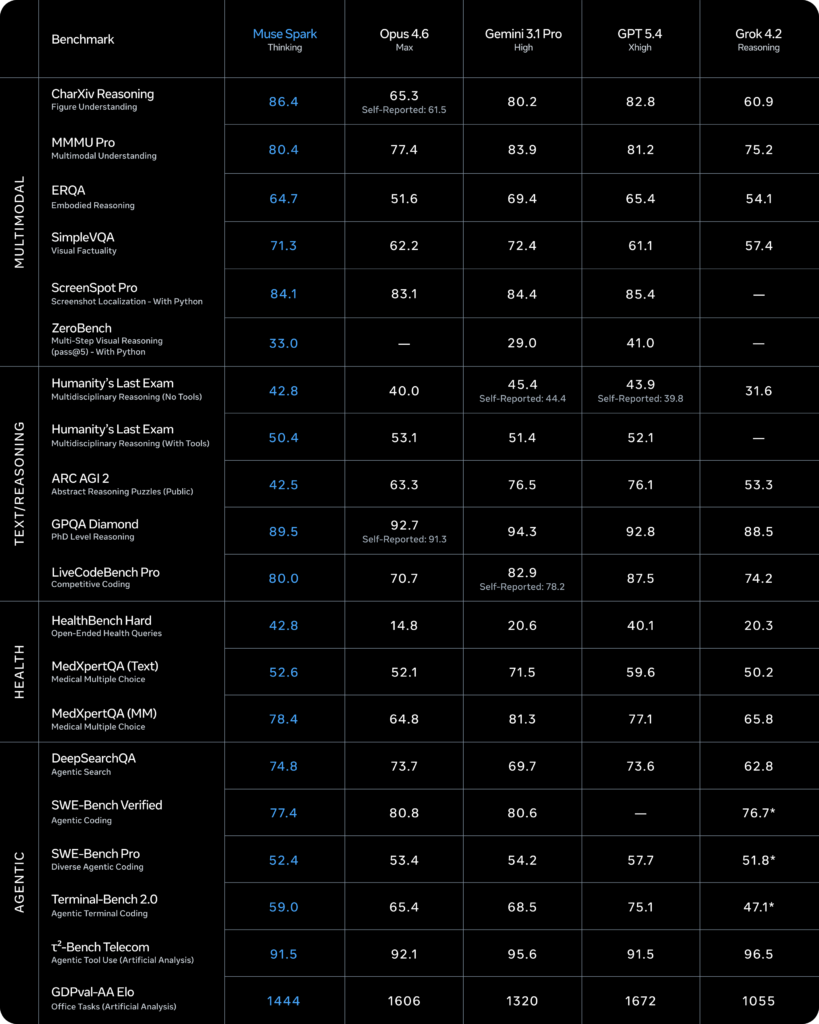
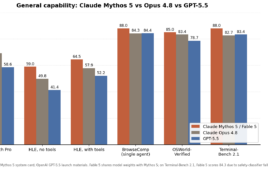
Meta’s benchmark comparison for Muse Spark, with categories weighted toward the company’s strongest showings. Muse Spark leads on all six multimodal tasks and all three health benchmarks but trails on ARC AGI 2, GPQA Diamond, LiveCodeBench Pro, and most agentic coding tasks. Source: Meta.
Exploring Meta’s AI terms
Meta’s AI Terms state that Meta uses interactions with its AIs “to personalize your experiences and ads, and improve AI at Meta.” The terms also instruct users not to share information they don’t want retained, “such as information about sensitive topics,” and say Meta may share information with “select partners.”
The AI Terms also tell users not to solicit “medical, psychological, financial, or legal advice” from the product, even as the Muse Spark launch post demos personalized food recommendations for a pescatarian user with high cholesterol.
Adams described the framing around health and wellness use cases as a potentially sensitive subject. “If consumers are sharing sensitive health information into an environment that’s not designed to ingest it, that’s like walking down the street and handing your medical chart to a complete stranger,” he said. “The consequences are far greater, because who knows how that data is going to be used.”
OpenAI and Anthropic rolled out health-focused products within days of each other in January 2026. OpenAI launched ChatGPT Health on January 7, with connections to Apple Health, MyFitnessPal, Function, and U.S. medical records through b.well. Anthropic followed on January 11 with Claude for Healthcare and an expanding network of health-data partners including HealthEx, Function, Apple Health, and Android Health Connect. Both support the kinds of consumer health and wellness context Meta’s Muse Spark demo points toward, including activity data, wellness-app information and, in some cases, medical records.
OpenAI is explicit in its terms for health uses: health conversations are not used to train foundation models, not used for ads, and ads do not appear in Health. Anthropic says it does not use users’ health data to train models. It also lacks Meta’s consumer ad business, though its broader consumer privacy language is still less tailored than OpenAI’s dedicated ChatGPT Health carve-out. Meta, by contrast, has said AI interactions can be used to personalize content and ads across its platforms though it also says sensitive topics such as health are not used to show ads.
That sits alongside Meta’s Washington and Nevada Consumer Health Data Privacy Policy, a notice required under state law for residents of those two states, which says Meta may collect, use,and disclose consumer health data for purposes including “providing marketing communications to you” and “providing, personalizing and improving our products and services.” The policy supplements Meta’s general privacy terms rather than replacing them, and Meta does not appear to offer an equally explicit nationwide health-data carve-out.
Adams said he sees a specific scenario playing out. “If I’m providing health information, and that is attached to my social graph throughout my experiences within Meta, and now, all of a sudden, I’m getting supplement ads,” he said.