As life science laboratories face escalating pressure to accelerate drug discovery while maintaining rigorous data integrity, the “manual bottleneck”—the human intervention required between high-tech instruments—remains a primary hurdle. To address this, Molecular Devices, a Danaher Corporation company, has announced a strategic collaboration with London-based Automata to create a truly interconnected research ecosystem.
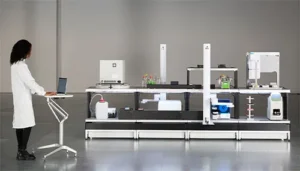
Credit: Molecular Devices
Molecular Devices’ imaging systems and microplate readers will be integrated with Automata’s LINQ platform to connect the machines via software and robotics. The LINQ platform allows instruments from different brands to communicate and move samples around without human intervention, transforming disparate pieces of lab hardware into a singular, flowing “nervous system” for research.
Today’s automation often exists in silos. A high-content screener might be automated internally, but moving plates between that screener, an incubator, and a liquid handler often requires a human scientist. This manual “bridge” introduces variability and potential error.
“Many of today’s scientific teams are working to increase productivity and data quality without adding operational complexity,” said Lars Hartvig Kristiansen, vice president of Product Innovation and Strategy at Molecular Devices. “Combining Molecular Devices’ microplate readers and high-content screening systems with Automata’s LINQ platform gives customers a clear path to connected, scalable workflows.”
The collaboration reflects broader strategic alignment: Danaher Ventures, the venture capital arm of Molecular Devices’ parent company, participated in Automata’s Series C funding round and secured a board seat, while Beckman Coulter Life Sciences, another Danaher company, is also integrating its instruments with LINQ, creating a unified ecosystem across multiple Danaher life sciences brands.




Tell Us What You Think!
You must be logged in to post a comment.