 At SLAS 2026, three orchestration platforms launched in the same week, multiple instruments shipped with API-first positioning, and two vendors debuted competing target engagement assays head-to-head. The closed-loop lab is now a procurement fight.
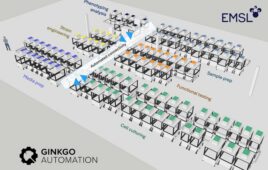
On February 5, Ginkgo Bioworks and OpenAI announced that GPT-5 had autonomously designed and iterated a large cell-free protein synthesis campaign in Ginkgo’s cloud lab: 36,000 reactions across 580 plates, 150,000 data points over six iterative rounds, and a roughly 40% cost improvement over the prior state of the art. The model beat the benchmark within three rounds. The human role was reduced to reagent prep and plate loading.
A handful of days later, SLAS 2026 opened in Boston with roughly two dozen companies issuing press releases at the time of writing. Read together, they show a supply-side sprint to fill every layer of the stack that Ginkgo just proved can work end to end.
The matrix below maps 15 of those companies across five layers of the autonomous lab stack: orchestration platforms, hardware, assays, software and infrastructure services, and scores each on AI integration and architectural openness. The sharpest tension running through it: open versus closed. Three orchestration startups (Automata, UniteLabs, Atinary) launched competing “Lab OS” platforms in the same week, each with a different answer to the question of who controls the software layer that coordinates hardware, models, and workflow decisions. That question used to be abstract. After Ginkgo showed the full loop working end to end, it is now a procurement fight.
SLAS 2026 · Boston
The lab OS wars: Company strategy matrix
15 companies. 5 stack layers. 3 orchestration philosophies. Sourced from the SLAS 2026 press kit, February 7–11.
| Company | Primary Move at SLAS 2026 | AI | Openness | Strategic Read |
|---|---|---|---|---|
| ■ Orchestration / Lab OS | ||||
| Automata | LINQ platform reframed as AI-native OS. $45M Series C led by Dimension; strategic investment from Danaher Ventures. | Med | Hybrid | Hardware-linked middleware. “Open by design” — but Danaher names Molecular Devices & Beckman Coulter as integration partners. Open rhetoric, vertical integration reality. |
| UniteLabs | Lab Automation OS launch. Python-native SDK, 100+ connectors, open-source repos. SiLA 2 compliant. | Med | Open-leaning | Software-first challenge to closed vendor stacks. No hardware dependency. Early deployments at Cradle, LSMC, a top-5 pharma. “Changing the unit economics of automation.” |
| Atinary | Self-Driving Labs launched in Boston Seaport. Closed-loop DMTA with ABB, Agilent, Bruker, Chemspeed, Mettler-Toledo. | High | Med | AI-first, selling the closed loop as a product. Supply-side mirror of Ginkgo. “Bringing AI into contact with reality.” |
| ■ Hardware / Workcells | ||||
| QIAGEN | QIAsprint Connect (192 samples/run) + QIAsymphony Connect (clinical) + QIAmini (low-throughput). Full throughput ladder. | Med | Closed | Ecosystem control + validation pitch. 21 CFR Part 11 ready. 50% plastic reduction. Single vendor reduces qualification burden for regulated labs. |
| Biosero | GoSimple workcell (Sartorius Octet, BD FACSLyric) + Assistive AI for Green Button Go. | Med–High | Med | Installed-base upgrade. Part of BICO Group (48K+ instruments). AI is “strictly assistive” — a compliance selling point. |
| Carterra | Vega HT-SPR — first 48-channel SPR. 12× throughput over market leader. 20K+ small molecule interactions/day. | Low | Med | Performance-led hardware. First shipment Q1 to top-10 pharma KOL. “No other label-free tech enables AI drug discovery at this scale.” |
| Veon Scientific | i.prep 2 open liquid handler. REST, Python & WebSocket APIs. “No closed GUIs or hidden software layers.” | Med | Open-leaning | API-first liquid handling. Designed to let AI models access every instrument programmatically. |
| ABB Robotics | GoFa cobots in 7 partner booths. Demo cells with Agilent, Mettler-Toledo, Biosero, UniteLabs, Atinary. | Med | Open-leaning | Ecosystem enabler — the physical layer every orchestration vendor plugs into. Not competing for control plane; competing for ubiquity. |
| ■ Assay / Reagent | ||||
| Promega | TarSeer BRETSA — NanoBRET + protein denaturation for live-cell target engagement. 20+ target classes. 96/384-well. | Med | Med | Expanding from NanoBRET. “You can now study intracellular target engagement for any protein in live cells.” Automation-ready format. |
| CellarisBio | MICRO-TAG — split-RNase target engagement. SLAS Ignite Award finalist. Real-time kinetics via QuantStudio. | Med | Med | Emerging challenger — head-to-head with Promega at the same show. Purpose-built for “undruggable” targets (IDPs, membrane proteins, TFs). |
| SPT Labtech | VPS4B ATPase screening workflow with BellBrook Labs. 13 novel inhibitors identified using dragonfly dispenser + Transcreener assays. | Low | Med | Application-proof strategy via partner workflows. Also showed integrated Automata LINQ screening for Mtb inhibitors. |
| ■ Software / Informatics | ||||
| Sapio Sciences | ELaiN 3rd-gen AI Lab Notebook + shadow AI survey (150 scientists). NVIDIA BioNeMo, Elsevier, DISGENET integrations. | High | Med | Data/informatics layer. Key signal: 45% of scientists using unapproved GenAI, according to Sapio research; 65% repeating experiments due to data findability failures. Demand-side pull is real. |
| Synthace | Charles River collaboration on DoE-driven assay development. 1536-well, 700+ conditions, multi-site validated. | Med | Med | Reproducibility, not autonomy. “The lab risks being left behind” vs. computation. Where most labs actually are in 2026. |
| ■ Infrastructure / Services | ||||
| Openshelf | LB (Lab Butler) — automated storage & retrieval for lab inventory. Open APIs. Founded by Opentrons alumni. | Low | Open-leaning | Filling the logistics gap. Inventory management is unsexy infrastructure the autonomous loop can’t run without. |
| Tangible Scientific | Compound Management as a Service. Targets the physical logistics bottleneck in DMTA cycles. | Low | N/A | Service model. Founded by Millennium / Constellation / Relay veterans. Claims 20–40% DMTA cycle time reduction. |
AI ratings reflect vendor self-positioning, not independent audit.
Openness = API surface + connector model + protocol portability.