Research & Development World

  • R&D World Home
  • Topics
    • Aerospace
    • Automotive
    • Biotech
    • Careers
    • Chemistry
    • Environment
    • Energy
    • Life Science
    • Material Science
    • R&D Management
    • Physics
  • Technology
    • 3D Printing
    • A.I./Robotics
    • Software
    • Battery Technology
    • Controlled Environments
      • Cleanrooms
      • Graphene
      • Lasers
      • Regulations/Standards
      • Sensors
    • Imaging
    • Nanotechnology
    • Scientific Computing
      • Big Data
      • HPC/Supercomputing
      • Informatics
      • Security
    • Semiconductors
  • R&D Market Pulse
  • R&D 100
    • 2025 R&D 100 Award Winners
    • 2025 Professional Award Winners
    • 2025 Special Recognition Winners
    • R&D 100 Awards Event
    • R&D 100 Submissions
    • Winner Archive
  • Resources
    • Research Reports
    • Digital Issues
    • Educational Assets
    • Subscribe
    • Video
    • Webinars
    • Content submission guidelines for R&D World
  • Global Funding Forecast
  • Top Labs
  • Advertise
  • SUBSCRIBE

NASA CubeSats Propel Toward Mars

By Andrew Good, Jet Propulsion Laboratory, NASA | June 4, 2018

NASA has achieved a first for the class of tiny spacecraft known as CubeSats, which are opening new access to space.

Over the past week, two CubeSats called MarCO-A and MarCO-B have been firing their propulsion systems to guide themselves toward Mars. This process, called a trajectory correction maneuver, allows a spacecraft to refine its path to Mars following launch. Both CubeSats successfully completed this maneuver; NASA’s InSight spacecraft just completed the same process on May 22.

The pair of CubeSats that make up the Mars Cube One (MarCO) mission both launched on May 5, along with the InSight lander, which is headed toward a Nov. 26 touchdown on the Red Planet. They were designed to trail InSight on the way to Mars, aiming to relay back data about InSight as it enters the planet’s atmosphere and attempts to land. The MarCOs were never intended to collect any science data; instead, they are a test of miniaturized communication and navigation technology that can blaze a path for future CubeSats sent to other planets.

Read more: Even Small Spacecraft Can Dream Big

Both MarCO-A and B successfully completed a set of communications tests in the past couple of weeks, says John Baker, program manager for planetary SmallSats at NASA’s Jet Propulsion Laboratory, Pasadena, Calif. JPL built both MarCO CubeSats and leads the mission.

“Our broadest goal was to demonstrate how low-cost CubeSat technology can be used in deep space for the first time,” Baker says. “With both MarCOs on their way to Mars, we’ve already traveled farther than any CubeSat before them.”
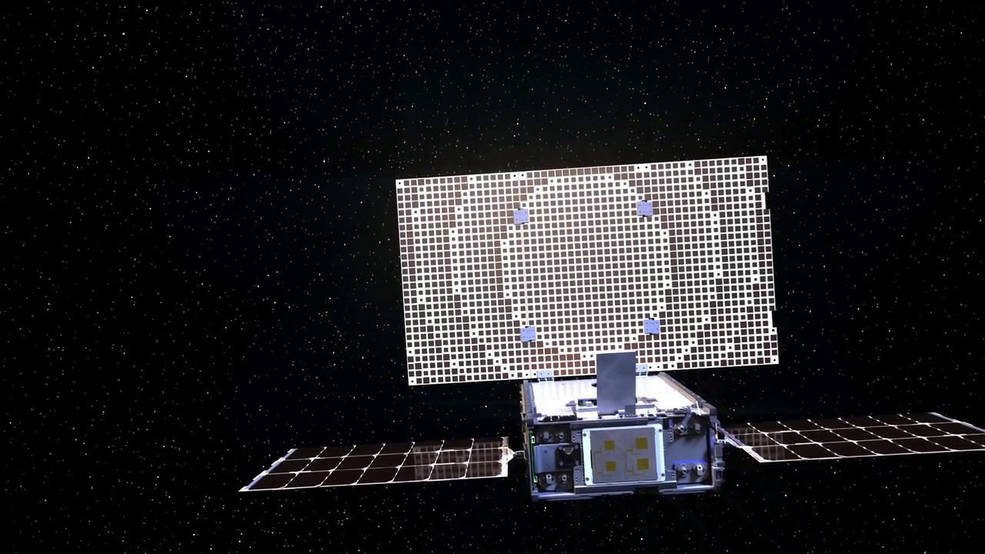
An artist’s concept of one of NASA’s MarCO CubeSats. The twin MarCOs are the first CubeSats to complete a trajectory correction maneuver, firing their thrusters to guide themselves toward Mars. Image: NASA/JPL-Caltech

While MarCO-A corrected its course to Mars relatively smoothly, MarCO-B faced some unexpected challenges. Its maneuver was smaller due to a leaky thruster valve that engineers have been monitoring for the past several weeks. The leak creates small trajectory changes on its own. Engineers have factored in these nudges so that MarCO-B can still perform a trajectory correction maneuver. It will take several more weeks of tracking to refine these nudges so that MarCO-B can follow InSight on its cruise through space.

“We’re cautiously optimistic that MarCO-B can follow MarCO-A,” says Joel Krajewski of JPL, MarCO’s project manager. “But we wanted to take more time to understand the underlying issues before attempting the next course-correction maneuver.”

Once the MarCO team has analyzed data, they’ll know the size of follow-on maneuvers. Several more course corrections will be needed to reach the Red Planet.

Should the CubeSats make it all the way to Mars, they will attempt to relay data to Earth about InSight’s landing. InSight won’t rely on either CubeSat for that data relay, however; that job will fall to NASA’s Mars Reconnaissance Orbiter.

Source: NASA
Related Articles Read More >

The science behind the Prada-designed spacesuit for Artemis 
NASA is confident Blue Origin will be ready for Artemis III despite explosion
Blue Origin explosion leaves Artemis experiments in limbo
SpaceX’s Starship V3 rocket completed its launch rehearsal
rd newsletter
EXPAND YOUR KNOWLEDGE AND STAY CONNECTED
Get the latest info on technologies, trends, and strategies in Research & Development.

R&D World Digital Issues

Fall 2025 issue

Browse the most current issue of R&D World and back issues in an easy to use high quality format. Clip, share and download with the leading R&D magazine today.

R&D 100 Awards
Research & Development World
  • Subscribe to R&D World Magazine
  • Sign up for R&D World’s newsletter
  • Contact Us
  • About Us
  • Drug Discovery & Development
  • Pharmaceutical Processing
  • Global Funding Forecast

Copyright © 2026 WTWH Media LLC. All Rights Reserved. The material on this site may not be reproduced, distributed, transmitted, cached or otherwise used, except with the prior written permission of WTWH Media
Privacy Policy | Advertising | About Us

Search R&D World

  • R&D World Home
  • Topics
    • Aerospace
    • Automotive
    • Biotech
    • Careers
    • Chemistry
    • Environment
    • Energy
    • Life Science
    • Material Science
    • R&D Management
    • Physics
  • Technology
    • 3D Printing
    • A.I./Robotics
    • Software
    • Battery Technology
    • Controlled Environments
      • Cleanrooms
      • Graphene
      • Lasers
      • Regulations/Standards
      • Sensors
    • Imaging
    • Nanotechnology
    • Scientific Computing
      • Big Data
      • HPC/Supercomputing
      • Informatics
      • Security
    • Semiconductors
  • R&D Market Pulse
  • R&D 100
    • 2025 R&D 100 Award Winners
    • 2025 Professional Award Winners
    • 2025 Special Recognition Winners
    • R&D 100 Awards Event
    • R&D 100 Submissions
    • Winner Archive
  • Resources
    • Research Reports
    • Digital Issues
    • Educational Assets
    • Subscribe
    • Video
    • Webinars
    • Content submission guidelines for R&D World
  • Global Funding Forecast
  • Top Labs
  • Advertise
  • SUBSCRIBE