Research & Development World

  • R&D World Home
  • Topics
    • Aerospace
    • Automotive
    • Biotech
    • Careers
    • Chemistry
    • Environment
    • Energy
    • Life Science
    • Material Science
    • R&D Management
    • Physics
  • Technology
    • 3D Printing
    • A.I./Robotics
    • Software
    • Battery Technology
    • Controlled Environments
      • Cleanrooms
      • Graphene
      • Lasers
      • Regulations/Standards
      • Sensors
    • Imaging
    • Nanotechnology
    • Scientific Computing
      • Big Data
      • HPC/Supercomputing
      • Informatics
      • Security
    • Semiconductors
  • R&D Market Pulse
  • R&D 100
    • 2025 R&D 100 Award Winners
    • 2025 Professional Award Winners
    • 2025 Special Recognition Winners
    • R&D 100 Awards Event
    • R&D 100 Submissions
    • Winner Archive
  • Resources
    • Research Reports
    • Digital Issues
    • Educational Assets
    • Subscribe
    • Video
    • Webinars
    • Content submission guidelines for R&D World
  • Global Funding Forecast
  • Top Labs
  • Advertise
  • SUBSCRIBE

NASA Telescope Gets a Shakedown

By Rob Gutro, NASA | February 14, 2017

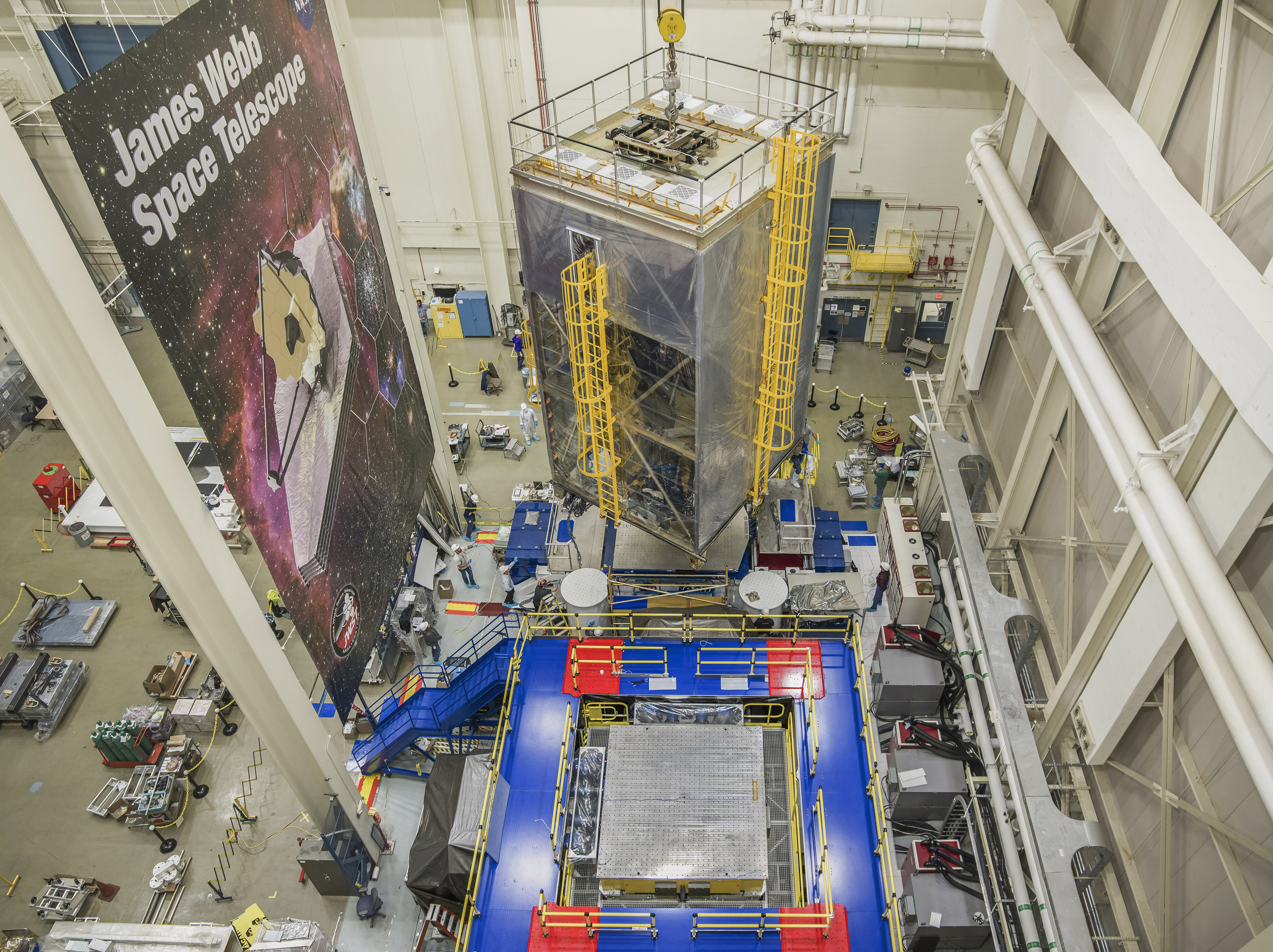
NASA engineers and technicians perform vibration testing on the James Webb Space Telescope. Image: NASA/Chris Gunn

Scientists and engineers had many challenges in designing the components of NASA’s James Webb Space Telescope and then had to custom design and build ways to test it.

Because of the sheer size and scale of the assembled Webb telescope, some of the equipment typically used to test spacecraft simply doesn’t measure up. One of those is a “shaker table” that is used to shake satellites to ensure a spacecraft like Webb can withstand the shaking that comes with a ride into space on a rocket.

So, engineers at Team Corporation in Burlington, Wash., built a new, large and advanced shaker table system at NASA’s Goddard Space Flight Center in Greenbelt, Md., especially for testing Webb. “The new “Vibration Test Systems” simulates the forces the telescope will feel during the launch by vibrating it from 5 to 100 times per second” says Jon Lawrence, Webb telescope mechanical systems lead and launch vehicle liaison at NASA’s Goddard Space Flight Center.

For Webb, the need for a new shaker system was a combination of things, including shaker force magnitude, the shaker table’s ability to handle the telescope’s highly offset center of gravity, and the need for a precision “smart” shaker control system — one that will automatically adjust shaker input levels based on test article responses, including an automatic ‘soft shutdown’ capability.  “No matter what facility anomaly might be experienced during testing (loss of power, loss of coolant, etc.), the Vibration Test System or VTS is designed to shut down ‘softly’ so as to avoid imparting potentially damaging loads,” Lawrence says. After vibration testing of the telescope is completed soon, the new VTS can be used to test other future large spacecraft. 

To make sure it works properly before using it to test the flight telescope, engineers put the new shaker system through its paces with many practice runs over months, using a dummy mass to represent the telescope.  In November, Webb was moved from the Spacecraft Systems Development and Integration Facility cleanroom and onto the new neighboring Vibration Test System (VTS), where testing is ongoing.  While in the shirtsleeve environment of the VTS, a large 3-story tall cover enshrouds the telescope, acting as a portable cleanroom that protects it from dust and dirt.

This spring, after vibration testing is complete, the Webb telescope will be shipped to NASA’s Johnson Space Center in Houston, Texas, for end-to-end optical tests in a vacuum at extremely cold temperatures, before it goes to Northrop Grumman Aerospace Systems in Redondo Beach, Calif., for final assembly and testing prior to launch. 

Source: NASA
Related Articles Read More >

The science behind the Prada-designed spacesuit for Artemis 
NASA is confident Blue Origin will be ready for Artemis III despite explosion
Blue Origin explosion leaves Artemis experiments in limbo
SpaceX’s Starship V3 rocket completed its launch rehearsal
rd newsletter
EXPAND YOUR KNOWLEDGE AND STAY CONNECTED
Get the latest info on technologies, trends, and strategies in Research & Development.

R&D World Digital Issues

Fall 2025 issue

Browse the most current issue of R&D World and back issues in an easy to use high quality format. Clip, share and download with the leading R&D magazine today.

R&D 100 Awards
Research & Development World
  • Subscribe to R&D World Magazine
  • Sign up for R&D World’s newsletter
  • Contact Us
  • About Us
  • Drug Discovery & Development
  • Pharmaceutical Processing
  • Global Funding Forecast

Copyright © 2026 WTWH Media LLC. All Rights Reserved. The material on this site may not be reproduced, distributed, transmitted, cached or otherwise used, except with the prior written permission of WTWH Media
Privacy Policy | Advertising | About Us

Search R&D World

  • R&D World Home
  • Topics
    • Aerospace
    • Automotive
    • Biotech
    • Careers
    • Chemistry
    • Environment
    • Energy
    • Life Science
    • Material Science
    • R&D Management
    • Physics
  • Technology
    • 3D Printing
    • A.I./Robotics
    • Software
    • Battery Technology
    • Controlled Environments
      • Cleanrooms
      • Graphene
      • Lasers
      • Regulations/Standards
      • Sensors
    • Imaging
    • Nanotechnology
    • Scientific Computing
      • Big Data
      • HPC/Supercomputing
      • Informatics
      • Security
    • Semiconductors
  • R&D Market Pulse
  • R&D 100
    • 2025 R&D 100 Award Winners
    • 2025 Professional Award Winners
    • 2025 Special Recognition Winners
    • R&D 100 Awards Event
    • R&D 100 Submissions
    • Winner Archive
  • Resources
    • Research Reports
    • Digital Issues
    • Educational Assets
    • Subscribe
    • Video
    • Webinars
    • Content submission guidelines for R&D World
  • Global Funding Forecast
  • Top Labs
  • Advertise
  • SUBSCRIBE