Research & Development World

  • R&D World Home
  • Topics
    • Aerospace
    • Automotive
    • Biotech
    • Careers
    • Chemistry
    • Environment
    • Energy
    • Life Science
    • Material Science
    • R&D Management
    • Physics
  • Technology
    • 3D Printing
    • A.I./Robotics
    • Software
    • Battery Technology
    • Controlled Environments
      • Cleanrooms
      • Graphene
      • Lasers
      • Regulations/Standards
      • Sensors
    • Imaging
    • Nanotechnology
    • Scientific Computing
      • Big Data
      • HPC/Supercomputing
      • Informatics
      • Security
    • Semiconductors
  • R&D Market Pulse
  • R&D 100
    • 2025 R&D 100 Award Winners
    • 2025 Professional Award Winners
    • 2025 Special Recognition Winners
    • R&D 100 Awards Event
    • R&D 100 Submissions
    • Winner Archive
  • Resources
    • Research Reports
    • Digital Issues
    • Educational Assets
    • Subscribe
    • Video
    • Webinars
    • PharmSci360
    • Content submission guidelines for R&D World
  • Global Funding Forecast
  • Top Labs
  • Advertise
  • SUBSCRIBE

New Laser Beam Shape Can ‘Sneak’ through Opaque Media

By Jim Shelton, Yale University | March 6, 2019

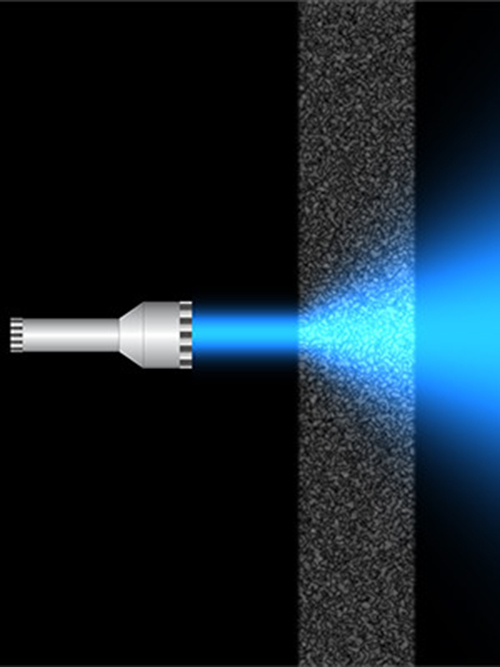
When a flashlight beam shines onto a strongly scattering medium such as white paint, the light diffuses in both longitudinal and lateral directions. Consequently, the transmitted beam becomes wider and the intensity is lower.

Researchers have found a way to pre-treat a laser beam so that it enters opaque surfaces without dispersing—like a headlight that’s able to cut through heavy fog at full strength.

The discovery from scientists at Yale University and the Missouri University of Science & Technology has potential applications for deep-tissue imaging and optogenetics, in which light is used to probe and manipulate cells in living tissue.

A study announcing the technique appears in the March 4 edition of the journal Nature Photonics.

“Typically, an optical beam propagating through a diffusive medium such as fog will spread laterally, but we have discovered that a special preparation of the laser beam can transmit all incoming light without lateral spread,” said principal investigator Hui Cao, the John C. Malone Professor of Applied Physics and of Physics at Yale.

The researchers used a spatial light modulator (SLM) and a charge-coupled device (CCD) camera to analyze an opaque material that is made of a layer of white paint. The SLM tailored the laser beam incident on the front surface of the material, and the CCD camera records intensity profiles behind it. With this information, the laser finds a “route” through the white paint.

The result is a beam that is more concentrated, with more light per volume inside and behind the opaque material. In addition to a layer of white paint, the materials in which the laser would be effective include biological tissue, fog, paper, and milk.

“Our method works for any opaque medium that does not absorb light,” Cao said.

The first author of the study is Yale postdoctoral research associate Hasan Yılmaz. Additional authors are Yale postdoctoral researcher Chia Wei Hsu and Missouri University of Science and Technology associate professor Alexey Yamilov.

“Enhancing optical energy in opaque scattering media is extremely important in optogenetics and deep-tissue imaging,” Yılmaz said. “Currently, penetration depth to probe and stimulate or image neurons inside the brain tissue is limited due to multiple-scattering.”

Financial support from the U.S. Office of Naval Research and the US-Israel Binational Science Foundation helped to fund the research.

Related Articles Read More >

The photon frontier: how O2O Lasercom is redefining deep-space data on Artemis II
laser reflect on optic table un quantum laboratory
2026 ultrafast laser buyer’s guide: 86 models compared
NASA R&D 100 Winner enables high-speed data transfer from space
Illustration of ultracold atoms (gold) flowing frictionlessly along a laser boundary (green), representing the quantum phenomenon of edge states.
MIT physicists directly observe frictionless ‘edge state’ flow in ultracold atoms, offering a glimpse of super-efficient electronics
rd newsletter
EXPAND YOUR KNOWLEDGE AND STAY CONNECTED
Get the latest info on technologies, trends, and strategies in Research & Development.

R&D World Digital Issues

Fall 2025 issue

Browse the most current issue of R&D World and back issues in an easy to use high quality format. Clip, share and download with the leading R&D magazine today.

R&D 100 Awards
Research & Development World
  • Subscribe to R&D World Magazine
  • Sign up for R&D World’s newsletter
  • Contact Us
  • About Us
  • Drug Discovery & Development
  • Pharmaceutical Processing
  • Global Funding Forecast

Copyright © 2026 Arrowfly LLC. All Rights Reserved. The material on this site may not be reproduced, distributed, transmitted, cached or otherwise used, except with the prior written permission of Arrowfly
Privacy Policy | Advertising | About Us

Search R&D World

  • R&D World Home
  • Topics
    • Aerospace
    • Automotive
    • Biotech
    • Careers
    • Chemistry
    • Environment
    • Energy
    • Life Science
    • Material Science
    • R&D Management
    • Physics
  • Technology
    • 3D Printing
    • A.I./Robotics
    • Software
    • Battery Technology
    • Controlled Environments
      • Cleanrooms
      • Graphene
      • Lasers
      • Regulations/Standards
      • Sensors
    • Imaging
    • Nanotechnology
    • Scientific Computing
      • Big Data
      • HPC/Supercomputing
      • Informatics
      • Security
    • Semiconductors
  • R&D Market Pulse
  • R&D 100
    • 2025 R&D 100 Award Winners
    • 2025 Professional Award Winners
    • 2025 Special Recognition Winners
    • R&D 100 Awards Event
    • R&D 100 Submissions
    • Winner Archive
  • Resources
    • Research Reports
    • Digital Issues
    • Educational Assets
    • Subscribe
    • Video
    • Webinars
    • PharmSci360
    • Content submission guidelines for R&D World
  • Global Funding Forecast
  • Top Labs
  • Advertise
  • SUBSCRIBE