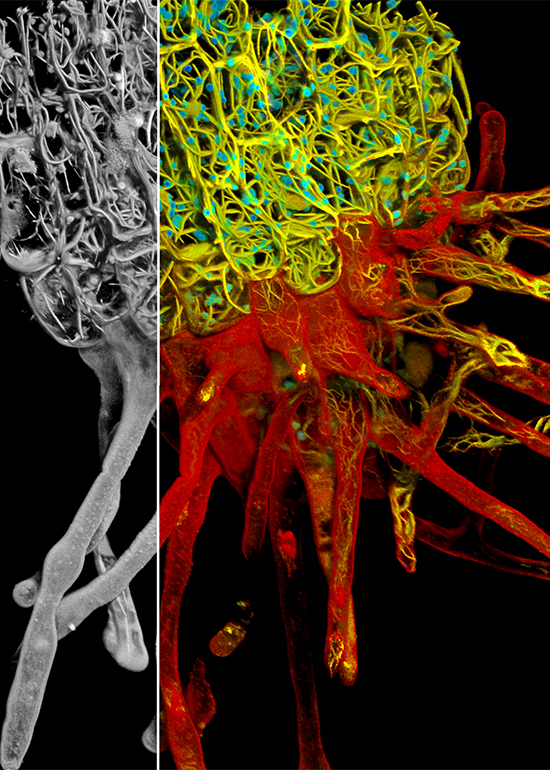
Simultaneous spectral (grey) and TauSense mode TauContrast (color) confocal imaging reveals contrast by lifetime. Root-hypocotyl-junction of Arabidopsis thaliana (Era et al. Plant Cell Physiol., 2009). Chlorophyll, Life-Act Venus, IProp.Sample courtesy: Dr. Krebs, COS, University of Heidelberg.
Designer and manufacturer of microscopes and scientific equipment, Leica Microsystems, has launched its flagship new confocal microscopy platform, STELLARIS. The platform will significantly improve how scientists are able to capture three-dimensional images of living cells and tissues.
Due to its optimized imaging performance, the new confocal platform gives researchers the power to see more and, as a result, collect more accurate and reliable data to prove hypotheses with precision. The combination of the unique new Power HyD detectors, White Light Laser and sophisticated software delivers brighter signals, resulting in images with more contrast and astounding detail. This data is helping researchers observe the inner workings of cellular processes – crucial for research in fields like cancer and neuroscience.
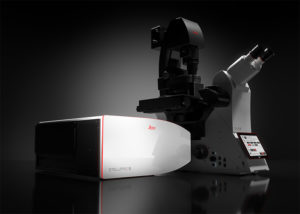
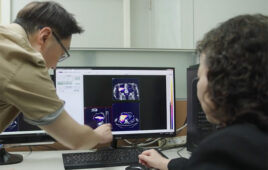
The STELLARIS 5 system is part of the new confocal microscopy platform STELLARIS from Leica Microsystems.
STELLARIS gives access to lifetime-based information in every experiment, in parallel with common intensity imaging approaches. Scientists will find that the unique TauSense lifetime-based imaging modes open up the potential to discover more. These modes complement a multitude of new ways to explore the function of molecules in their cellular context and help, for example, separate fluorophores even when their emissions fully overlap. Another benefit is that the number of simultaneous detection channels can be expanded by using lifetime-based information. Access to this advanced imaging information takes just one click. The new smart user interface, ImageCompass, ensures that scientists have the productivity to do more, as setting up even complex experiments is now much easier and more intuitive than ever before.
“STELLARIS increases the potential for new discoveries by providing users with a new breadth of scientific applications thanks to complete spectral freedom combined with lifetime-based modes. Scientists of all levels of experience will now be able to benefit from advanced imaging information obtained during their experiments – collecting more accurate and reliable data,” said Christine Munz, vice president Life Science.
“In microscopy, our mission is to empower our customers to drive progress in science. To get them closer to the truth, we have re-imagined the confocal microscope. STELLARIS offers additional information that is simply not available in conventional confocal systems. You get immediate access to functional information without having to learn complex, advanced techniques. This development will open up confocal microscopy to a much wider group of scientists and researchers, drive up productivity and enable new breakthroughs to be achieved in laboratories around the world,” added Markus Lusser, president.
STELLARIS offers significant enhancements compared to existing confocal systems on the market. The enhanced sensitivity in the blue-green range (PDE > 55%) improves the detection limits and dynamic range for the most commonly used fluorophores. The extension of the detection range to the Near Infrared (NIR) provides up to 67% more dynamic range compared to current state-of-the-art detectors. The NIR extension allows for additional freedom when selecting dyes and up to three additional colors. The new detector generation in combination with the renowned Leica spectral detection technology and a newly designed beam path to maximize transmission efficiency, enables efficient signal acquisition while valuable samples are afforded the lowest possible exposure to light. Ultimately, this facilitates ‘gentle’ live cell imaging, preserving sample integrity and improving reproducibility of results.
The integrated TauSense is an innovative set of imaging modes based on fluorescence lifetime without the need to add extra dedicated hardware. It enables scientists to differentiate between specific fluorescence signals and unwanted autofluorescence to improve the quality of the final image and separate fluorophores that could not be previously separated with spectral unmixing.
STELLARIS replaces Leica Microsystems’ SP8 platform with two main systems: the STELLARIS 5 and the advanced STELLARIS 8.
For more information, visit leica-microsystems.com