Research & Development World

  • R&D World Home
  • Topics
    • Aerospace
    • Automotive
    • Biotech
    • Careers
    • Chemistry
    • Environment
    • Energy
    • Life Science
    • Material Science
    • R&D Management
    • Physics
  • Technology
    • 3D Printing
    • A.I./Robotics
    • Software
    • Battery Technology
    • Controlled Environments
      • Cleanrooms
      • Graphene
      • Lasers
      • Regulations/Standards
      • Sensors
    • Imaging
    • Nanotechnology
    • Scientific Computing
      • Big Data
      • HPC/Supercomputing
      • Informatics
      • Security
    • Semiconductors
  • R&D Market Pulse
  • R&D 100
    • 2025 R&D 100 Award Winners
    • 2025 Professional Award Winners
    • 2025 Special Recognition Winners
    • R&D 100 Awards Event
    • R&D 100 Submissions
    • Winner Archive
  • Resources
    • Research Reports
    • Digital Issues
    • Educational Assets
    • R&D Index
    • Subscribe
    • Video
    • Webinars
    • Content submission guidelines for R&D World
  • Global Funding Forecast
  • Top Labs
  • Advertise
  • SUBSCRIBE

New nanotechnology method increases microalgae biofuel yield by 300%

By Julia Rock-Torcivia | July 24, 2025

Scientists from the University of Texas at El Paso demonstrated a new technique to improve the yield of biofuel from microalgae. Their study in ACS Applied Bio Materials centers on the microalga Chlorella vulgaris, which is commonly found in freshwater and can be used to produce biofuels. 
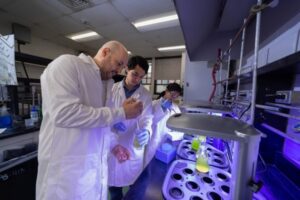
The team, led by Hamidreza Sharifan, Ph.D., assistant professor in the Department of Chemistry and Biochemistry (left), includes Luis Salmeron Covarrubias, a senior environmental science major (center), and Kavitha Beluri, a doctoral student in environmental science and engineering. Credit: The University of Texas at El Paso

The researchers demonstrated that doses of zinc oxide (ZnO) nanoparticles can enhance the lipid content of the microalga, including triacylglycerol, which is utilized in the production of biofuels. 

When the researchers exposed the C. vulgaris cells to 30-50 mg/L of synthesized ZnO, the cells’ lipid content increased from 14% to 48%, more than a 300% increase. They found that concentrations of ZnO above 50 mg/L caused oxidative damage to the cells, while concentrations below 30 mg/L did not optimize lipid production. 

The team is continuing to refine this process and hopes to show its reliability at a large scale as well as with other microalgae species. 

The biofuel suitability score

The researchers also developed the Biofuel Sustainability Score (BSS), which combines multiple factors to evaluate and optimize the conditions of biofuel production. The BSS framework could provide insights for future strategies in biofuel production. 

The BSS integrates lipid content, biomass productivity, oxidative stress levels and pigment retention to determine the best conditions for biofuel production. The researchers designed the framework to determine the best balance between oxidative stress management and lipid production. 

The BSS is a weighted percentage of lipid percentage, biomass productivity, photosynthetic pigments and oxidative stress, where stress lowered the BSS while the other parameters increased the score. 

The researchers used their BSS formula to determine that their method worked best at concentrations between 30-50 mg/L, optimizing lipid production without sacrificing cell health. 

Using microalgae for biofuel

Algae biofuel is an alternative to fossil fuels that uses algae to produce oils. Lipids from the algae are extracted and converted into biodiesel or refined into replacements for petroleum fuels. The carbohydrate content of algae can be fermented into bioethanol or butanol fuel. 


Some research has shown that algae species are made up of 40% lipids by weight, according to Britannica, all of which can be turned into biofuel. The process is also carbon neutral, as algae take in carbon dioxide during photosynthesis, offsetting the CO2 that is released when the fuel is burned. Compared to other biofuel resources, such as corn, algae can produce more oil per acre, making it a more efficient option for biofuel production.


Related Articles Read More >

California microgrid pilots EV integration model for wildfire-prone regions
Enough power for 3.5 homes: the hidden cost of fume hoods 
Nuclear research stalls just as AI-driven power demand surges
Solving the EV charger problem with streetlights
rd newsletter
EXPAND YOUR KNOWLEDGE AND STAY CONNECTED
Get the latest info on technologies, trends, and strategies in Research & Development.
RD 25 Power Index

R&D World Digital Issues

Fall 2025 issue

Browse the most current issue of R&D World and back issues in an easy to use high quality format. Clip, share and download with the leading R&D magazine today.

Research & Development World
  • Subscribe to R&D World Magazine
  • Sign up for R&D World’s newsletter
  • Contact Us
  • About Us
  • Drug Discovery & Development
  • Pharmaceutical Processing
  • Global Funding Forecast

Copyright © 2025 WTWH Media LLC. All Rights Reserved. The material on this site may not be reproduced, distributed, transmitted, cached or otherwise used, except with the prior written permission of WTWH Media
Privacy Policy | Advertising | About Us

Search R&D World

  • R&D World Home
  • Topics
    • Aerospace
    • Automotive
    • Biotech
    • Careers
    • Chemistry
    • Environment
    • Energy
    • Life Science
    • Material Science
    • R&D Management
    • Physics
  • Technology
    • 3D Printing
    • A.I./Robotics
    • Software
    • Battery Technology
    • Controlled Environments
      • Cleanrooms
      • Graphene
      • Lasers
      • Regulations/Standards
      • Sensors
    • Imaging
    • Nanotechnology
    • Scientific Computing
      • Big Data
      • HPC/Supercomputing
      • Informatics
      • Security
    • Semiconductors
  • R&D Market Pulse
  • R&D 100
    • 2025 R&D 100 Award Winners
    • 2025 Professional Award Winners
    • 2025 Special Recognition Winners
    • R&D 100 Awards Event
    • R&D 100 Submissions
    • Winner Archive
  • Resources
    • Research Reports
    • Digital Issues
    • Educational Assets
    • R&D Index
    • Subscribe
    • Video
    • Webinars
    • Content submission guidelines for R&D World
  • Global Funding Forecast
  • Top Labs
  • Advertise
  • SUBSCRIBE