The Korea Institute of Energy Research (KIER) and top U.S. National Laboratories formalize a roadmap to integrate AI into the global energy transition.
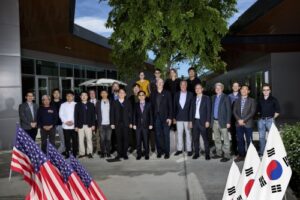
KIER-LLNL Workshop Group Photo (the 11th from the left, President Yi, Chang-Keun and LLNL PAD Glenn A. Fox) Credit: KIER
The KIER, Korea’s only government-funded energy research institute, held workshops from March 23 to 30 with leading U.S. Department of Energy (DOE) national laboratories—the Lawrence Livermore National Laboratory (LLNL) and the National Laboratory of the Rockies (NLR) to strengthen Korea-U.S. energy technology cooperation and reinforce the foundation for international research collaboration.
The workshops aimed to establish mid- to long-term cooperation strategies and identify specific joint research projects tied to both countries’ national AI initiatives. NLR and LLNL both signed memorandums of understanding (MOUs) with KIER, focused on energy technologies. NLR signed theirs in January 2025, and LLNL one year later.
The Genesis mission and K-Moonshot
The Genesis mission was launched by an executive order in November, 2025. The mission aims to build an integrated AI discovery platform across all 17 DOE national laboratories, connecting supercomputers, quantum systems, experimental instruments, and federal scientific datasets. The DOE announced a total of $293 million in funding for the mission.
The mission is giving researchers access to AI-ready federal datasets, domain-specific foundation models, autonomous lab tools and supercomputing infrastructure across the 17 national labs.
Last month, Deputy Prime Minister Bae Kyung-hoon of Korea announced K-Moonshot, 12 defined national research missions over 10 years spanning AI-accelerated drug development, brain implants, high-efficiency solar, quantum computing and more.
The planned cooperation builds on the foundation set in August 2023, with the Spirit of Camp David announcement, which established mechanisms for national labs cooperation, collaborative R&D and personnel exchanges.
Strategic alignment of AI and energy research
The institutions identified AI-energy cooperation projects that align with both initiatives and prepared a plan to establish an advisory committee for bilateral and multilateral joint research with LLNL.
“LLNL and NLR in the U.S. are research institutions possessing world-class large-scale research infrastructure and scientific and technological capabilities,” said KIER President Yi Chang-Keun. “Through this workshop, we will further strengthen cooperation between research institutions in Korea and the U.S. and expand international joint research in future energy fields such as hydrogen, secondary batteries, carbon capture, and AI-based energy technologies to lead global energy technology innovation.”
The six fields where this could open opportunities are AI-based energy systems, critical minerals, hydrogen production and utilization, secondary batteries, solar energy and carbon capture. Both the Genesis mission and K-Moonshot are focused on AI accelerating discovery across different fields, especially those with traditionally slow timelines, such as drug discovery. Both countries are funding “AI scientists” systems, agents capable of hypothesis generation, experiment design and automated result analysis.
The agreements between the countries could facilitate shared facility access, personnel exchanges and joint funding potential. NLR is scheduled to visit KIER and begin joint project proposals in April.