Researchers from Empa’s Functional Polymers laboratory have developed a new electrode based on graphene, which could help supercapacitors have higher energy densities.

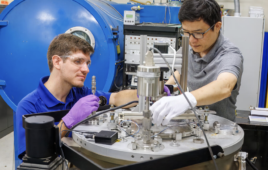
From left: Sina Azad, Vahid Charkesht and Jakob Heier with a graphene electrode. Credit: Empa
Like batteries, supercapacitors store electrical energy. While supercapacitors absorb and release energy faster than a battery, they cannot hold as much electricity. The researchers set out to improve this fault by creating a new electrode based on graphene, a two-dimensional form of carbon.
Focusing on scalability, not record-breaking
The team’s supercapacitor did not break the record for highest energy density, but that was not their goal. Instead, the scientists were focused on making their process scalable, so it could be implemented on an industrial level.
Supercapacitors store energy electrostatically, with a liquid electrolyte carrying the ions from one electrode to the other. The amount of energy in the supercapacitor is determined by the number of ions attached to the surface of the electrode. Therefore, increasing the surface area increases the energy density.
Usually, the electrodes are made of activated carbon, which has a low electrical conductivity. This reduces the energy density of the electrode. The team instead used graphene, which has a higher conductivity.
Pure graphene is taken from graphite, but conventional production methods are expensive and produce small amounts of graphene. The team instead developed a new way to produce it from graphite that is cost-effective and efficient. After the graphene is produced, it is processed into a printable ink.
Offering increased control
In conventional methods, the electrodes are printed on flexible films, then cut and rolled into supercapacitors. In order to print activated carbon, it has to be mixed with binding agents that reduce its porosity.
The researchers mixed two types of graphene to create their electrode, enabling them to influence the size of the pores between the graphene layers, which is impossible with activated carbon. “If the pore size of the electrode is matched to the size of the ions in the electrolyte, the energy density of the supercapacitor increases dramatically,” explained Empa researcher Sina Azad.
The researchers hope to bring their new electrodes to market as a high-tech product. Their project will continue until 2028, in which time they want to manufacture the electrodes and install them in functional prototypes. The team also has to find a suitable electrolyte and precisely characterize the finished supercapacitors.
“We want to develop a real, reliable product,” summarizes Azad.
Supercapacitors could solve AI’s energy problem
According to the International Energy Agency, a single ChatGPT request requires ten times more electricity than a Google search. In 2022, AI data centers accounted for approximately 1% of global electricity demand. In Ireland, data centers consumed 17% of the country’s total electricity consumption in 2022. This electricity demand is only expected to increase.
AI training requires a significant amount of electricity, enough to cause a massive energy spike, according to IEEE Spectrum. Supercapacitors could be a possible solution to AI’s increasing energy demand. At least three AI companies are planning to add banks of supercapacitors to their data centers, IEEE Spectrum reported.
Power equipment suppliers are anticipating this need. Siemens Energy released the E-statcom, a supercapacitor bank that can boost power into the grid as needed. Eaton is selling the XLHV, which can deliver up to 420 kilowatts of power.
Supercapacitors can be used to smooth fluctuations in the grid, which could become important as renewable energy sources are more variable than fossil fuels.