Research & Development World

  • R&D World Home
  • Topics
    • Aerospace
    • Automotive
    • Biotech
    • Careers
    • Chemistry
    • Environment
    • Energy
    • Life Science
    • Material Science
    • R&D Management
    • Physics
  • Technology
    • 3D Printing
    • A.I./Robotics
    • Software
    • Battery Technology
    • Controlled Environments
      • Cleanrooms
      • Graphene
      • Lasers
      • Regulations/Standards
      • Sensors
    • Imaging
    • Nanotechnology
    • Scientific Computing
      • Big Data
      • HPC/Supercomputing
      • Informatics
      • Security
    • Semiconductors
  • R&D Market Pulse
  • R&D 100
    • 2025 R&D 100 Award Winners
    • 2025 Professional Award Winners
    • 2025 Special Recognition Winners
    • R&D 100 Awards Event
    • R&D 100 Submissions
    • Winner Archive
  • Resources
    • Research Reports
    • Digital Issues
    • Educational Assets
    • R&D Index
    • Subscribe
    • Video
    • Webinars
    • Content submission guidelines for R&D World
  • Global Funding Forecast
  • Top Labs
  • Advertise
  • SUBSCRIBE

New Study Discovers ‘Killer Peptide’ That Helps Eliminate Resistant Cancer Cells

By University of Kentucky | August 9, 2017

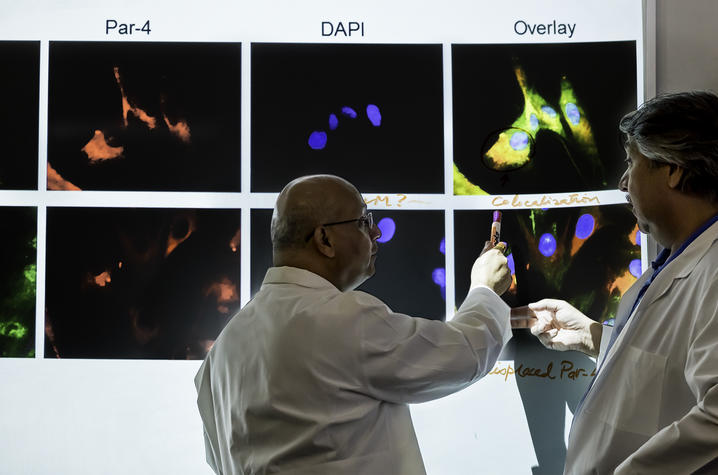
UK’s Vivek Rangnekar, left, and Ravshan Burikhanov. Source: University of Kentucky

 A new study by University of Kentucky Markey Cancer Center researchers shows that when therapy-sensitive cancer cells die, they release a “killer peptide” that can eliminate therapy-resistant cells.

Tumor relapse is a common problem following cancer treatment, because primary tumor cells often contain therapy-resistance cancer cells that continue to proliferate after the therapy-sensitive cells have been eliminated.

In the new study, published in Cancer Research, Markey scientists identified a Par-4 amino-terminal fragment (PAF) that is released by diverse therapy-sensitive cancer cells following therapy-induced cleavage of the tumor suppressor Par-4 protein. PAF caused death in cancer cells resistant to therapy and inhibited metastatic tumor growth in mice. Additionally, the PAF entered only cancer cells, not normal cells, keeping healthy tissue intact.

The findings indicate that this naturally generated PAF could potentially be harnessed to target neighboring or distant cancer cells to overcome metastasis and therapy resistance in tumors.

“This new information could positively impact how physicians plan their treatments, so as to use the sensitive cells in the tumor to release this peptide to help eliminate the resistant cells,” said Vivek Rangnekar, principal investigator and Alfred Cohen Chair in Oncology Research with the UK College of Medicine’s Department of Radiation Medicine. “We are developing PAF against therapy-resistant tumor metastasis for which no other treatment options are available.”

Markey researchers Nikhil Hebbar and Ravshan Burikhanov from Rangnekar’s team were the first two authors on the study, which also involved a partnership with Dr. Kojo Elenitoba-Johnson at the University of Pennsylvania.

Rangnekar’s team first announced the generation of the cancer-resistant Par-4 mouse back in 2007. Since then, his team’s work has spawned numerous research projects focusing on preventing and treating many types of cancer, including Markey oncologist Dr. Peng Wang’s clinical trial using the anti-malarial drug hydroxychloroquine to induce Par-4 secretion.
Related Articles Read More >

How Prelude and QDX are using quantum chemistry to discover cancer treatments
US political drama is pushing life sciences talent toward Switzerland, Basel leader says
Thermo Fisher targets early-stage CGT bottlenecks with new Philadelphia hub
AUTOMA+ 2025 brings global pharma expertise to Austria
rd newsletter
EXPAND YOUR KNOWLEDGE AND STAY CONNECTED
Get the latest info on technologies, trends, and strategies in Research & Development.
RD 25 Power Index

R&D World Digital Issues

Fall 2025 issue

Browse the most current issue of R&D World and back issues in an easy to use high quality format. Clip, share and download with the leading R&D magazine today.

Research & Development World
  • Subscribe to R&D World Magazine
  • Sign up for R&D World’s newsletter
  • Contact Us
  • About Us
  • Drug Discovery & Development
  • Pharmaceutical Processing
  • Global Funding Forecast

Copyright © 2025 WTWH Media LLC. All Rights Reserved. The material on this site may not be reproduced, distributed, transmitted, cached or otherwise used, except with the prior written permission of WTWH Media
Privacy Policy | Advertising | About Us

Search R&D World

  • R&D World Home
  • Topics
    • Aerospace
    • Automotive
    • Biotech
    • Careers
    • Chemistry
    • Environment
    • Energy
    • Life Science
    • Material Science
    • R&D Management
    • Physics
  • Technology
    • 3D Printing
    • A.I./Robotics
    • Software
    • Battery Technology
    • Controlled Environments
      • Cleanrooms
      • Graphene
      • Lasers
      • Regulations/Standards
      • Sensors
    • Imaging
    • Nanotechnology
    • Scientific Computing
      • Big Data
      • HPC/Supercomputing
      • Informatics
      • Security
    • Semiconductors
  • R&D Market Pulse
  • R&D 100
    • 2025 R&D 100 Award Winners
    • 2025 Professional Award Winners
    • 2025 Special Recognition Winners
    • R&D 100 Awards Event
    • R&D 100 Submissions
    • Winner Archive
  • Resources
    • Research Reports
    • Digital Issues
    • Educational Assets
    • R&D Index
    • Subscribe
    • Video
    • Webinars
    • Content submission guidelines for R&D World
  • Global Funding Forecast
  • Top Labs
  • Advertise
  • SUBSCRIBE