 When Washington turns research budgets into a political battleground, it sends what one Swiss ecosystem leader calls a “fatal signal” to scientists watching from around the world. Increasingly, that signal is redirecting their attention toward Switzerland, and especially toward the Basel region.
“We are hearing more and more from US scientists and companies that they view research in their country as being under threat,” said Dr. Christof Klöpper, CEO of Basel Area Business & Innovation. “It sends a fatal signal when research budgets are cut for political reasons, particularly for institutions such as the National Institutes of Health or leading US universities.”
Klöpper is not an outside commentator throwing stones. He has led Basel’s regional innovation and investment agency since 2016, after a career that included heading technology and industry development for the Basel-Stadt economics department and running Technologiepark Basel. His doctorate from the University of Basel focused on the geography of innovation in biotechnology, which makes the current shift in research migration patterns more than a passing curiosity for him.
“In an environment defined by threat and uncertainty, free science cannot flourish and researchers begin to look for other options,” he said.
American style business, Swiss style stability
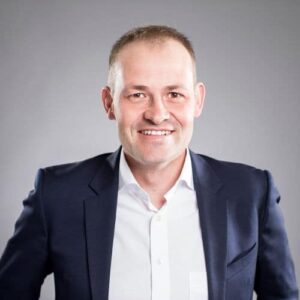
Dr. Christof Klöpper, CEO
For decades, when researchers talked about “other options,” they usually meant moving to the United States. Now, Klöpper hears the opposite conversation from scientists already working in U.S. institutions who are unsettled by what they see.
“I observe that many scientists in the U.S. are concerned about how current political dynamics are affecting their research and long-term opportunities,” he said.
What makes his pitch to those scientists more credible is that he does not frame Switzerland as a conventional European alternative. Instead, he highlights how closely it mirrors the U.S. on the factors that matter to investors and high-growth companies.
“In many ways, Switzerland is more similar to the U.S. than to its European neighbors,” Klöpper said. Both, in his view, share “a business-friendly environment, a flexible labor market and favorable tax conditions.”
The divergence appears when politics enters the lab. While US researchers worry that a change in government could jeopardize multi-year grants or reshape research priorities overnight, Klöpper presents Switzerland as a country where the guardrails are stronger.
“What currently sets Switzerland apart is its political stability and reliability,” he said. The country “pursues a supportive research policy and maintains an open immigration system for skilled labor,” which means that a scientist planning a decade-long program has a better chance of seeing it through.
Basel turns US anxiety into a selling point
Basel already sits at the center of one of Europe’s densest life sciences corridors, with global pharma firms, contract research organizations, and a long tail of startups clustered in and around the city. That critical mass, Klöpper argues, is now being amplified by political developments far beyond Switzerland’s borders.
“The Basel area in particular offers a large pool of life sciences experts, attractive support packages for innovative companies, high wage levels, and an excellent quality of life,” he said.
Recent headline commitments, such as Fondation Botnar’s endowment of more than $1 billion over 15 years for the Botnar Institute of Immune Engineering in Basel, have sharpened international attention on the region’s ecosystem. Klöpper is quick to welcome that capital, but he insists it is not the main point of differentiation. Instead, he circles back to the perception that scientific work itself is more secure.
“The current skepticism toward science in the U.S. gives Switzerland an opportunity to position itself as a location where scientific excellence continues to be highly valued,” he said.
In practice, that means his organization is not just passively receiving inquiries from frustrated US researchers. It is actively cultivating them, offering relocation support, connections to local employers and investors, and access to Switzerland Innovation Park sites across the region.
The policy question for Washington
Klöpper’s analysis is not anti-American. His own academic training included time in the United States, and he repeatedly stresses that the country’s combination of elite universities and economic power remains unmatched. The problem, as he sees it, is that those strengths are being undermined when scientific institutions find themselves pulled into partisan fights.
“I am convinced that free science, uninfluenced by political considerations, is the foundation for innovation,” he said. “The U.S., with its economic strength and academic excellence, has long demonstrated this.”
That history is exactly why the current wave of politically motivated budget cuts feels so dangerous to him. The United States spent decades building a reputation as the place where ambitious researchers could pursue bold ideas with a reasonable expectation of stable support. If that reputation erodes, countries that can combine intellectual freedom with predictable policy will have a powerful recruiting message.
Klöpper’s prescription for U.S. policymakers is simple, even if it is politically difficult: rebuild a clear firewall between scientific decision making and partisan conflict.
“I hope that the country will continue to pursue that path in the future,” he said.
For now, the tension between chaos and stability is shaping a quiet but important rebalancing of the global life sciences map. From his office in Basel, Klöpper is betting that scientists who want US style dynamism without US style volatility will increasingly decide that Switzerland is close enough on the first point, and far ahead on the second