Research & Development World

  • R&D World Home
  • Topics
    • Aerospace
    • Automotive
    • Biotech
    • Careers
    • Chemistry
    • Environment
    • Energy
    • Life Science
    • Material Science
    • R&D Management
    • Physics
  • Technology
    • 3D Printing
    • A.I./Robotics
    • Software
    • Battery Technology
    • Controlled Environments
      • Cleanrooms
      • Graphene
      • Lasers
      • Regulations/Standards
      • Sensors
    • Imaging
    • Nanotechnology
    • Scientific Computing
      • Big Data
      • HPC/Supercomputing
      • Informatics
      • Security
    • Semiconductors
  • R&D Market Pulse
  • R&D 100
    • 2025 R&D 100 Award Winners
    • 2025 Professional Award Winners
    • 2025 Special Recognition Winners
    • R&D 100 Awards Event
    • R&D 100 Submissions
    • Winner Archive
  • Resources
    • Research Reports
    • Digital Issues
    • Educational Assets
    • Subscribe
    • Video
    • Webinars
    • Content submission guidelines for R&D World
  • Global Funding Forecast
  • Top Labs
  • Advertise
  • SUBSCRIBE

New Theory Finds ‘Traffic Jams’ in Jet Stream Cause Abnormal Weather Patterns

By University of Chicago | May 25, 2018

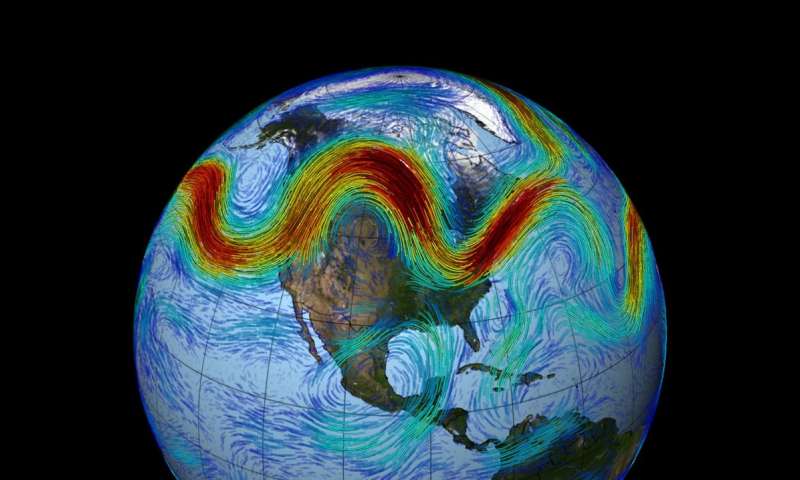
Illustration of the Northern Hemisphere’s polar jet stream. Credit: NASA’s Goddard Space Flight Center

The sky sometimes has its limits, according to new research from two University of Chicago atmospheric scientists.

A study published May 24 in Science offers an explanation for a mysterious and sometimes deadly weather pattern in which the jet stream, the global air currents that circle the Earth, stalls out over a region. Much like highways, the jet stream has a capacity, researchers said, and when it’s exceeded, blockages form that are remarkably similar to traffic jams—and climate forecasters can use the same math to model them both.

The deadly 2003 European heat wave, California’s 2014 drought and the swing of Superstorm Sandy in 2012 that surprised forecasters—all of these were caused by a weather phenomenon known as “blocking,” in which the jet stream meanders, stopping weather systems from moving eastward. Scientists have known about it for decades, almost as long as they’ve known about the jet stream—first discovered by pioneering University of Chicago meteorologist Carl-Gustaf Rossby, in fact—but no one had a good explanation for why it happens.

“Blocking is notoriously difficult to forecast, in large part because there was no compelling theory about when it forms and why,” said study coauthor Noboru Nakamura, a professor in the Department of the Geophysical Sciences.

Nakamura and then-graduate student Clare S.Y. Huang were studying the jet stream, trying to determine a clear set of measurements for blocking in order to better analyze the phenomenon. One of their new metrics was a term that measured the jet stream’s meander. Looking over the math, Nakamura realized that the equation was nearly identical to one devised decades ago by transportation engineers trying to describe traffic jams.

“It turns out the jet stream has a capacity for ‘weather traffic,’ just as highway has traffic capacity, and when it is exceeded, blocking manifests as congestion,” said Huang.

Much like car traffic, movement slows when multiple highways converge and the speed of the jet stream is reduced due to topography such as mountains or coasts.

The result is a simple theory that not only reproduces blocking, but predicts it, said Nakamura, who called making the cross-disciplinary connection “one of the most unexpected, but enlightening moments in my research career—truly a gift from God.”

The explanation may not immediately improve short-term weather forecasting, the researchers said, but it will certainly help predict long-term patterns, including which areas may see more drought or floods.

Their initial results suggest that while climate change probably increases blocking by running the jet stream closer to its capacity, there will be regional differences: for example, the Pacific Ocean may actually see a decrease in blocking over the decades.

“It’s very difficult to forecast anything until you understand why it’s happening, so this mechanistic model should be extremely helpful,” Nakamura said.

And the model, unlike most modern climate science, is computationally simple: “This equation captures the essence with a much less complicated system,” Huang said.
Related Articles Read More >

How a new permafrost climate model fits a dangerous pattern in climate science
Trump administration to dismantle ocean observatories that provide data freely to researchers
Atmospheric carbon dioxide hits record 431 ppm as Mauna Loa Observatory faces funding cuts
Microplastics may contribute to global warming new research indicates
rd newsletter
EXPAND YOUR KNOWLEDGE AND STAY CONNECTED
Get the latest info on technologies, trends, and strategies in Research & Development.

R&D World Digital Issues

Fall 2025 issue

Browse the most current issue of R&D World and back issues in an easy to use high quality format. Clip, share and download with the leading R&D magazine today.

R&D 100 Awards
Research & Development World
  • Subscribe to R&D World Magazine
  • Sign up for R&D World’s newsletter
  • Contact Us
  • About Us
  • Drug Discovery & Development
  • Pharmaceutical Processing
  • Global Funding Forecast

Copyright © 2026 WTWH Media LLC. All Rights Reserved. The material on this site may not be reproduced, distributed, transmitted, cached or otherwise used, except with the prior written permission of WTWH Media
Privacy Policy | Advertising | About Us

Search R&D World

  • R&D World Home
  • Topics
    • Aerospace
    • Automotive
    • Biotech
    • Careers
    • Chemistry
    • Environment
    • Energy
    • Life Science
    • Material Science
    • R&D Management
    • Physics
  • Technology
    • 3D Printing
    • A.I./Robotics
    • Software
    • Battery Technology
    • Controlled Environments
      • Cleanrooms
      • Graphene
      • Lasers
      • Regulations/Standards
      • Sensors
    • Imaging
    • Nanotechnology
    • Scientific Computing
      • Big Data
      • HPC/Supercomputing
      • Informatics
      • Security
    • Semiconductors
  • R&D Market Pulse
  • R&D 100
    • 2025 R&D 100 Award Winners
    • 2025 Professional Award Winners
    • 2025 Special Recognition Winners
    • R&D 100 Awards Event
    • R&D 100 Submissions
    • Winner Archive
  • Resources
    • Research Reports
    • Digital Issues
    • Educational Assets
    • Subscribe
    • Video
    • Webinars
    • Content submission guidelines for R&D World
  • Global Funding Forecast
  • Top Labs
  • Advertise
  • SUBSCRIBE