Project Amplify
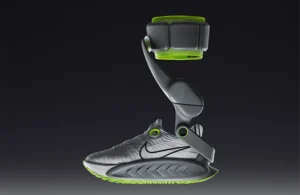
On Thursday, Nike announced several new products, including Project Amplify, a powered footwear system for running and walking. The system is “engineered to augment natural lower leg and ankle movement,” according to the press release. It is “in effect, a second set of calf muscles.” The product is still in early testing.
“Our job is to dream big while keeping athletes at the center,” Michael Donaghu, VP of Create The Future, Emerging Sport and Innovation, said in the release. “Project Amplify started with a single question: What if we could find a way to help athletes move faster and farther with less energy and a lot more fun?”
In testing, the system helped some athletes reduce their mile time from 12 minutes to ten. These athletes have also reported that the product makes it easier to walk or run uphill.
Designing neuroscience-based footwear
Along with Project Amplify, the company also announced a neuroscience-based footwear designed to activate sensory receptors in the feet to help athletes feel calmer and more focused. The models are called Mind 001 and Mind 002, and will be available in Jan. 2026.
The shoes feature 22 independent foam nodes that act as pistons and gimbals as athletes move to heighten sensory awareness, which can improve concentration. These shoes also mark the debut of Nike’s Mind Science Department, a group within the Nike Sport Research Lab that is studying the mind-body connection.
Nike is also releasing a 3D-printed sneaker, the Air Max 95000. The shoe features a “Big Bubble Max Air unit” in the heel and forefoot to provide a smoother, springy feeling. The shoe will be available next month.

The Air Max 95000 marks the debut of Nike’s Project Nectar, a 3D-printing process designed specifically for Nike shoes. The shoe was developed with Zellerfeld using the company’s Gen3 printers. Zellerfeld sells 3D-printed shoes by various brands and designers, offering custom-fitted shoes using scans of the customers’ feet.
Keeping warm – or cold
Along with these footwear innovations, Nike revealed a Therma-FIT Air Milano Jacket that provides personalized thermal control. The jacket allows athletes to regulate their temperature by inflating or deflating air within the jacket’s baffles. Team USA athletes will be the first to wear the new jacket at the Olympics in Milan. The jacket is also fitted with accessibility features – interior bottom hem thumb loops and a magnetic zipper – designed for use by Paralympic athletes.
“Air Milano shows Nike at its best — blending athlete science and data-driven design to create responsive, engineered garments that drive athletic performance,” Danielle Kayembe, Expert, Apparel Product Innovation Management, said in a press release.
Nike’s strategic shift
Under CEO Elliott Hill, who took the position last year, Nike has been shifting away from the traditional grouping of apparel under groups like men’s, women’s and children’s and towards a focus on sport-specific categories such as running, basketball and football.
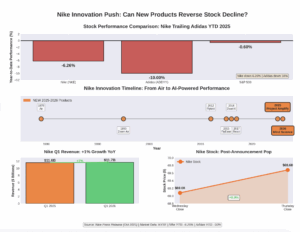
Early signs suggest the strategy may be working. Nike announced its financial results for the first quarter of 2026 on Sept. 30. The company reported $11.7 billion in revenue, up 1% compared to last year.
“I’m encouraged by the momentum we generated in the quarter, but progress will not be linear as dimensions of our business recover on different timelines,” said Matthew Friend, Executive Vice President & Chief Financial Officer, NIKE, Inc.
Nike stock rose 0.9% from $69.08 at close on Wednesday to $69.68 at close on Thursday following the announcements of the new products. Its stock is down 6.26% YTD, compared to competitor Adidas, which is down 10%. The new product releases could provide Nike with enough momentum to solidify its lead on Adidas.
Nike does not break out “Research and development” as a separate line item in its income statement, although it describes Product Research, Design and Development as “key factors” in its success. This accounting approach stands in stark contrast to pharmaceutical and technology companies, where R&D can represent 10-30% or more of revenue, and receives prominent disclosure.
Instead, Nike employs a hybrid innovation model that blends internal expertise with extensive external collaboration, although it has had comparatively fewer pivotal product launches over the past decade. Examples include the groundbreaking Nike Air line (launched in 1979 with pressurized-gas cushioning), Zoom Air (1995, responsive cushioning for speed), Flyknit (2012, precision-engineered knitted uppers), FlyEase (2015, accessibility-focused designs), React foam (2017, durable cushioning) and ZoomX (2016, ultra-lightweight foam for marathon runners).