Research & Development World

  • R&D World Home
  • Topics
    • Aerospace
    • Automotive
    • Biotech
    • Careers
    • Chemistry
    • Environment
    • Energy
    • Life Science
    • Material Science
    • R&D Management
    • Physics
  • Technology
    • 3D Printing
    • A.I./Robotics
    • Software
    • Battery Technology
    • Controlled Environments
      • Cleanrooms
      • Graphene
      • Lasers
      • Regulations/Standards
      • Sensors
    • Imaging
    • Nanotechnology
    • Scientific Computing
      • Big Data
      • HPC/Supercomputing
      • Informatics
      • Security
    • Semiconductors
  • R&D Market Pulse
  • R&D 100
    • 2025 R&D 100 Award Winners
    • 2025 Professional Award Winners
    • 2025 Special Recognition Winners
    • R&D 100 Awards Event
    • R&D 100 Submissions
    • Winner Archive
  • Resources
    • Research Reports
    • Digital Issues
    • Educational Assets
    • R&D Index
    • Subscribe
    • Video
    • Webinars
    • Content submission guidelines for R&D World
  • Global Funding Forecast
  • Top Labs
  • Advertise
  • SUBSCRIBE

Novel PET Imaging Agent Targets Copper in Tumors, Detects Prostate Cancer Recurrence Early

By Society of Nuclear Medicine and Molecular Imaging | March 5, 2018

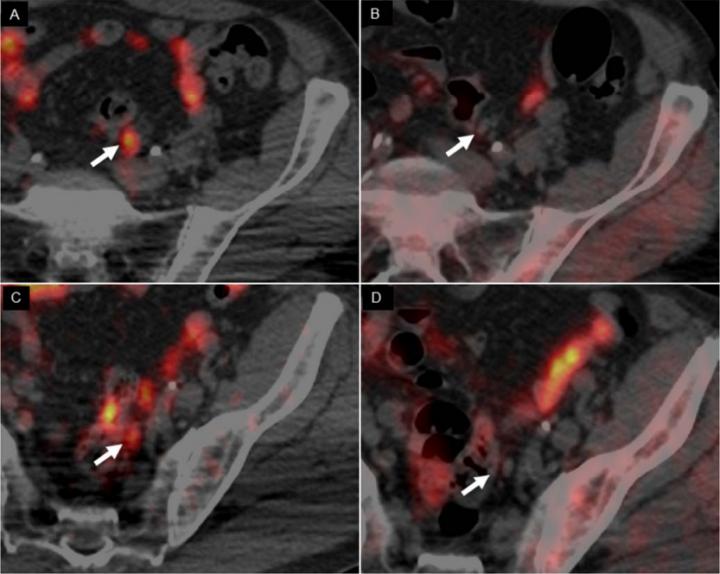
In scans of a 62-yr-old man with Gleason 4+3 PCa treated with radical prostatectomy, with rising PSA level (1.32) and PSA doubling time of 3.7 months, 64CuCl2-PET/CT images revealed 2 positive small left iliac lymph nodes (A,C), whereas 18F-Choline PET/CT (B,D) was negative (arrows).

An Italian study featured in the March issue of The Journal of Nuclear Medicine demonstrates that a novel nuclear medicine imaging agent targeting copper accumulation in tumors can detect prostate cancer recurrence early in patients with biochemical relapse (rising prostate-specific antigen [PSA] level).

Copper tends to be more concentrated in tumors, making it a good imaging biomarker. For this study of 50 patients, researchers conducted PET/CT scans comparing the new imaging agent, copper-64 chloride (64CuCl2), with fluorine-18-choline (18F-Choline). Multiparametric magnetic resonance imaging (mpMRI) was also conducted. In addition to calculating the detection rate of each imaging modality, the biodistribution, kinetics of the lesions and radiation dosimetry of 64CuCl2 were evaluated.

“This is the first time this novel agent has been compared with 18F-Choline-PET/CT in a considerable number of prostate cancer patients with biochemical relapse,” explains Arnoldo Piccardo, of E.O. Ospedali Galliera in Genoa, Italy. He points out, “Early detection of prostate cancer relapse may improve the clinical management of patients, for example implementing early salvage radiotherapy.”

The effective dose of 64CuCl2 was determined to be 5.7 mSv, similar to those of other established PET tracers (although higher than for 18F-Choline, which is 4 mSv). Unlike 18F-Choline, 64CuCl2 is neither accumulated in, nor excreted from, the urinary tract (main uptake is in the liver); this allows for thorough pelvic assessment, increasing the possibility of identifying small lesions close to the bladder. No adverse reactions were observed after the injection of 64CuCl2, and results show that 64CuCl2-PET/CT has a higher detection rate than 18F-Choline-PET/CT in patients with low levels of PSA (<1 ng/ml).

“This study determined that the biodistribution of 64CuCl2 is more suitable than that of 18F-Choline for exploring the pelvis and prostatic bed,” says Piccardo. “In patients with biochemical relapse and a low PSA level, 64CuCl2-PET/CT shows a significantly higher detection rate than 18F-Choline-PET/CT.” He reports, “Larger trials with this PET tracer are expected to further define its capabilities and role in the management of prostate cancer.”

Related Articles Read More >

How Prelude and QDX are using quantum chemistry to discover cancer treatments
US political drama is pushing life sciences talent toward Switzerland, Basel leader says
Thermo Fisher targets early-stage CGT bottlenecks with new Philadelphia hub
AUTOMA+ 2025 brings global pharma expertise to Austria
rd newsletter
EXPAND YOUR KNOWLEDGE AND STAY CONNECTED
Get the latest info on technologies, trends, and strategies in Research & Development.
RD 25 Power Index

R&D World Digital Issues

Fall 2025 issue

Browse the most current issue of R&D World and back issues in an easy to use high quality format. Clip, share and download with the leading R&D magazine today.

Research & Development World
  • Subscribe to R&D World Magazine
  • Sign up for R&D World’s newsletter
  • Contact Us
  • About Us
  • Drug Discovery & Development
  • Pharmaceutical Processing
  • Global Funding Forecast

Copyright © 2025 WTWH Media LLC. All Rights Reserved. The material on this site may not be reproduced, distributed, transmitted, cached or otherwise used, except with the prior written permission of WTWH Media
Privacy Policy | Advertising | About Us

Search R&D World

  • R&D World Home
  • Topics
    • Aerospace
    • Automotive
    • Biotech
    • Careers
    • Chemistry
    • Environment
    • Energy
    • Life Science
    • Material Science
    • R&D Management
    • Physics
  • Technology
    • 3D Printing
    • A.I./Robotics
    • Software
    • Battery Technology
    • Controlled Environments
      • Cleanrooms
      • Graphene
      • Lasers
      • Regulations/Standards
      • Sensors
    • Imaging
    • Nanotechnology
    • Scientific Computing
      • Big Data
      • HPC/Supercomputing
      • Informatics
      • Security
    • Semiconductors
  • R&D Market Pulse
  • R&D 100
    • 2025 R&D 100 Award Winners
    • 2025 Professional Award Winners
    • 2025 Special Recognition Winners
    • R&D 100 Awards Event
    • R&D 100 Submissions
    • Winner Archive
  • Resources
    • Research Reports
    • Digital Issues
    • Educational Assets
    • R&D Index
    • Subscribe
    • Video
    • Webinars
    • Content submission guidelines for R&D World
  • Global Funding Forecast
  • Top Labs
  • Advertise
  • SUBSCRIBE