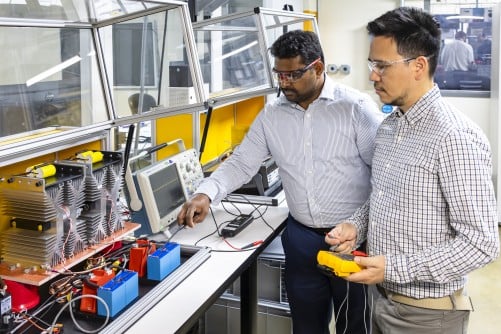
Prasad Kandula and Marcio Magri Kimpara initiated tests on medium-voltage circuit breakers developed by ORNL that use cost-effective semiconductors to safeguard direct current grid systems. Credit: Carlos Jones/ORNL, U.S. Dept. of Energy
Researchers at Oak Ridge National Laboratory have demonstrated a circuit breaker that could finally make medium-voltage DC power distribution economically viable for data centers and manufacturing facilities, the lab announced in a press release. By using 1950s-era thyristors instead of modern semiconductors, the team achieved sub-50-microsecond interruption times at a fraction of the cost.
The research addresses a long-standing technical barrier: while DC power systems can deliver more capacity through existing cables and eliminate AC/DC conversions, they’ve been held back by the lack of affordable protection devices. Unlike AC current, which naturally crosses zero 120 times per second, DC flows continuously in one direction, making it much harder to interrupt safely when faults occur.
Medium-voltage DC breakers on the market typically operate in tens of milliseconds: commercial breakers from major vendors advertise operation times from 30 ms to 70–300 ms. Researchers have reduced mechanical designs to 8–10 ms, but even that is too slow to stop a fault before arc energy damages equipment.
Solid-state breakers use transistors for microsecond response and eliminate arcing, but they dissipate heat continuously and are costly at medium voltages. Silicon-carbide or gallium-nitride devices can deliver microsecond response but cost remains a barrier. Hybrid breakers combine mechanical and solid-state elements but remain complex and expensive.
ORNL’s approach: old silicon, new tricks
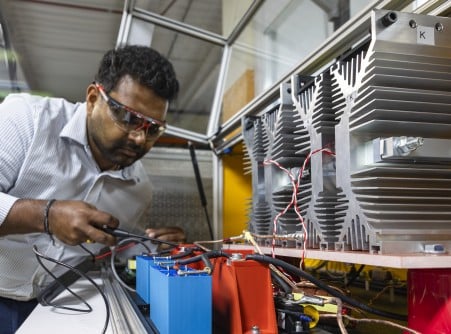
Prasad Kandula and his team are expanding the deployment of medium-voltage circuit breakers that rely on cost-effective semiconductors to reduce overheating and arcing in direct current grid systems. Credit: Carlos Jones/ORNL, U.S. Dept. of Energy
The Department of Energy’s Oak Ridge National Laboratory (ORNL) announced a prototype breaker that attacks the cost barrier with a deliberately low-tech component. Instead of exotic wide-bandgap semiconductors, it uses thyristors, a robust and inexpensive device first commercialized in the 1950s. Lead researcher Prasad Kandula said his team chose a technology that is “robust, efficient and inexpensive”.
In tests at Oak Ridge’s Grid Research Innovation and Development Center, engineers built a prototype that interrupts 1,400 V DC in under 50 µs. The research group then connected breakers in series to share the voltage and achieved a 1,800 V test; they plan to stack more modules to reach 10 kV. For comparison, commercial DC breakers typically handle 1–2 kV.
Kandula points out that DC distribution could increase capacity and cut losses because DC avoids the 60-Hz switching losses of AC and reduces conversion steps. “The lack of medium-voltage circuit breakers for direct current has been an obstacle to flexibility in delivering electricity,” he said.
Context and caveats
Faster than mechanical: At 50 µs, ORNL’s demonstration is orders of magnitude faster than mechanical breakers, which operate in tens of milliseconds. It even beats the 250–500 µs target of the Georgia Tech hybrid project. Rapid interruption lowers the “let-through” energy and reduces the risk of fire.
Cheaper silicon: Using thyristors could make the breakers affordable. Wide-bandgap devices such as SiC MOSFETs have low conduction losses but remain expensive. By contrast, thyristors are commodity devices. ORNL mitigates current-sharing challenges by placing modules in series rather than in parallel, though voltage balancing between modules becomes critical.
Still a prototype: Oak Ridge tested its breaker at 1.4 kV and 1.8 kV with unspecified current levels. Commercial medium-voltage applications often involve thousands of amperes. Scaling to 10 kV requires many devices in series and careful balancing. The prototype also needs to demonstrate reliable operation under repeated fault events and thermal cycling.
Market competition: HVDC breaker manufacturers such as ABB, Mitsubishi Electric/Scibreak and GEIRI have demonstrated hybrid or mechanical breakers interrupting 20–26 kA at 200–350 kV within 2–7 ms. These devices target transmission grids rather than distribution. ORNL’s technology aims to fill the gap by delivering sub-100-µs interruption at tens of kilovolts.
What it could mean for the grid
Direct-current distribution is not just an academic curiosity. DC lines can carry more power through existing conductors than AC because there is no skin effect or reactive component. They also reduce conversion losses when connecting DC sources such as solar photovoltaics, batteries and electric-vehicle chargers. But the safety and reliability of DC grids hinge on protective devices that can act quickly and economically. Oak Ridge’s thyristor-based breaker shows that mature silicon devices can deliver sub-100-µs interruption at medium voltage. If the team can scale the device to 10 kV, handle significant currents and manage heat dissipation, it could unlock cost-effective DC feeders for data centers, manufacturing plants and heavy-duty charging stations.
Edison might quip that DC is finally getting its second act. For now, ORNL’s work suggests that sometimes the path to a modern grid involves dusting off an old component and pushing it far beyond what its inventors envisioned.