Research & Development World

  • R&D World Home
  • Topics
    • Aerospace
    • Automotive
    • Biotech
    • Careers
    • Chemistry
    • Environment
    • Energy
    • Life Science
    • Material Science
    • R&D Management
    • Physics
  • Technology
    • 3D Printing
    • A.I./Robotics
    • Software
    • Battery Technology
    • Controlled Environments
      • Cleanrooms
      • Graphene
      • Lasers
      • Regulations/Standards
      • Sensors
    • Imaging
    • Nanotechnology
    • Scientific Computing
      • Big Data
      • HPC/Supercomputing
      • Informatics
      • Security
    • Semiconductors
  • R&D Market Pulse
  • R&D 100
    • 2025 R&D 100 Award Winners
    • 2025 Professional Award Winners
    • 2025 Special Recognition Winners
    • R&D 100 Awards Event
    • R&D 100 Submissions
    • Winner Archive
  • Resources
    • Research Reports
    • Digital Issues
    • Educational Assets
    • R&D Index
    • Subscribe
    • Video
    • Webinars
    • Content submission guidelines for R&D World
  • Global Funding Forecast
  • Top Labs
  • Advertise
  • SUBSCRIBE

Patent Issued to NRL for Solar Microbial Fuel Cell

By Naval Research Laboratory | June 23, 2017

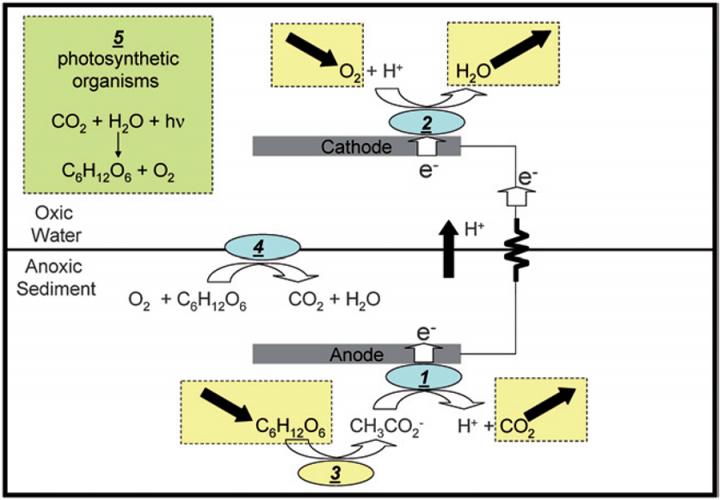
This is a schematic depiction of simplified mechanism of power generation by the benthic microbial fuel cell (BMFC), without box labeled ‘5’ corresponding to photosynthesis, and for the microbial photoelectrochemical solar microbial fuel cell (SMFC) reported here, with box labeled 5. Other labels include: (1) biofilm catalyzed anode reaction; (2) biofilm catalyzed cathode reaction; (3) fermentative reaction, and (4) the microbial oxygen barrier. (Credit: U.S. Naval Research Laboratory)

The U.S. Naval Research Laboratory (NRL), Center for Biomolecular Science and Engineering, has received a U.S. patent for a self-assembling, self-repairing, and self-contained microbial photoelectrochemical solar cell driven entirely by sunlight and microorganisms.

A solar microbial fuel cell (SMFC) is a non-semiconductor-based system, which employs microorganisms to generate electric power by photosynthetically replenishing reactants of a sealed microbial fuel cell using sunlight.

The SMFC reactants (glucose and oxygen) are internally regenerated by a group of photosynthetic microbes whose reactants, carbon dioxide (CO2) and water (H2O), are the products of the microbial fuel cell. This interdependency results in many thousands of hours of long-term electricity generation from sunlight without replenishment of the microbial fuel cell reactants.

“Natural photosynthetic systems, such as trees and algae blooms, self-repair, a property that makes them highly durable,” said Dr. Lenny Tender, research chemist, Center for Bio/Molecular Science and Engineering. “Here, we incorporate photosynthetic organisms with the self-assembling and self-maintaining benthic microbial fuel cell (BMFC) to enable durable land-based photoelectrochemical solar cells.”

The BMFC generates electrical power by oxidizing organic matter (fuel) residing in sediment pore water with oxygen (oxidant) in overlying water, and consists of an anode imbedded in the marine sediment connected by an external electrical circuit to a cathode positioned in overlying water. Unlike the open marine-based BMFC generator, the SMFC apparatus does not require an endless flux of reactants from sediment and seawater to persistently generate power, but instead, recycles the organic matter sealed within the unit to regenerate the reactants.

“Microorganisms harvested from sea water in shallow coastal environments, in relatively low abundance, become enriched when the cell is sealed due to the accumulation of carbon dioxide and depletion of oxygen in the overlying water,” Tender said. “These organisms use sunlight to convert the electrode products to glucose and oxygen, which can be re-utilized in the electrode reactions eliminating the need for a constant flux of new glucose and oxygen.”

Tender added that the SMFC combines energy storage with power delivery. Meaning, when there is abundant sunlight, photosynthesis will result in generation of fuel and oxidant, some of which can be used to generate power immediately, and the remainder accumulated to be used later when there is no Sun. This is ideally done without the need for capacitor or battery storage devices.

The SMFC can be ‘stacked’ in series to increase voltage and can power any device that currently uses a conventional photovoltaic power supply. However, work is underway to understand the limiting factors.

Related Articles Read More >

How X-ray absorption spectroscopy is making hydrogen fuel more efficient
California microgrid pilots EV integration model for wildfire-prone regions
Enough power for 3.5 homes: the hidden cost of fume hoods 
Nuclear research stalls just as AI-driven power demand surges
rd newsletter
EXPAND YOUR KNOWLEDGE AND STAY CONNECTED
Get the latest info on technologies, trends, and strategies in Research & Development.
RD 25 Power Index

R&D World Digital Issues

Fall 2025 issue

Browse the most current issue of R&D World and back issues in an easy to use high quality format. Clip, share and download with the leading R&D magazine today.

R&D 100 Awards
Research & Development World
  • Subscribe to R&D World Magazine
  • Sign up for R&D World’s newsletter
  • Contact Us
  • About Us
  • Drug Discovery & Development
  • Pharmaceutical Processing
  • Global Funding Forecast

Copyright © 2025 WTWH Media LLC. All Rights Reserved. The material on this site may not be reproduced, distributed, transmitted, cached or otherwise used, except with the prior written permission of WTWH Media
Privacy Policy | Advertising | About Us

Search R&D World

  • R&D World Home
  • Topics
    • Aerospace
    • Automotive
    • Biotech
    • Careers
    • Chemistry
    • Environment
    • Energy
    • Life Science
    • Material Science
    • R&D Management
    • Physics
  • Technology
    • 3D Printing
    • A.I./Robotics
    • Software
    • Battery Technology
    • Controlled Environments
      • Cleanrooms
      • Graphene
      • Lasers
      • Regulations/Standards
      • Sensors
    • Imaging
    • Nanotechnology
    • Scientific Computing
      • Big Data
      • HPC/Supercomputing
      • Informatics
      • Security
    • Semiconductors
  • R&D Market Pulse
  • R&D 100
    • 2025 R&D 100 Award Winners
    • 2025 Professional Award Winners
    • 2025 Special Recognition Winners
    • R&D 100 Awards Event
    • R&D 100 Submissions
    • Winner Archive
  • Resources
    • Research Reports
    • Digital Issues
    • Educational Assets
    • R&D Index
    • Subscribe
    • Video
    • Webinars
    • Content submission guidelines for R&D World
  • Global Funding Forecast
  • Top Labs
  • Advertise
  • SUBSCRIBE