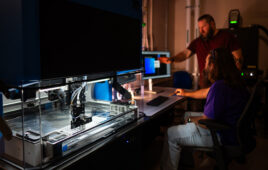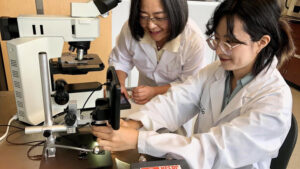
Dr. Carolyn Ren (left) works with PhD student Qianying (Alice) Mao at the University of Waterloo on a handheld device that detects E. coli bacteria in water within minutes.
A new sensor developed at the University of Waterloo aims to take the guesswork out of monitoring drinking water. Using a gold-plated sensor the size of a dime paired with a smartphone-sized circuit board containing a vector network analyzer (VNA), researchers have built a palm-sized device that can detect Escherichia coli in minutes. The system costs about $70 Canadian to produce and was adapted from technology the team originally used to identify the SARS-CoV-2 virus during the pandemic.
The resonance-frequency sensor is coated with antibodies that specifically bind E. coli. When bacteria in a water sample attach to the antibody, the sensor’s microwave resonance frequency shifts. The VNA detects and analyzes that shift, providing an immediate readout of both the presence and concentration of the pathogen.
Lead researcher Carolyn Ren, a mechanical and mechatronics engineering professor who holds the Canada Research Chair in microfluidic technologies, said the device is both sensitive and selective and could be transformative for public health. “Testing shows it is very accurate, both in terms of specificity – the ability to differentiate between E. coli and other bacteria – and sensitivity,” Ren said in the press release. Current E. coli tests typically involve collecting water samples and shipping them to centralized laboratories, a process that can take days and leaves people exposed to contaminated water in the interim. By contrast, the Waterloo-built device could be used on-site in homes, at water treatment plants or to monitor lakes and reservoirs. It could be scaled to handle larger sample volumes required by international testing standards.
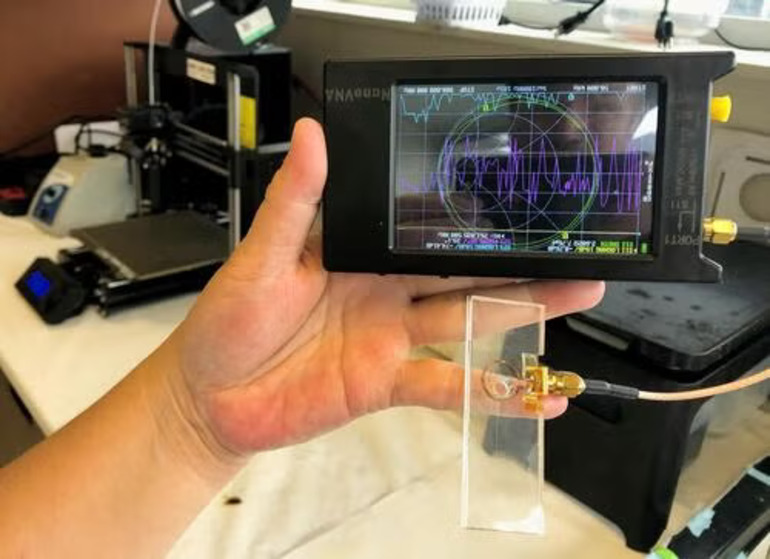
Researchers at the University of Waterloo developed a palm-sized device, costing about $70 to produce, that uses a gold-plated sensor and vector network analyzer to rapidly identify E. coli contamination in water.
A global problem
Contamination with E. coli, a bacterium naturally found in the intestines of humans and animals, remains a significant public-health challenge. According to the National Institutes of Health, Shiga toxin–producing E. coli causes about millions if illnesses and hundreds if deaths worldwide each year, with babies and young children bearing the brunt. Researchers are particularly concerned about developing countries; one study in sub-Saharan Africa found that 71% of rural household water samples were contaminated. Ren hopes the low cost and portability of the Waterloo sensor will make testing accessible in resource-limited settings. She and her colleagues, including pharmacy professor Emmanuel Ho, earth and environmental sciences professor Philippe Van Cappellen, and postdoctoral researcher Weijia Cui, published their work in Biosensors and Bioelectronics.
Sensors and micro-devices proliferate
The Waterloo gadget arrives amid a broader push to decentralize water monitoring. Earlier generations of portable detectors have targeted other contaminants: in 2017, University of Wisconsin–Milwaukee engineer Junhong Chen and his colleagues developed a graphene-based field-effect transistor that can monitor heavy metals, nitrates, phosphates and even bacteria in real time. The device uses reduced graphene-oxide nanosheets; when analytes bind to the functionalized surface, the sheets’ electrical conductivity changes and the concentration can be inferred. Chen noted that intrinsic graphene has electron mobility a hundred times higher than silicon, making it potentially attractive for sensitive sensors. His startup, NanoAffix Science, built a prototype handheld detector for lead ions in drinking water.
More recently, scientists at Nanyang Technological University (NTU) in Singapore designed a handheld heavy-metal detector inspired by the human body’s use of chelating agents. The device combines an optical fiber sensor coated with a chelating agent and a laser. When metal ions bind to the agent, the output light spectrum shifts; the system can detect trace levels of heavy metals in five minutes and identify up to 24 different metal contaminants. Unlike test strips or metal electrodes, the NTU sensor does not require users to mix samples with buffer solutions and remains effective even when exposed to air.