Scientists at the University of Glasgow have made a second significant breakthrough in the treatment of chronic myeloid leukaemia – using precision medicine to kill more than 90% of chronic myeloid leukaemia (CML) stem cells. The results are published today in the high impact journal Cancer Discovery.
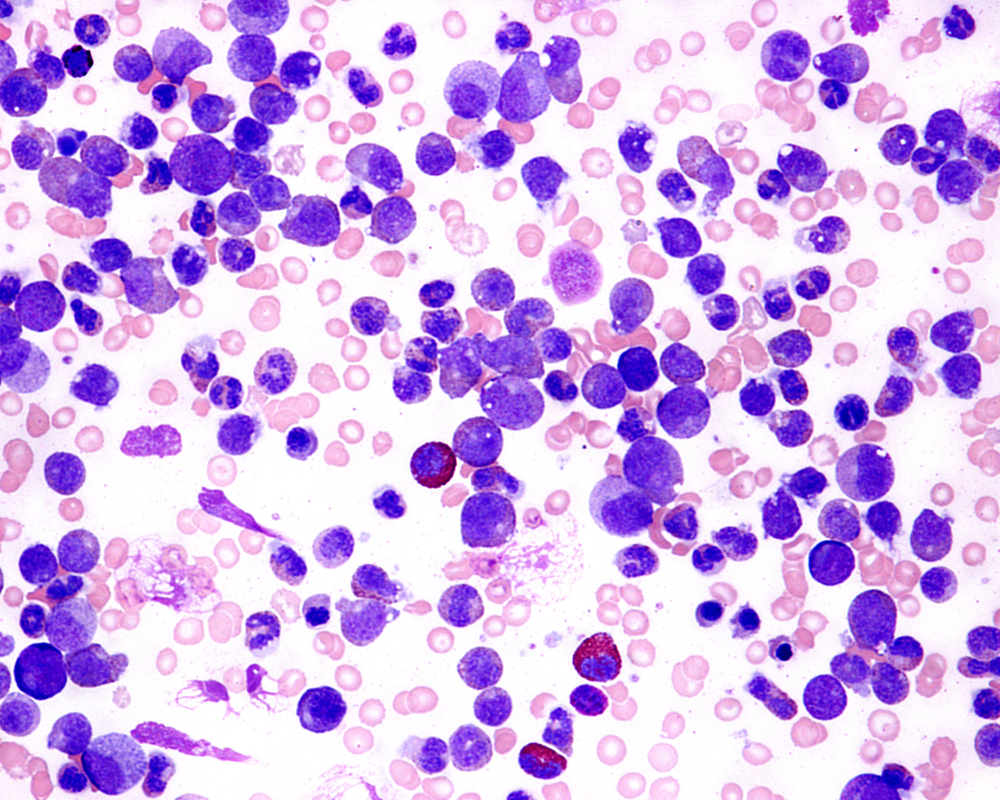
CML is a rare form of blood cancer. An individual gets CML when normal blood stem cells are turned into leukaemic stem cells, or CML stem cells. These CML stem cells then produce large numbers of leukaemic cells which, if left untreated, is fatal.
At present, CML patients are treated with tyrosine kinase inhibitors, otherwise known as TKIs. Treatment of patients with TKIs alone rarely cures the disease but hold its advancement at bay. As a result, many patients need to remain on TKIs for the rest of their lives. But the drugs are expensive and can cause serious side effects in some patients. In the European Union, it is estimated that there are currently150,000 patients with CML, and the TKIs they take cost a total of £5.0 billion per year.
TKIs do not kill the CML stem cells which cause the disease and researchers at the University of Glasgow have been searching for ways to kill the CML stem cells for many years. The research teams, led by Dr David Vetrie and Professor Tessa Holyoake at the Institute of Cancer Sciences, University of Glasgow, believe they have found a new drug that could lead to a cure for CML by killing the CML stem cells.
The drug works by inhibiting the activity of a protein called EZH2. EZH2 had previously been shown to be important for the survival of other types of cancer cells, but had never before been studied in CML.
Dr David Vetrie, based at the Wolfson Wohl Cancer Research Centre in Glasgow, said: “This discovery, based on 7 years of experimental work, is a great example of precision medicine – finding drugs that target only the CML stem cells we want to kill, while leaving normal cells unharmed.”
“Having a new drug that we can give to patients alongside a TKI is an ideal scenario in the clinic – TKIs kill most of the CML cells, and we believe that the EZH2 inhibitor will kill the remaining CML stem cells.”
Dr Mary Scott, first author on the paper, added: “Our aim is to take this drug into clinical trials with CML patients. Current clinical trials using an EZH2 inhibitor in other forms of blood cancer have shown some promising early results. The drug is taken as a pill, is very safe and has minimal side-effects, making it ideally suited for the CML clinic.”
In early June, Professor Holyoake’s team, based at the Paul O’Gorman Leukaemia Research Centre in Glasgow, reported in the journal Naturethat a completely different drug combination was also highly effective at targeting CML stem cells.
Professor Holyoake said: “The findings of this paper and those of our previous Nature paper, demonstrate how the Glasgow research teams are tirelessly searching for new approaches to identify a range of drugs that will kill CML stem cells.
“No two CML patients are alike in how they respond to a drug, so it’s important we develop an array of potential novel therapies to maximise the chances that CML may one day be cured in all patients. Our immediate goal is to take the drugs we have reported in both papers into a single clinical trial.”
Diana Jupp, Director of Patient Experience at Bloodwise, said: “In recent years, thanks to research, this once usually fatal leukaemia has been transformed into a manageable condition for most patients.
“However, there are still some patients who do not respond to current drugs or develop resistance to them and many will experience side-effects that can have a severe impact on their quality of life. These promising findings could lead to drugs that provide a permanent cure by targeting the cancer stem cells that drive this disease, which is a hugely exciting prospect.”
Dr Áine McCarthy, senior science information officer at Cancer Research UK, said: “We know that when cancer comes back it’s a lot harder to treat, and a person’s chances of surviving the disease decrease. That’s why early research like this is exciting, as it has identified a new way to target and kill leukaemia cells that can be left behind after treatment and sometimes cause the disease to return. The next step will be to carry out clinical trials in patients to find out if this combination is effective and safe.”
Professor Holyoake said: “The findings of this paper and those of our previous Nature paper, demonstrate how the Glasgow research teams are tirelessly searching for new approaches to identify a range of drugs that will kill CML stem cells.
“No two CML patients are alike in how they respond to a drug, so it’s important we develop an array of potential novel therapies to maximise the chances that CML may one day be cured in all patients. Our immediate goal is to take the drugs we have reported in both papers into a single clinical trial.”
Diana Jupp, Director of Patient Experience at Bloodwise, said: “In recent years, thanks to research, this once usually fatal leukaemia has been transformed into a manageable condition for most patients.
“However, there are still some patients who do not respond to current drugs or develop resistance to them and many will experience side-effects that can have a severe impact on their quality of life. These promising findings could lead to drugs that provide a permanent cure by targeting the cancer stem cells that drive this disease, which is a hugely exciting prospect.”
Dr Áine McCarthy, senior science information officer at Cancer Research UK, said: “We know that when cancer comes back it’s a lot harder to treat, and a person’s chances of surviving the disease decrease. That’s why early research like this is exciting, as it has identified a new way to target and kill leukaemia cells that can be left behind after treatment and sometimes cause the disease to return. The next step will be to carry out clinical trials in patients to find out if this combination is effective and safe.”