Research & Development World

  • R&D World Home
  • Topics
    • Aerospace
    • Automotive
    • Biotech
    • Careers
    • Chemistry
    • Environment
    • Energy
    • Life Science
    • Material Science
    • R&D Management
    • Physics
  • Technology
    • 3D Printing
    • A.I./Robotics
    • Software
    • Battery Technology
    • Controlled Environments
      • Cleanrooms
      • Graphene
      • Lasers
      • Regulations/Standards
      • Sensors
    • Imaging
    • Nanotechnology
    • Scientific Computing
      • Big Data
      • HPC/Supercomputing
      • Informatics
      • Security
    • Semiconductors
  • R&D Market Pulse
  • R&D 100
    • 2026 R&D 100 Award Winners
    • 2026 Professional Award Winners
    • 2026 Special Recognition Winners
    • R&D 100 Awards Event
    • R&D 100 Submissions
    • Winner Archive
  • Resources
    • Research Reports
    • Digital Issues
    • Educational Assets
    • Subscribe
    • Video
    • Webinars
    • PharmSci360
    • Content submission guidelines for R&D World
  • Global Funding Forecast
  • Top Labs
  • Advertise
  • SUBSCRIBE

R&D 100 winner of the day: Millimeter-Wave Shoe Scanner

By Heather Hall | October 5, 2020


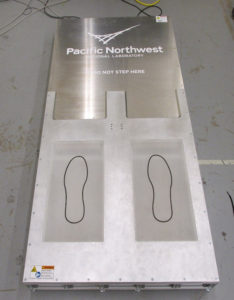
The millimeter-wave shoe scanner. PNNL and DHS S&T developed the millimeter-wave shoe scanner that can scan under a person’s feet with no need to remove the shoes.

What if airline passengers could leave their shoes on while still being scanned for security? Pacific Northwest National Laboratory (PNNL) partnered with the U.S. Department of Homeland Security (DHS) Science & Technology Directorate (S&T) to build the millimeter-wave shoe scanner developed the Millimeter-Wave Shoe Scanner — a solution that relies on proven state-of-the-art imaging to improve throughput at aviation security checkpoints. Leveraging decades of experience with millimeter-wave technology, PNNL and DHS S&T’s system can quickly scan footwear from under a person’s feet. Similar to the full-body scanners at the airports, which also use harmless millimeter waves, the scanner looks for concealed threats in the soles of shoes. When a passenger steps on the scanner, millimeter waves pass through the shoe’s material, reflecting any concealed items, and subsequently produces a high-resolution, three-dimensional (3-D) image using low-power holographic radar imaging technology, in a matter of seconds. Millimeter-wave technology has been proven to use non-harmful, ultra-high-frequency radio waves to detect and identify concealed objects in airport security body scanners nationwide. This innovative technology can integrate with existing architectures, streamlining security screening while sustaining detection capabilities that protect our nation’s travelers.


Related Articles Read More >

The Space Systems Division (05)-developed Parallelogram Synchronized Truss Assembly (PaSTA), seen Aug. 12, 2025, is a mechanism that will be integrated into the Life-Extension In-orbit Servicer (LEXI) and Astroscale Prototype Servicer for Refueling (APS-R) spacecrafts.
One SwRI R&D 100 winner turns buckled fiberglass into a spacecraft truss. The other models freight rail with 900 hours of BNSF field data
Winners unveiled for 2026 R&D 100 Special Recognition categories
R&D World announces 2026 R&D 100 Professional Award Winners
R&D World announces 2026 R&D 100 Leader of the Year
rd newsletter
EXPAND YOUR KNOWLEDGE AND STAY CONNECTED
Get the latest info on technologies, trends, and strategies in Research & Development.

R&D World Digital Issues

Fall 2025 issue

Browse the most current issue of R&D World and back issues in an easy to use high quality format. Clip, share and download with the leading R&D magazine today.

R&D 100 Awards
Research & Development World
  • Subscribe to R&D World Magazine
  • Sign up for R&D World’s newsletter
  • Contact Us
  • About Us
  • Drug Discovery & Development
  • Pharmaceutical Processing
  • Global Funding Forecast

Copyright © 2026 Arrowfly LLC. All Rights Reserved. The material on this site may not be reproduced, distributed, transmitted, cached or otherwise used, except with the prior written permission of Arrowfly
Privacy Policy | Advertising | About Us

Search R&D World

  • R&D World Home
  • Topics
    • Aerospace
    • Automotive
    • Biotech
    • Careers
    • Chemistry
    • Environment
    • Energy
    • Life Science
    • Material Science
    • R&D Management
    • Physics
  • Technology
    • 3D Printing
    • A.I./Robotics
    • Software
    • Battery Technology
    • Controlled Environments
      • Cleanrooms
      • Graphene
      • Lasers
      • Regulations/Standards
      • Sensors
    • Imaging
    • Nanotechnology
    • Scientific Computing
      • Big Data
      • HPC/Supercomputing
      • Informatics
      • Security
    • Semiconductors
  • R&D Market Pulse
  • R&D 100
    • 2026 R&D 100 Award Winners
    • 2026 Professional Award Winners
    • 2026 Special Recognition Winners
    • R&D 100 Awards Event
    • R&D 100 Submissions
    • Winner Archive
  • Resources
    • Research Reports
    • Digital Issues
    • Educational Assets
    • Subscribe
    • Video
    • Webinars
    • PharmSci360
    • Content submission guidelines for R&D World
  • Global Funding Forecast
  • Top Labs
  • Advertise
  • SUBSCRIBE