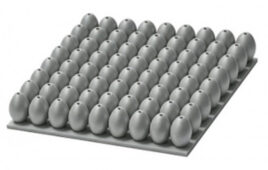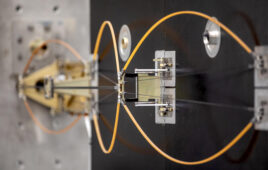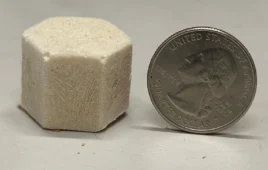
A CHESS-based thermoelectric device during testing, showing ice buildup. The setup evaluates how efficiently the materials convert electrical power into cooling, supporting advances in solid-state refrigeration and energy-harvesting research. Credit: Johns Hopkins APL/Ed Whitman
A scalable solid-state thermoelectric cooling technology using nano-engineered materials called
CHESS (Controlled Hierarchically Engineered Superlattice Structures) has shown roughly double the materials performance near room temperature compared with conventional bulk thermoelectric materials. The work was developed at Johns Hopkins Applied Physics Laboratory, with Samsung Research collaborating on refrigeration-system testing and analysis.
CHESS is designed to reduce heat flow through the material (low thermal conductivity) while maintaining electrical conductivity comparable to bulk thermoelectric materials, a key combination for improving thermoelectric cooling performance.
In the video below, Rama Venkatasubramanian, chief technologist for thermoelectrics and principal staff scientist at Johns Hopkins APL, describes how tailoring the material’s structure helps meet that objective.
In the same video, Jonathan Pierce, a senior research engineer at Johns Hopkins APL, describes how hands-on materials growth and device integration helped align the team around a shared development vision.
In tests published in Nature Communications (May 2025), the APL and Samsung Research team reported nearly 100% improvement in materials figure of merit (ZT) near room temperature relative to traditional bulk thermoelectric materials, along with about 70% improvement in system-level refrigeration performance in a fully integrated setup.
Because thermoelectric cooling is solid-state, the approach can eliminate the need for compressors and chemical refrigerants, enabling quieter, more compact cooling systems. It also uses remarkably little material, just 0.003 cubic centimeters per refrigeration unit, about the size of a grain of sand.
The materials are grown using metal-organic chemical vapor deposition (MOCVD), a well-established semiconductor manufacturing process.
“This is a process that’s well established in the semiconductor industry, and it’s completely scalable,” said Jon Pierce, senior research engineer at APL. “Not only can we grow this material, we can grow it at scale.”
The team has demonstrated tabletop-scale refrigeration and says the next steps include scaling to larger systems, including freezer-capable designs, and exploring applications such as wearable electronics cooling and energy harvesting.
This marks the second R&D 100 recognition for CHESS-related work; the materials previously won in 2023 for noninvasive cooling therapies for prosthetics.