Liquid metals (LMs) have a unique combination of properties that suit the extreme environment of space, such as wide liquid-temperature ranges, high thermal and electrical conductivity, low vapor pressure, large surface tension and responsiveness to electric and magnetic fields. Gallium and bismuth-based alloys are often highlighted as the most promising candidates due to their chemical stability and biocompatibility.
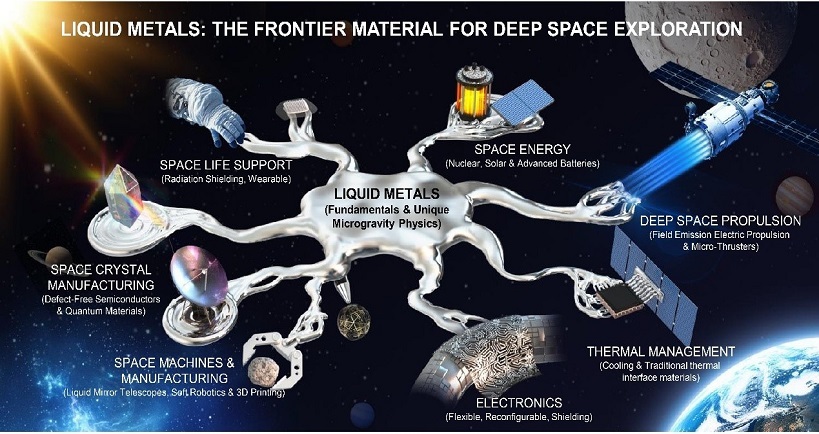
Credit: Chinese Academy of Sciences
LMs could have a wide number of applications in space exploration. They can serve as propellants, thermal interface materials, stretchable antennas, supercapacitors and can be woven into spacesuits to provide radiation shielding and antimicrobial protection.
Some of the most promising applications of LMs for space include field emission electric propulsion, coolants for nuclear reactors and thermal management on spacecraft.
Liquid metals for space travel
A research team from the Technical Institute of Physics and Chemistry of the Chinese Academy of Sciences demonstrated how room-temperature liquid metals can serve as critical materials for future deep-space exploration.
They explored how field emission systems based on LMs deliver low thrust, high-precision adjustability, high efficiency and high specific impulse, making them suited for ultra-high-precision attitude control, formation flying and atmosphere drag compensation for micro- and nanosatellites.
The scientists also found that LMs perform well in space thermal management systems due to their high thermal conductivity, inherent fluidity and structural stability. LMs can withstand the intense vibrational shocks of launch as well as severe aerodynamic heating during reentry.
The study also explored how LM soft robotics could play a vital role in missions such as lunar base construction and planetary exploration.
For spacesuits, flexible conductive fibers derived from LMs enable efficient electromagnetic shielding for radiation protection. Various flexible sensors fabricated with LMs support comprehensive real-time monitoring of astronauts’ physiological parameters and spacesuit environmental conditions. They can also sustain autonomous medical requirements in deep-space environments, providing end-to-end life and health support for missions independent of ground assistance.
FEEP thrusters
Field emission electric propulsion (FEEP) thrusters are a mature real-world application of liquid metals in space. FEEP is an advanced electrostatic propulsion system that uses a liquid metal, usually cesium, indium or mercury, as a propellant.
FEEP thrusters generate thrust by using a powerful electric field to rip ions directly out of a liquid metal surface and hurl them away at extreme velocities. The propellant is fed to a sharp needle or slit emitter, where a voltage of around 10 kV creates an intense electric field that deforms the liquid surface into a cone shape called a Taylor cone. At the tip of the cone, atoms are field-evaporated into ions and accelerated away, producing a tiny but incredibly precise thrust.
The specific impulse in FEEP thrusters is far higher than any chemical thruster due to the exhaust velocity, which is up to 100 km/s. The tradeoff is that thrust is minuscule, making FEEP useless for launch but ideal for ultra-precise attitude control, drag compensation and formation flying.
The fuel efficiency of FEEP is five to 10 times better than chemical thrusters, meaning less propellant mass is needed to achieve the same velocity. It could be especially useful in missions like LISA Pathfinder, which focused on gravitational wave detection, and formation-flying satellite constellations.
By the end of 2023, more than 270 FEEP-based propulsion systems have been launched, with system powers between 40 and 100 W.
Liquid metal cooling for nuclear reactors
Liquid metals have been used as nuclear reactor coolants since the 1950s. LMs generally have high boiling points and low vapor pressure, reducing the probability of accidents and enabling operation at near-ambient pressure. This could be essential for space nuclear power, where pressurized water systems would be impractical.
Some reactor designs can immerse the entire core and heat exchangers into a pool of coolant, virtually eliminating the risk that cooling will be lost. For space, this could mean lighter, simpler and safer reactors.
LMs also have high thermal conductivity, enabling high power density. This makes them attractive in situations where size and weight are at a premium, such as space travel.
The U.S. tested its first and only space reactor aboard SNAP-10A for 43 days in 1965. NASA tested its Kilopower system with a full-power nuclear test in 2018. Kilopower uses passive sodium heat pipes, hollow tubes with liquid sodium inside that transfer heat via evaporation and condensation with no pump required.
NASA is now collaborating with the DOE and industry to design, fabricate and test a 40-kilowatt class fission power system to operate on the Moon by the early 2030s. Four such units could provide enough power for a crewed outpost.
Fission surface power can provide abundant and continuous power regardless of environmental conditions, making it useful for operation on the Moon and Mars.
Next-generation fission reactors using liquid metal coolants such as sodium or lead are currently under design and construction. LM-cooled reactors are also easy to miniaturize and modularize. As well as space, these systems could have roles in harsh-environment energy supply and deep-sea exploration.
Liquid metals for thermal management
In space, the only way to reject heat is radiation, which is slow and requires large surface areas. Getting heat from components like processors, electronics and transmitters to a radiator efficiently is a central engineering challenge in spacecraft design.
LMs could act as thermal interface materials, which are used to fill the gaps between two solid surfaces. A new material made from a mix of liquid metal and aluminum nitride can remove 2,760 watts of heat from an area of 16 square centimeters, cutting the energy needed for cooling pumps by 65%.
LMs could also be used to move larger amounts of heat across a spacecraft through a fluid loop. For the same microchannel configuration at a flow rate of 1 to 2 L/min, the average heat transfer thermal resistance of liquid metal microchannels is reduced by 28.1% compared to conventional water-cooled microchannels. Under the optimized configuration, liquid metal microchannels achieve a 26.9% reduction in total thermal resistance, requiring 79.2% fewer channels and operating at 50% lower flow velocity than water-cooled microchannels.
Phase change materials (PCMs) store heat as the latent heat of melting rather than as a temperature rise. Conventional organic PCMs have low thermal conductivity, so the stored heat can’t spread through them quickly enough to protect components. LM-based PCMs, usually gallium or sodium alloys, are gradually replacing previously used mercury due to their environmentally friendly characteristics.