Research & Development World

  • R&D World Home
  • Topics
    • Aerospace
    • Automotive
    • Biotech
    • Careers
    • Chemistry
    • Environment
    • Energy
    • Life Science
    • Material Science
    • R&D Management
    • Physics
  • Technology
    • 3D Printing
    • A.I./Robotics
    • Software
    • Battery Technology
    • Controlled Environments
      • Cleanrooms
      • Graphene
      • Lasers
      • Regulations/Standards
      • Sensors
    • Imaging
    • Nanotechnology
    • Scientific Computing
      • Big Data
      • HPC/Supercomputing
      • Informatics
      • Security
    • Semiconductors
  • R&D Market Pulse
  • R&D 100
    • 2025 R&D 100 Award Winners
    • 2025 Professional Award Winners
    • 2025 Special Recognition Winners
    • R&D 100 Awards Event
    • R&D 100 Submissions
    • Winner Archive
  • Resources
    • Research Reports
    • Digital Issues
    • Educational Assets
    • Subscribe
    • Video
    • Webinars
    • Content submission guidelines for R&D World
  • Global Funding Forecast
  • Top Labs
  • Advertise
  • SUBSCRIBE

Researchers developed an AI tool to help build greener buildings

By Julia Rock-Torcivia | July 16, 2025

Researchers at the University of Notre Dame developed an AI tool, called EcoSphere, to help make cities greener. They published their findings in npj Urban Sustainability. 
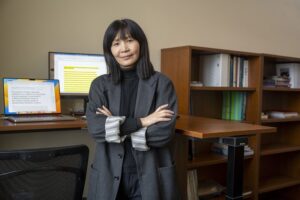
Credit: Barbara Johnston/University of Notre Dame
Ming Hu, associate dean for research, scholarship and creative work, School of Architecture, University of Notre Dame

The researchers aim to help urban policymakers make informed decisions about sustainable building practices. “Our goal is to develop tools that assess the carbon emission reduction and mitigation potentials of the built environment infrastructure, both through renovation and improved new construction,” said Ming Hu, the associate dean for research, scholarship and creative work in Notre Dame’s School of Architecture.

The hidden impact of embodied carbon

Embodied carbon is greenhouse gas (GHG) emissions from the manufacturing, transportation, installation, maintenance and disposal of building materials. It makes up a large part of global GHG emissions; embodied carbon accounted for 37% of global energy-related carbon dioxide emissions in 2020, according to the UN.

In their study, researchers found that the most effective way to reduce embodied carbon is to focus on renovating and improving buildings’ lifespans, rather than undertaking new construction. According to the study, new construction produces up to 7,500 times more carbon dioxide than renovation. The study also indicated that buildings with a 50-year lifespan have three times more embodied carbon than buildings with an 80-year lifespan. 

These results came from over 350,000 simulated scenarios, which drew data from more than 1 million Chicago buildings. The researchers transformed these simulations into an AI-powered platform called EcoSphere, with results to be published in Automation in Construction next month. 

A map produced by EcoSphere showing the median year built of buildings in Chicago. Credit: Notre Dame University

Exposing the impact with EcoSphere

The platform combines national building datasets, embodied carbon data, Google Street View, satellite imagery and machine learning to generate graphics that visualize emissions data. The graphics are presented in an interactive dashboard, enabling users to dive deeper into simulation results. The team hopes this will help policymakers and non-experts understand their city’s carbon footprint. 

EcoSphere uses AI to gather high-resolution building data and categorizes the buildings into archetypes to allow for detailed simulations. The results of the simulation are presented in three optimistic scenarios, three pessimistic scenarios and three most probable scenarios. The study to be published in August will cover case studies of the platform in Chicago and Indianapolis.

“Together, these studies show how detailed data and smart software can help empower city planners to make informed decisions for a greener future,” Hu said.

Related Articles Read More >

MBARI's Monterey Accelerated Research System (MARS) connects seafloor instruments to shore through a roughly 51-kilometer power and fiber-optic cable (red line) ending at a node about 891 meters down. The Geo-Sense system described in the new paper takes the opposite approach: a portable, battery-powered cable that records locally with no link to shore. Researchers used MARS's own fiber data to cross-check Geo-Sense's earthquake detections. Credit: MBARI
How lightweight AI startup Lightscline helped turn one to two years of seafloor data analysis into a two-month sprint
Why Washington wants a 30-day look at frontier AI before it ships, and is backing a voluntary approach
Trump’s AI push turns government into reviewer, warfighter supplier and possible shareholder
OpenAI research and product leads detail GPT-Rosalind capabilities and benchmarks
rd newsletter
EXPAND YOUR KNOWLEDGE AND STAY CONNECTED
Get the latest info on technologies, trends, and strategies in Research & Development.

R&D World Digital Issues

Fall 2025 issue

Browse the most current issue of R&D World and back issues in an easy to use high quality format. Clip, share and download with the leading R&D magazine today.

R&D 100 Awards
Research & Development World
  • Subscribe to R&D World Magazine
  • Sign up for R&D World’s newsletter
  • Contact Us
  • About Us
  • Drug Discovery & Development
  • Pharmaceutical Processing
  • Global Funding Forecast

Copyright © 2026 WTWH Media LLC. All Rights Reserved. The material on this site may not be reproduced, distributed, transmitted, cached or otherwise used, except with the prior written permission of WTWH Media
Privacy Policy | Advertising | About Us

Search R&D World

  • R&D World Home
  • Topics
    • Aerospace
    • Automotive
    • Biotech
    • Careers
    • Chemistry
    • Environment
    • Energy
    • Life Science
    • Material Science
    • R&D Management
    • Physics
  • Technology
    • 3D Printing
    • A.I./Robotics
    • Software
    • Battery Technology
    • Controlled Environments
      • Cleanrooms
      • Graphene
      • Lasers
      • Regulations/Standards
      • Sensors
    • Imaging
    • Nanotechnology
    • Scientific Computing
      • Big Data
      • HPC/Supercomputing
      • Informatics
      • Security
    • Semiconductors
  • R&D Market Pulse
  • R&D 100
    • 2025 R&D 100 Award Winners
    • 2025 Professional Award Winners
    • 2025 Special Recognition Winners
    • R&D 100 Awards Event
    • R&D 100 Submissions
    • Winner Archive
  • Resources
    • Research Reports
    • Digital Issues
    • Educational Assets
    • Subscribe
    • Video
    • Webinars
    • Content submission guidelines for R&D World
  • Global Funding Forecast
  • Top Labs
  • Advertise
  • SUBSCRIBE