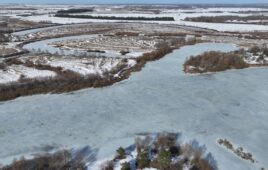
Compaction bands at multiple scales ranging from the field scale to the specimen scale to the meso and grain scale. At the field scale, picture shows the presence of narrow tabular structures within the host rock in the Valley of Fire. At the grain scale, images show clear differences in porosity (dark spots) density. This research aims at quantifying the impact of grain scale features in macroscopic physical properties that control behavior all the way to the field scale. Image: José Andrade/Caltech |

When geologists survey an area of land for the potential
that gas or petroleum deposits could exist there, they must take into account
the composition of rocks that lie below the surface. Take, for instance,
sandstone. Previous research had suggested that compaction bands—highly
compressed, narrow, flat layers within the sandstone—are much less permeable
than the host rock and might act as barriers to the flow of oil or gas.
Now, researchers led by José Andrade, associate professor
of civil and mechanical engineering at the California Institute of Technology
(Caltech), have analyzed x-ray images of Aztec sandstone and revealed that
compaction bands are actually more permeable than earlier models indicated.
While they do appear to be less permeable than the surrounding host rock, they
do not appear to block the flow of fluids. Their findings were reported in Geophysical Research Letters.
The study includes the first observations and
calculations that show fluids have the ability to flow in sandstone that has
compaction bands. Prior to this study, there had been inferences of how
permeable these formations were, but those inferences were made from 2D images.
This paper provides the first permeability calculations based on actual rock
samples taken directly from the field in the Valley
of Fire, Nev. From the data they collected, the
researchers concluded that these formations are not as impermeable as
previously believed, and that therefore their ability to trap fluids—like oil,
gas, and CO2—should be measured based on 3D images taken from the
field.
Cross-sectional slice of material showing pore-scale structure in Valley of Fire sandstone: A. Host rock. B. Inside compaction band. Darker spots represent voids, which are clearly more abundant in the host rock that inside the compaction band. Image: José Andrade/Caltech |

“These results are very important for the
development of new technologies such as CO2 sequestration and
hydraulic fracturing of rocks for natural gas extraction,” says Andrade.
“The quantitative connection between the microstructure of the rock and
the rock’s macroscopic properties, such as hydraulic conductivity, is crucial,
as physical processes are controlled by pore-scale features in porous
materials. This work is at the forefront of making this quantitative
connection.”
The research team connected the rocks’ 3D micromechanical
features—such as grain size distribution, which was obtained using
microcomputed tomography images of the rocks to build a 3D model—with
quantitative macroscopic flow properties in rocks from the field, which they
measured on many different scales. Those measurements were the first ever to
look at the three-dimensional ability of compaction bands to transmit fluid.
The researchers say the combination of these advanced imaging technologies and
multi-scale computational models will lead to accurate measurements of crucial
physical properties, such as permeability, in rocks and similar materials.
Andrade says the team wants to
expand these findings and techniques. “An immediate idea involves the
coupling of solid deformation and chemistry,” he says. “Accounting
for the effect of pressures and their potential to exacerbate chemical
reactions between fluids and the solid matrix in porous materials, such as
compaction bands, remains a fundamental problem with multiple applications
ranging from hydraulic fracturing for geothermal energy and natural gas
extraction, to applications in biological tissue for modeling important
processes such as osteoporosis. For instance, chemical reactions take place as
part of the process utilized in fracturing rocks to enhance the extraction of
natural gas.”