Research & Development World

  • R&D World Home
  • Topics
    • Aerospace
    • Automotive
    • Biotech
    • Careers
    • Chemistry
    • Environment
    • Energy
    • Life Science
    • Material Science
    • R&D Management
    • Physics
  • Technology
    • 3D Printing
    • A.I./Robotics
    • Software
    • Battery Technology
    • Controlled Environments
      • Cleanrooms
      • Graphene
      • Lasers
      • Regulations/Standards
      • Sensors
    • Imaging
    • Nanotechnology
    • Scientific Computing
      • Big Data
      • HPC/Supercomputing
      • Informatics
      • Security
    • Semiconductors
  • R&D Market Pulse
  • R&D 100
    • 2025 R&D 100 Award Winners
    • 2025 Professional Award Winners
    • 2025 Special Recognition Winners
    • R&D 100 Awards Event
    • R&D 100 Submissions
    • Winner Archive
  • Resources
    • Research Reports
    • Digital Issues
    • Educational Assets
    • Subscribe
    • Video
    • Webinars
    • Content submission guidelines for R&D World
  • Global Funding Forecast
  • Top Labs
  • Advertise
  • SUBSCRIBE

Researchers synthesize first Berkelium-containing molecule

By Brian Buntz | September 9, 2025

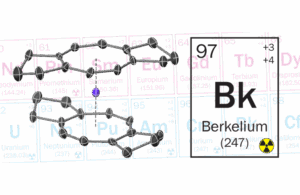
The molecular structure of berkelocene, featuring a berkelium atom (purple) bound between two carbon rings (gray). The backdrop highlights rare-earth elements (pink) and actinides (blue) on the Periodic Table.

Berkelocene’s “sandwich” structure: a berkelium atom (purple) between two substituted cyclooctatetraene rings (gray). Periodic Table background highlights rare-earths (pink) and actinides (blue). Credit: Alyssa Gaiser/LBNL.

Scientists at Lawrence Berkeley National Laboratory built a first: berkelocene. It binds carbon to berkelium-249 and puts the atom between two substituted cyclooctatetraene-based ligands. The surprise? In this molecule, berkelium is tetravalent (Bk⁴⁺), not Tb-like as many models predicted. In plain terms: the berkelium atom ends up more positively charged than expected and bonds to the carbon rings in an unusual way.

The team had just 0.3 mg of berkelium from ORNL’s National Isotope Development Center. They worked in air-free, radiological labs and confirmed the symmetric “sandwich” by single-crystal X-ray diffraction; the work used resources at the Advanced Light Source. Computations at the University at Buffalo and spectroscopy show Bk–C bonding and charge distribution that depart from lanthanide analogies. Those details sharpen actinide models. They are useful for problems like long-term nuclear-waste chemistry.

This finding overturns decades-old theories on actinide chemistry, especially for transplutonium elements like berkelium, and could improve strategies for nuclear waste management and remediation.

The work was published in Science (DOI: 10.1126/science.adr3346).
Berkelium, a synthetic radioactive element with atomic number 97, belongs to the actinide series and does not occur naturally on Earth. Discovered in December 1949 at the University of California, Berkeley, by chemists Stanley G. Thompson, Albert Ghiorso and Glenn T. Seaborg, it was named after the city and produced via nuclear reactions in accelerators or reactors. As one of the transuranic elements beyond uranium, berkelium exists only in trace amounts. In other words, typically milligrams or less, limiting its study to specialized labs handling high radioactivity.
Related Articles Read More >

MXenes, the family of 2D transition metal carbides, get a clean surface, and a 160-fold conductivity jump
A dual-energy catalyst breaks down drug pollution where conventional treatments fail
How a forgotten can of vintage ether can become a ticking time bomb
UC Riverside’s $5 fake drug detector uses toy robot sensors to catch counterfeit medications
rd newsletter
EXPAND YOUR KNOWLEDGE AND STAY CONNECTED
Get the latest info on technologies, trends, and strategies in Research & Development.

R&D World Digital Issues

Fall 2025 issue

Browse the most current issue of R&D World and back issues in an easy to use high quality format. Clip, share and download with the leading R&D magazine today.

R&D 100 Awards
Research & Development World
  • Subscribe to R&D World Magazine
  • Sign up for R&D World’s newsletter
  • Contact Us
  • About Us
  • Drug Discovery & Development
  • Pharmaceutical Processing
  • Global Funding Forecast

Copyright © 2026 WTWH Media LLC. All Rights Reserved. The material on this site may not be reproduced, distributed, transmitted, cached or otherwise used, except with the prior written permission of WTWH Media
Privacy Policy | Advertising | About Us

Search R&D World

  • R&D World Home
  • Topics
    • Aerospace
    • Automotive
    • Biotech
    • Careers
    • Chemistry
    • Environment
    • Energy
    • Life Science
    • Material Science
    • R&D Management
    • Physics
  • Technology
    • 3D Printing
    • A.I./Robotics
    • Software
    • Battery Technology
    • Controlled Environments
      • Cleanrooms
      • Graphene
      • Lasers
      • Regulations/Standards
      • Sensors
    • Imaging
    • Nanotechnology
    • Scientific Computing
      • Big Data
      • HPC/Supercomputing
      • Informatics
      • Security
    • Semiconductors
  • R&D Market Pulse
  • R&D 100
    • 2025 R&D 100 Award Winners
    • 2025 Professional Award Winners
    • 2025 Special Recognition Winners
    • R&D 100 Awards Event
    • R&D 100 Submissions
    • Winner Archive
  • Resources
    • Research Reports
    • Digital Issues
    • Educational Assets
    • Subscribe
    • Video
    • Webinars
    • Content submission guidelines for R&D World
  • Global Funding Forecast
  • Top Labs
  • Advertise
  • SUBSCRIBE