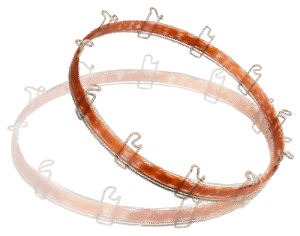
 Restek Corporation used its Pittcon 2026 appearance to showcase the RMX line of GC columns, the company’s first new column family in years. The new line is built around a proprietary deactivation chemistry called TriMax.
The flagship product, the RMX-5Sil MS, ships in 17 SKUs across four column formats. Those include integrated guard column and transfer line configurations that eliminate leak-prone connections. The company says the columns are a direct response to a convergence of regulatory and workflow pressures, including the pending methylene chloride restrictions that are pushing environmental labs toward lower extraction volumes and alternate solvents, that have exposed the limitations of existing column technology.
TriMax: a three-dimensional deactivation chemistry
The core innovation behind the RMX line is TriMax, a three-dimensional deactivation chemistry that Restek says was designed from scratch.
In a press conference, Ramkumar Dhandapani, Ph.D., director of product management, said Restek “took a deliberate decision to go for a deactivation specifically designed for low-level detection.” TriMax, he explained, is “a three-dimensional array of bonding, cross-linking and deactivation” that avoids industrial reagents entirely. Because it was purpose-built for GC, the result is a pristine surface free of the active sites that cause peak tailing or analyte adsorption. Unlike traditional deactivations that can favor one compound class over another, TriMax produces what Dhandapani called “an unbiased surface” that treats acids, bases and neutrals equally.
Head-to-head data against competitors
To substantiate its claims, Restek ran the RMX-5Sil MS against three competitor columns, two marketed as premium offerings and one traditional 5Sil-type column,using 52 challenging semivolatile compounds spanning acids, bases and neutrals. The test parameters included peak asymmetry, linearity (R² and %RSD), recovery at both the lowest calibration point and at 50 ppb, and repeatability.
According to Restek’s data, the RMX column met “ideal” data quality criteria for more compounds across all test parameters than any of the competitor columns, with the most pronounced advantages in asymmetry for acids and bases. Traditional columns typically produce about 4,000 plates per meter, Dhandapani said, “while ours averages around 4,560. That’s another reason you see better peak shape, not just for acids and bases, but also for neutrals.”
Thermal stability testing reinforced the durability claims. After 15 aggressive cycles ramping to 330°C with four-hour holds, the RMX maintained symmetric peaks for both acidic and basic probe compounds and kept bleed levels low and stable, a critical factor for MS-based methods where column bleed raises background noise. In field testing on dirty matrices, one lab recorded 1,800 to 1,900 injections with only two trims on the RMX, versus 1,100 injections and seven or eight trims on a traditional column, what Dhandapani called “almost 1.5 times better performance.”
Built-in guard and transfer line formats
Beyond the core deactivation chemistry, Restek is emphasizing the practical workflow advantages of its integrated column formats, particularly for labs running large analyte panels where routine column trimming creates cascading problems.
When analysts trim a conventional column to remove contaminated length, Dhandapani explained, “the retention time starts to shift. That’s like 24 hours of work to reassign those retention times” across a 200- to 500-analyte panel. With the Integra-Guard format, “you trim a sacrificial section. You don’t compromise on the retention or on the resolution.”
For mass spectrometry users, the Integra-Transfer Line format addresses a different pain point: column bleed at the high temperatures maintained at the MS interface. Mass spec transfer lines typically run at 300 to 350°C, and at those temperatures, Dhandapani said, a regular column “starts to spit stuff onto the mass spec. That’s costly maintenance.” The Integra-Transfer Line replaces that section with deactivated tubing carrying no stationary phase, so “nothing bleeds into the MS. You get lower noise, better signal, and less downtime.”
A dual format combining both integrated guard and transfer line is also available. Restek says the Integra-Transfer Line configuration is unique to the company.
Early adopter feedback
Carlos Parra, a QC MS Specialist II at NOW Foods with over 21 years of analytical chemistry experience, has been testing the RMX-5Sil MS on complex botanical matrices in the company’s pesticide residue laboratory. Parra is mentioned in Restek’s marketing materials. Dhandapani described the results during his Pittcon presentation, calling the botanical matrices “really sticky” and among the most analytically challenging samples the column had faced. On the RMX, the lab could identify “at least two to three linear transitions that they could use for quantification,” he said. On the traditional column, those compounds “got masked by the matrix. We couldn’t even see some of the pesticides at lower levels.”
In a separate testimonial published by Restek, Parra confirmed the field results, adding that the integrated guard and transfer line design reduced instrument interruptions and extended column life in the lab’s schedule-driven QC environment.
Restek is showcasing the RMX column line at Pittcon 2026 (booth 3328). Dhandapani presents a Learning Lab session Wednesday, March 11, at 11:30 a.m. in the Pittcon Pavilion.