Research & Development World

  • R&D World Home
  • Topics
    • Aerospace
    • Automotive
    • Biotech
    • Careers
    • Chemistry
    • Environment
    • Energy
    • Life Science
    • Material Science
    • R&D Management
    • Physics
  • Technology
    • 3D Printing
    • A.I./Robotics
    • Software
    • Battery Technology
    • Controlled Environments
      • Cleanrooms
      • Graphene
      • Lasers
      • Regulations/Standards
      • Sensors
    • Imaging
    • Nanotechnology
    • Scientific Computing
      • Big Data
      • HPC/Supercomputing
      • Informatics
      • Security
    • Semiconductors
  • R&D Market Pulse
  • R&D 100
    • 2025 R&D 100 Award Winners
    • 2025 Professional Award Winners
    • 2025 Special Recognition Winners
    • R&D 100 Awards Event
    • R&D 100 Submissions
    • Winner Archive
  • Resources
    • Research Reports
    • Digital Issues
    • Educational Assets
    • R&D Index
    • Subscribe
    • Video
    • Webinars
    • Content submission guidelines for R&D World
  • Global Funding Forecast
  • Top Labs
  • Advertise
  • SUBSCRIBE

Revolutionary Acupuncture Needles Have Enhanced Therapeutic Properties

By R&D Editors | October 18, 2016

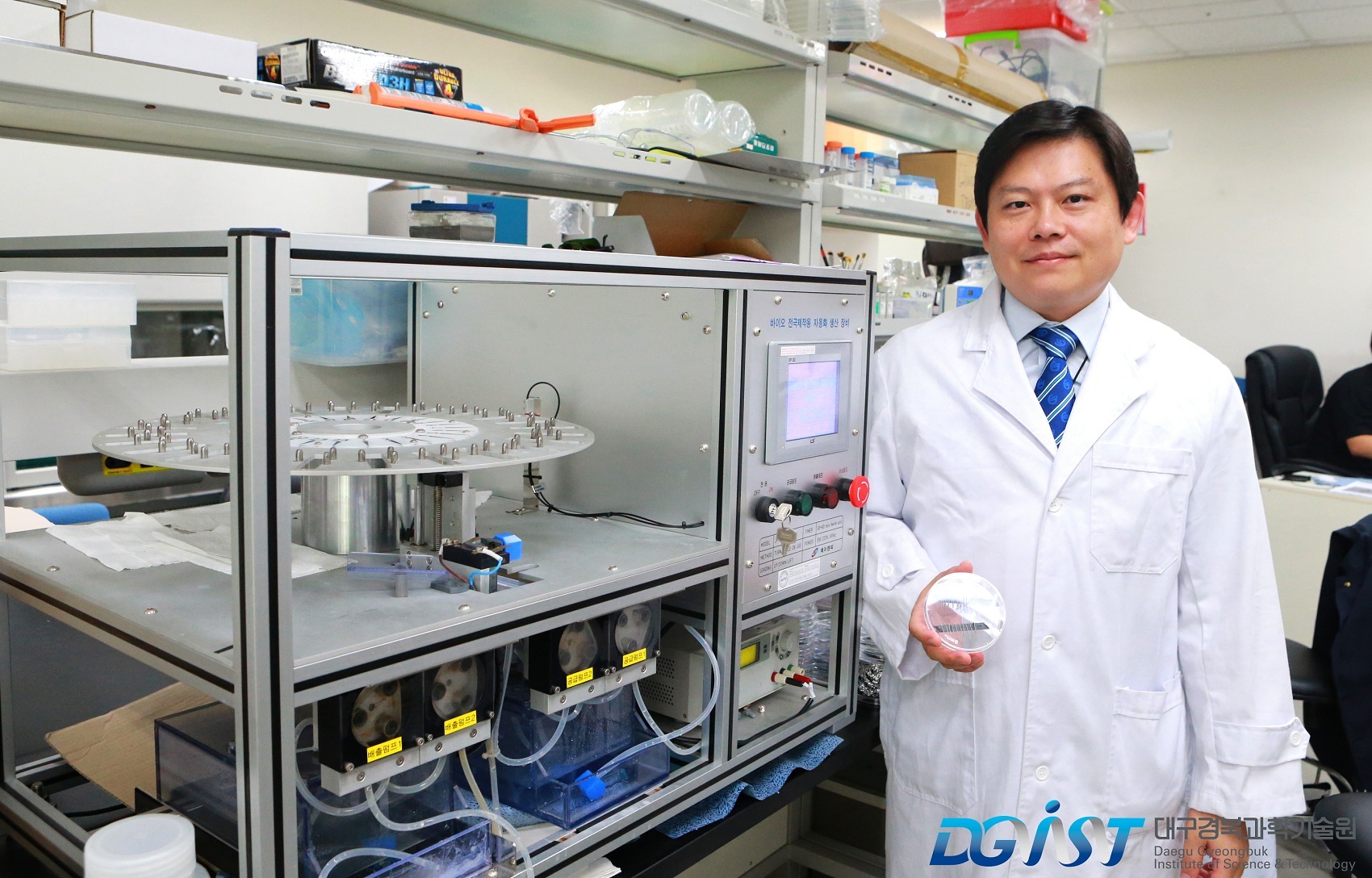
A research team from Daegu Gyeongbuk Institute of Science and Technology (DGIST) led by Professor Su-Il In, who developed acupuncture needles combined with nanotechnology, has been recognized as the world’s first application of this technology. This development is expected to open new directions in the Oriental medicine research field.

In’s research team from the Department of Energy Systems Engineering succeeded in developing porous acupuncture needles (hereafter PANs) that offer enhanced therapeutic properties by applying nanotechnology on the acupuncture needles for the first time in the world.    

The findings of this experiment, which was conducted in collaboration with DGIST’s research team and the Addiction Control Research Center at Daegu Haany University, have attracted the attention of the relevant academic field in light of the fact that the experiment combined nanotechnology with acupuncture needles.

In’s research team developed PANs with fine pores ranging in sizes from nanometers (nm= one billionth of a meter) to micrometers (㎛ = one millionth of a meter) on the surface of the needles using a nano-electrochemical method.

PANs are formed by anodization, and are characterized by a widened surface of the needles through the following process: anion (F-) contained in the electrolyte bored into the surface of the metal needles (positive) and created fine and uniform pores.


PANs are expected to be as effective as conventional large and long needles by minimizing the sense of pain during acupuncture treatment while expanding the surface area of the needle 20 times greater than conventional acupuncture ones.

Through electrophysiological experiments with rats, In’s research team proved that PANs excel in transferring signals from a spinal dorsal horn by the in vivostimulation of Shenmen (HT7) points, and in particular, demonstrated that the efficacy of PANs is superior to conventional acupuncture needles in treating alcohol and cocaine addiction in animal experiments.  

Applications for international patents for the fabrication technology of PANs developed by DGIST have already been submitted in countries such as the US, China, and Europe. In addition, in the domestic oriental medicine field, the fact that the efficacy of acupuncture needles has been improved through their structural transformation by applying nanotechnology has been recognized and evaluated as the first such instance in the thousand-year history of eastern medicine.

In says, “The development of nanotechnology has taken science and technology to the next level in various fields such as solar cells, quantum computers, display development, and the like. Based on this experiment’s achievement of combining nanotechnology and oriental medicine, I will continue to conduct research in order to be at the forefront of the scientific population of oriental medicine.” 

Director Jae-ha Yang from Daegu Haany University says, “In Western medicine, nanotechnology is widely used from diagnosis to treatment; but in eastern medicine, particularly in acupuncture therapy, it is rare to utilize nano science. The findings of this study are expected to open new directions in the field of eastern medicine where nano science is rarely explored and utilized.” 

In’s research findings were published on Oct. 7 in the online edition of Scientific Reports.
Source: Daegu Gyeongbuk Institute of Science and Technology

Related Articles Read More >

CEA-Leti achieves 400°C CMOS fabrication milestone for 3D chip stacking
The 2025 R&D 100 Finalists are here
New nanotechnology method increases microalgae biofuel yield by 300%
New nanopore sensor paves the way for fast, accurate, low-cost DNA sequencing
rd newsletter
EXPAND YOUR KNOWLEDGE AND STAY CONNECTED
Get the latest info on technologies, trends, and strategies in Research & Development.
RD 25 Power Index

R&D World Digital Issues

Fall 2025 issue

Browse the most current issue of R&D World and back issues in an easy to use high quality format. Clip, share and download with the leading R&D magazine today.

Research & Development World
  • Subscribe to R&D World Magazine
  • Sign up for R&D World’s newsletter
  • Contact Us
  • About Us
  • Drug Discovery & Development
  • Pharmaceutical Processing
  • Global Funding Forecast

Copyright © 2025 WTWH Media LLC. All Rights Reserved. The material on this site may not be reproduced, distributed, transmitted, cached or otherwise used, except with the prior written permission of WTWH Media
Privacy Policy | Advertising | About Us

Search R&D World

  • R&D World Home
  • Topics
    • Aerospace
    • Automotive
    • Biotech
    • Careers
    • Chemistry
    • Environment
    • Energy
    • Life Science
    • Material Science
    • R&D Management
    • Physics
  • Technology
    • 3D Printing
    • A.I./Robotics
    • Software
    • Battery Technology
    • Controlled Environments
      • Cleanrooms
      • Graphene
      • Lasers
      • Regulations/Standards
      • Sensors
    • Imaging
    • Nanotechnology
    • Scientific Computing
      • Big Data
      • HPC/Supercomputing
      • Informatics
      • Security
    • Semiconductors
  • R&D Market Pulse
  • R&D 100
    • 2025 R&D 100 Award Winners
    • 2025 Professional Award Winners
    • 2025 Special Recognition Winners
    • R&D 100 Awards Event
    • R&D 100 Submissions
    • Winner Archive
  • Resources
    • Research Reports
    • Digital Issues
    • Educational Assets
    • R&D Index
    • Subscribe
    • Video
    • Webinars
    • Content submission guidelines for R&D World
  • Global Funding Forecast
  • Top Labs
  • Advertise
  • SUBSCRIBE