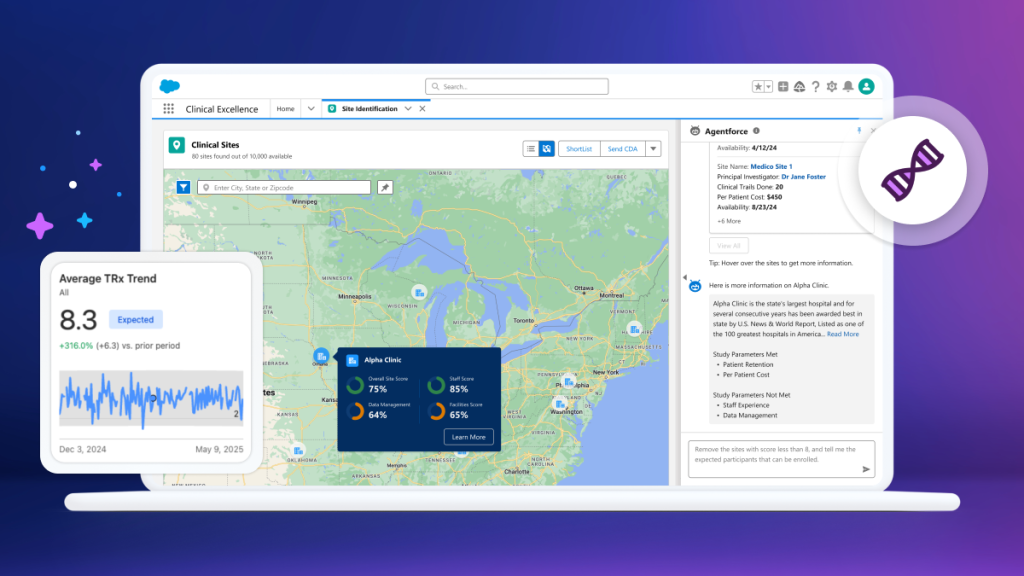
Salesforce announced on Aug. 26, 2025, that more than 70 companies, including pharmaceutical and medical-device players and CROs, have selected its Life Sciences Cloud to unify clinical, commercial and patient-services data. Customers include Pfizer, Takeda, Fresenius Kabi, Boehringer Ingelheim and Penumbra. Salesforce describes the platform as an end-to-end engagement system that brings together sales, service, marketing, and clinical functions. Life Sciences Cloud also offers embedded industry-specific AI tools for clinical trial recruitment, patient support programs and HCP engagement.
Salesforce describes Life Sciences Cloud as an Agentforce-enabled, end-to-end agentic AI customer experience platform that integrates sales, service, marketing, and clinical data. The platform includes industry-specific prompts, data models, and AI capabilities and is purpose-built for clinical trial recruitment, patient services, and HCP engagement.
The platform addresses data silos that hamper a development process extending nearly a decade, and cost hundreds of millions of dollars, or more, per asset. Life Sciences Cloud taps AI to streamline engagement with healthcare organizations, letting teams focus more on patients. Clinical trial sites and sponsors can use its AI capabilities for optimized candidate recruitment, diverse participant matching, and smart site selection. Field sales reps benefit from AI-assistive tools for visit preparation and follow‑up, while patient services teams automate coverage analysis, proactive alerts, and bulk verifications to support medication adherence.
In essence, Salesforce notes the platform helps customers “bring life-enhancing treatments to patients faster” by collapsing fragmented workflows. Frank Defesche, Salesforce’s SVP and GM of Life Sciences, said in an interview with R&D World:
The faster you can run clinical trials, the faster you can get therapies to market.—Defesche
Customer feedback highlights practical applications. At Centricity Research, COO Alexandra Walton said the platform streamlines study start-up and management, integrating with clinical trial management systems for scheduling and reporting. CliniLink founder Paresh Shah described using it to reduce patient dropouts through predictive analytics and automated, multi-channel outreach. Protas CIO Stefan Blixen-Finecke noted its role in enabling large-scale, low-cost, high-quality trials, including the world’s largest pivotal phase 3 study for chronic kidney disease.
In patient services, Boehringer Ingelheim VP Deb Reardon said it supports their mission to transform patient and provider experiences across the healthcare ecosystem. Mirum’s Renee Shiota explained plans to bring services in-house to improve enrollment, data visibility, and adherence for ultra-rare diseases.
For commercial operations, Apitoria CEO Dr. Sanjay Chaturvedi said it replaces spreadsheets with AI tools to cut costs and boost conversions. CONMED VP Kelly Fitzgerald cited streamlined processes and better engagement. Other users, like LifeHealthcare CEO Paul Petherbridge, Hetero AVP Yeshwant Nikte, Menarini director Germano D’Amore, Penumbra director Prashant Ponde, and Tandem Diabetes Care CIO Boris Stojnic, reported gains in efficiency, stronger data insights, and improved customer outreach.
Salesforce’s Life Sciences Cloud arrives as enterprises move from pilots to early scaling of agentic AI, but broad deployment is still limited. In Capgemini Research Institute’s April 2025 survey of 1,522 executives, only 14% report AI agents implemented at partial or full scale, with 23% piloting and 61% still exploring or planning deployments within 6–12 months. Capgemini also recontacted 900 respondents and found similar adoption levels, indicating the pattern is robust.
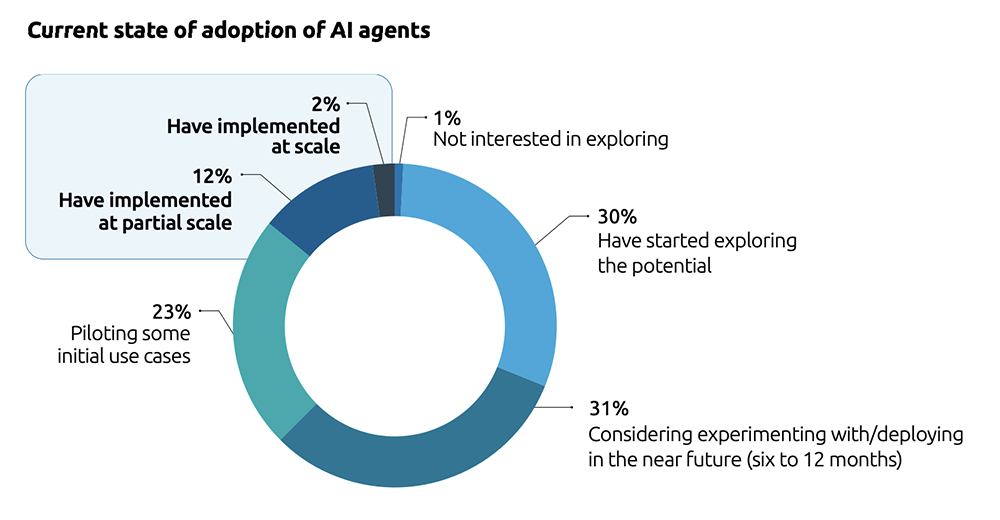
Current state of enterprise AI-agent adoption: 30% exploring, 31% considering trials in 6–12 months, 23% piloting, 12% partial scale, 2% at scale, 1% not interested. Source: Capgemini Research Institute, “Rise of agentic AI,” April 2025 (N=1,522).