Researchers from Sandia National Laboratories are investigating methods to capture methane from biogas, a mixture found in waste such as food scraps, manure and sewage. Biogas is a renewable energy source produced by breaking down organic matter that can be used to fuel vehicles, heat homes and generate electricity.

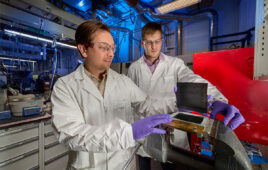
Jessica Rimsza uses a sonication probe to thoroughly mix powder in a solvent to make porous liquid for further testing. (Photo by Craig Fritz)
“We are creating new types of porous liquids that can selectively capture methane and other gases,” Jessica Rimsza, a materials engineer at Sandia, said in a press release. “This could provide a supplemental domestic energy source to support U.S. energy independence.”
Porous liquids enable selective capture
A porous liquid is a liquid solvent combined with a porous solid material, creating a liquid full of tiny cavities, allowing it to absorb and store gas molecules. By mixing different solids and solvents, researchers can tailor how the porous liquid behaves.
The team at Sandia has created dozens of different porous liquids. “There are hundreds of thousands of porous materials and there are tens of thousands of solvents, so there’s a vast untapped number of possible combinations from which to form porous liquids,” Rimsza said. “Even if a vanishingly small fraction of those end up being useful, that could still be thousands and thousands of potential good combinations.”
The team is currently working on porous liquids that can selectively capture methane from biogas, separating it from carbon dioxide and other impurities. After the methane is captured, it can be released from the liquid and used for electricity generation, heating, steel and glass production and other applications. It could also be used to produce hydrogen, methanol, ammonia and acetylene, which are used in fertilizers, plastics and other materials.
In earlier research, the team designed porous liquids capable of selectively capturing carbon dioxide, which can be used in soft drink manufacturing as well as other applications.
The team has published several papers on their research and has submitted a broad patent covering the definition and design principles of porous liquids.