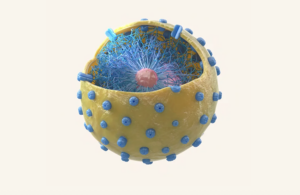
A 3D rendering of a biological cell from the company’s homepage, where it animates to reveal layers of internal complexity. Image credit: Owkin.
Agentic AI company Owkin and Sanofi have extended their collaboration with a five-year license for K Pro, Owkin’s AI scientist, under which Owkin will lead the end-to-end development of novel, purpose-built biopharma agents for Sanofi. Owkin pitches K Pro as a system that reasons over biological data and orchestrates AI agents to run research and decision-making tasks that traditionally fall to teams of human scientists.
K Pro pairs Owkin’s multimodal patient-data network with specialized agentic AI to support each stage of drug development, from early discovery through clinical trials, alongside competitive intelligence. The new agents, which Owkin describes as autonomous assistants capable of running complex R&D tasks, will be deployed through the platform with the stated goal of complementing and reinforcing Sanofi’s existing agentic capabilities.
The extension “marks a shift toward truly embedded AI,” said Thomas Clozel, Owkin’s CEO and co-founder, in a statement. Embedded has a concrete meaning in Owkin’s architecture. K Pro is an orchestrator whose individual tools and agents sit behind MCP servers, the same modular layer Owkin used to ship its first external agent, Pathology Explorer, through Anthropic’s Claude earlier this year. The Sanofi agents would run on that interoperable plumbing inside Sanofi’s own stack, rather than as analyses Owkin delivers from the outside.
Emmanuel Frenehard, Sanofi’s chief digital officer, framed the agents as part of a broader frontier-AI push. “By implementing purpose-built agentic systems into our workflows, we aim to empower our teams to operate with greater speed, depth, and confidence,” he said. It is a bet Sanofi is not placing on Owkin alone: in January, the company expanded a parallel collaboration with CytoReason, another agentic-AI vendor, in a deal valued at up to $16 million.
The collaboration between Sanofi and Owkin dates back to November 2021, when Sanofi made a $180 million equity investment in Owkin alongside a $90 million, three-year oncology collaboration spanning four cancers: non-small cell lung cancer, triple-negative breast cancer, mesothelioma, and multiple myeloma. The initial scope covered target identification in oncology and patient subgrouping, and later expanded to drug positioning for Sanofi’s immunology pipeline. Sanofi’s role has since evolved from investor and customer to a partner running Owkin’s agents inside its own workflows.
Jonas Béal, Owkin’s head of product, described the platform as “modular by design.” Architecturally, it runs on a two-track model strategy.
It runs on a two-track model strategy. The first track uses frontier models from vendors such as Anthropic and OpenAI as the reasoning engines. Because those models are proprietary, Owkin can’t touch their weights, so it improves everything around them instead: the tools, the instructions, and what Béal calls “recipes that teach them how to accomplish a given task.” That is in-context and tool learning rather than retraining the model.
The second track uses open-weight models Owkin can modify directly. Its in-house example is OwkinZero, a smaller model the company fine-tunes with reinforcement learning on biological data and feeds back into the system. For that open-weight work, Béal said Owkin has leaned on the Qwen models for their strong ratio of performance to size, and is now investigating newer releases such as Kimi.
Supporting both tracks is K Pro’s multimodal patient-data network, drawn from partnerships with hundreds of academic centers, which Béal called the difference between real biological insight and, without it, “LLM guesses.”
The expanded Sanofi is part of a broader pattern. In May, Owkin struck a structurally similar arrangement with AstraZeneca, a multi-year K Pro license under which it would build agents, initially for competitive intelligence, inside AstraZeneca’s systems.