Research & Development World

  • R&D World Home
  • Topics
    • Aerospace
    • Automotive
    • Biotech
    • Careers
    • Chemistry
    • Environment
    • Energy
    • Life Science
    • Material Science
    • R&D Management
    • Physics
  • Technology
    • 3D Printing
    • A.I./Robotics
    • Software
    • Battery Technology
    • Controlled Environments
      • Cleanrooms
      • Graphene
      • Lasers
      • Regulations/Standards
      • Sensors
    • Imaging
    • Nanotechnology
    • Scientific Computing
      • Big Data
      • HPC/Supercomputing
      • Informatics
      • Security
    • Semiconductors
  • R&D Market Pulse
  • R&D 100
    • 2025 R&D 100 Award Winners
    • 2025 Professional Award Winners
    • 2025 Special Recognition Winners
    • R&D 100 Awards Event
    • R&D 100 Submissions
    • Winner Archive
  • Resources
    • Research Reports
    • Digital Issues
    • Educational Assets
    • Subscribe
    • Video
    • Webinars
    • Content submission guidelines for R&D World
  • Global Funding Forecast
  • Top Labs
  • Advertise
  • SUBSCRIBE

Saving Energy with 3D Solutions

By Tokyo Institute of Technology | December 6, 2016

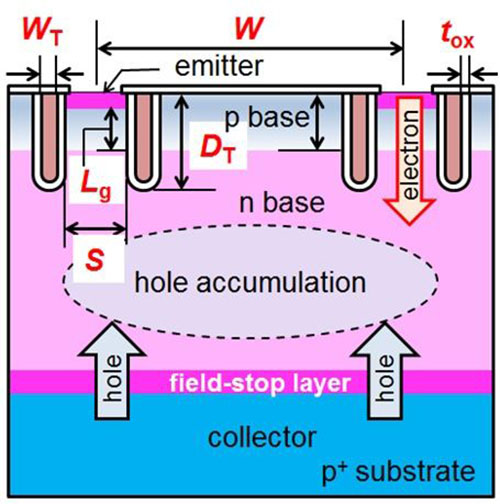
Trench gate IGBT schematic indicating the mesa width (S), gate length (Lg), and the oxide thickness in the MOSFET (tox), cell pitch (W), and the trench depth (DT). Image: Tokyo Institute of Technology

In electronics, lower power consumption leads to operation cost savings, environmental benefits and the convenience advantages from longer running devices. While progress in energy efficiencies has been reported with alternative materials such as SiC and GaN, energy-savings in the standard inexpensive and widely used silicon devices are still keenly sought. K. Tsutsui at Tokyo Institute of Technology and colleagues in Japan have now shown that by scaling down size parameters in all three dimensions their device they can achieve significant energy savings.

Tsutsui and colleagues studied silicon insulated gate bipolar transistors (IGBTs), a fast-operating switch that features in a number of every day appliances. While the efficiency of IGBTs is good, reducing the ON resistance, or the voltage from collector to emitter required for saturation (Vce(sat)), could help increase the energy efficiency of these devices further.

Previous investigations have highlighted that increases in the “injection enhancement (IE) effect”, which give rise to more charge carriers, leads to a reduction in Vce(sat). Although this has been achieved by reducing the mesa width in the device structure, the mesa resistance was thereby increased as well. Reducing the mesa height could help counter the increased resistance but is prone to impeding the (IE) effect. Instead the researchers reduced the mesa width, gate length, and the oxide thickness in the MOSFET to increase the IE effect and so reduce Vce(sat) from 1.70 to 1.26 V. With these alterations the researchers also used a reduced gate voltage, which has advantages for CMOS integration.

They conclude, “It was experimentally confirmed for the first time that significant Vce(sat) reduction can be achieved by scaling the IGBT both in the lateral and vertical dimensions with a decrease in the gate voltage.”

Source: Tokyo Institute of Technology

Related Articles Read More >

DOE announces first selections for nuclear energy DOME program
Five key trends that defined the show floor at Interphex 2026 
NANO Nuclear could have a reactor on the Moon by 2030 CEO says
DOE to award $100 million in grants amid science funding cuts
rd newsletter
EXPAND YOUR KNOWLEDGE AND STAY CONNECTED
Get the latest info on technologies, trends, and strategies in Research & Development.

R&D World Digital Issues

Fall 2025 issue

Browse the most current issue of R&D World and back issues in an easy to use high quality format. Clip, share and download with the leading R&D magazine today.

R&D 100 Awards
Research & Development World
  • Subscribe to R&D World Magazine
  • Sign up for R&D World’s newsletter
  • Contact Us
  • About Us
  • Drug Discovery & Development
  • Pharmaceutical Processing
  • Global Funding Forecast

Copyright © 2026 WTWH Media LLC. All Rights Reserved. The material on this site may not be reproduced, distributed, transmitted, cached or otherwise used, except with the prior written permission of WTWH Media
Privacy Policy | Advertising | About Us

Search R&D World

  • R&D World Home
  • Topics
    • Aerospace
    • Automotive
    • Biotech
    • Careers
    • Chemistry
    • Environment
    • Energy
    • Life Science
    • Material Science
    • R&D Management
    • Physics
  • Technology
    • 3D Printing
    • A.I./Robotics
    • Software
    • Battery Technology
    • Controlled Environments
      • Cleanrooms
      • Graphene
      • Lasers
      • Regulations/Standards
      • Sensors
    • Imaging
    • Nanotechnology
    • Scientific Computing
      • Big Data
      • HPC/Supercomputing
      • Informatics
      • Security
    • Semiconductors
  • R&D Market Pulse
  • R&D 100
    • 2025 R&D 100 Award Winners
    • 2025 Professional Award Winners
    • 2025 Special Recognition Winners
    • R&D 100 Awards Event
    • R&D 100 Submissions
    • Winner Archive
  • Resources
    • Research Reports
    • Digital Issues
    • Educational Assets
    • Subscribe
    • Video
    • Webinars
    • Content submission guidelines for R&D World
  • Global Funding Forecast
  • Top Labs
  • Advertise
  • SUBSCRIBE