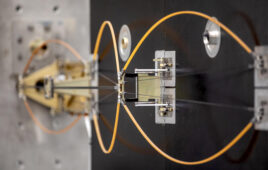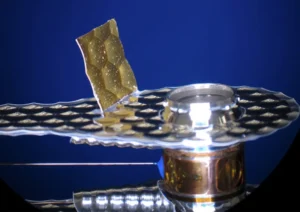
The THOR target with the windows around the hohlraum’s equator. Image from Los Alamos National Lab.
A Los Alamos National Laboratory team has advanced inertial-confinement fusion (ICF), a method that uses lasers to compress fuel pellets and trigger nuclear fusion, mimicking the sun’s energy production. The researchers achieved ignition with a novel windowed hohlraum, a cavity (from the German “Hohlraum,” meaning “hollow space” or “empty room”) dubbed THOR (Thinned Hohlraum Optimization for Radflow). The shot produced 2.4 ± 0.09 MJ of fusion energy, meeting the publicly stated ignition criterion (fusion energy > laser energy delivered to the target); the laser energy for this shot has not been disclosed. At the same time, it allowed a controlled burst of x-rays to escape. Those x-rays will support future experiments on material responses.
Standard National Ignition Facility (NIF) targets use cylindrical hohlraums with two laser-entrance holes at the ends. THOR adds equatorial windows that vent x-rays, creating an external, high-fluence x-ray source for stockpile-stewardship studies. The risk is that any leakage or asymmetry can choke off ignition. Demonstrating self-heating (“burning plasma”) under these conditions validates Los Alamos’ 3-D hydro-rad-transport code x-RAGE and opens a new regime where a single shot both generates and diagnoses extreme states of matter.
This approach modifies the standard fusion target, which is a cylindrical hohlraum that converts laser light to x-rays and, via two end LEHs, symmetrically drives the capsule. The THOR target, however, intentionally adds small windows, or “equatorial apertures,” around its center. The great challenge is that these windows act like leaks, letting crucial energy escape and threatening the perfect implosion required to spark ignition. By successfully achieving ignition with these windows open, the experiment validates a new platform where a single shot can serve a dual purpose: creating a self-sustaining fusion reaction while also producing a powerful x-ray source to study how materials behave in extreme environments.
Building on NIF’s recent performance
THOR’s 2.4 MJ result builds on a series of steadily improving NIF achievements. The facility produced 3.15 MJ in December 2022, followed by 5.0 MJ from a 2.05 MJ drive on February 23, 2025 (achieving a target gain of approximately 2.4). Most recently, NIF reached a record 8.6 MJ from just 2.08 MJ of drive energy on April 7, 2025: a gain of about 4.1. These successes demonstrate that ignition is both repeatable and robust enough to accommodate significant target modifications like THOR’s windowed design.
By comparison, China’s flagship SG-III laser delivers 180 kJ of ultraviolet energy. That’s roughly one-tenth of NIF’s capability. The SG-III facility supports target physics development rather than pursuing full-scale ignition.
Chinese researchers are exploring an octahedral spherical hohlraum design to improve implosion symmetry. Early SG-III tests confirmed this approach can maintain spherical implosions, though only at sub-megajoule energies. Meanwhile, parallel work on double-shell capsules reports DT yields up to approximately 7.1×10⁸ on SG-III (hundred-kJ class), with other SG-III implosion campaigns approaching ~10¹⁰ neutrons. That’s still far below NIF’s MJ-scale energy output. To date, no publicly verified Chinese experiment has achieved the ignition criterion of fusion energy exceeding laser input energy.
What’s next
Los Alamos scientists say the immediate goals are to increase window transparency, quantify the emerging x-ray spectrum, and attach material samples directly to THOR assemblies. Key technical questions for upcoming shots include:
- How much laser energy reached the THOR target and what was the resulting target gain?
- What symmetry penalties, if any, occur as window size increases?
- Can the escaping x-ray dose be tuned shot-to-shot for differential material testing?
These tests will decide if windowed hohlraums join NIF’s standard toolkit or stay niche. Beyond that, THOR could accelerate hybrid experiments blending fusion ignition with radiation-effects research, aiding U.S. nuclear stockpile stewardship without live tests.
The U.S. maintains a clear scientific lead in fusion, with NIF’s repeated megajoule-scale ignition dwarfing China’s sub-ignition experiments. However, Beijing’s $2.1 billion bet on China Fusion Energy Co. signals a strategy reminiscent of its successful capture of global markets in solar panels and batteries. The technologies are largely invented in America but commercially dominated by China through state-backed industrial scale-up.
While Los Alamos pushes the boundaries of what’s possible with innovations like THOR, the real competition may be shifting from laboratory breakthroughs to industrial scale-up. The U.S. leads in proving fusion works; China is positioning to make it profitable. History suggests that scientific firsts don’t guarantee commercial dominance.