Research & Development World

  • R&D World Home
  • Topics
    • Aerospace
    • Automotive
    • Biotech
    • Careers
    • Chemistry
    • Environment
    • Energy
    • Life Science
    • Material Science
    • R&D Management
    • Physics
  • Technology
    • 3D Printing
    • A.I./Robotics
    • Software
    • Battery Technology
    • Controlled Environments
      • Cleanrooms
      • Graphene
      • Lasers
      • Regulations/Standards
      • Sensors
    • Imaging
    • Nanotechnology
    • Scientific Computing
      • Big Data
      • HPC/Supercomputing
      • Informatics
      • Security
    • Semiconductors
  • R&D Market Pulse
  • R&D 100
    • 2025 R&D 100 Award Winners
    • 2025 Professional Award Winners
    • 2025 Special Recognition Winners
    • R&D 100 Awards Event
    • R&D 100 Submissions
    • Winner Archive
  • Resources
    • Research Reports
    • Digital Issues
    • Educational Assets
    • Subscribe
    • Video
    • Webinars
    • Content submission guidelines for R&D World
  • Global Funding Forecast
  • Top Labs
  • Advertise
  • SUBSCRIBE

Scientists find lithium cloud left by reentry of SpaceX rocket

By Julia Rock-Torcivia | February 24, 2026

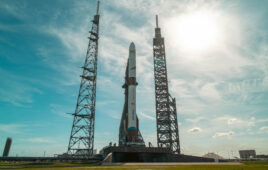
A SpaceX Falcon 9 rocket made an uncontrolled reentry over Europe, creating a visible fireball last year. Using a specialized laser instrument called a resonance lidar, scientists in northern Germany detected a 10-fold spike in lithium atoms at about 96 kilometers altitude, roughly 20 hours after the rocket burned up. They published their findings in Communications Earth & Environment last week. This is the first time a ground-based instrument has directly measured atmospheric pollution caused by a reentering piece of space debris. 

SpaceX Falcon 9

Tracing metals at the edge of the atmosphere 

The researchers used a resonance fluorescence lidar tuned to lithium’s atomic transition at 670.7926 nm to detect traces of the metal. The system uses a xenon-chloride excimer laser firing at 50 Hz. Measurements were taken every 80 seconds with a resolution of 200 meters. This same system has previously detected calcium and nickel in the mesosphere. 

Combined with the SIMONe-Germany meteor radar network and a physics-informed neural network called HYPER for reconstructing 3D wind fields, the instrument suite can detect trace metals in the mesosphere and lower thermosphere. 

SIMONe-Germany operates at 32.55 MHz across two transmitting sites and seven remote receiving stations across northern Germany. The system detects Doppler shifts of radio waves bouncing off meteor trails to reconstruct wind vectors in 3D. HYPER then turns the measurements into a continuous 4D wind field, incorporating physical constraints like mass and momentum conservation, making it reliable in regions with limited data coverage. 

The paper also marks the first use of the UA-ICON upper-atmospheric wind model for back trajectory calculations at mesospheric altitudes. The model runs at 20 km horizontal resolution with a vertical domain extending to 150 km and produces wind fields every 10 minutes, incorporating ECMWF weather data below 50 km. 

The back trajectories were calculated using a Runge-Kutta integration scheme, with the radar’s measured wind variability used to randomly perturb 8,000 trajectory runs. The radar provided real wind measurements which are used to validate the UA-ICON model and define the uncertainty bounds on the back trajectory ensemble. 

What this means for the new space age

The Falcon 9’s aluminum-lithium alloy hull contained approximately 30 kilograms of lithium, which is rarely found in naturally occurring meteorites, letting the scientists know the pollution came from the rocket rather than a natural piece of debris. Natural daily lithium input from cosmic dust is only about 80 grams per day. They ruled out natural explanations like geomagnetic storms or ion layers by checking space weather data and ionosphere measurements, which showed no unusual occurrences that night. 

Within decades, artificial satellite reentry mass flux could exceed 40% of the natural meteoroid influx. SpaceX’s Starlink satellite network alone is planned to exceed 40,000 satellites, all of which will have a limited lifespan. Many of these satellites will reenter the atmosphere, possibly leaving lithium clouds like the reentry of the Falcon 9. The metals released, including lithium, could disrupt stratospheric ozone chemistry, affect high-altitude cloud formation and alter Earth’s radiative balance in unexpected ways. 
Related Articles Read More >

The science behind the Prada-designed spacesuit for Artemis 
NASA is confident Blue Origin will be ready for Artemis III despite explosion
Blue Origin explosion leaves Artemis experiments in limbo
SpaceX’s Starship V3 rocket completed its launch rehearsal
rd newsletter
EXPAND YOUR KNOWLEDGE AND STAY CONNECTED
Get the latest info on technologies, trends, and strategies in Research & Development.

R&D World Digital Issues

Fall 2025 issue

Browse the most current issue of R&D World and back issues in an easy to use high quality format. Clip, share and download with the leading R&D magazine today.

R&D 100 Awards
Research & Development World
  • Subscribe to R&D World Magazine
  • Sign up for R&D World’s newsletter
  • Contact Us
  • About Us
  • Drug Discovery & Development
  • Pharmaceutical Processing
  • Global Funding Forecast

Copyright © 2026 WTWH Media LLC. All Rights Reserved. The material on this site may not be reproduced, distributed, transmitted, cached or otherwise used, except with the prior written permission of WTWH Media
Privacy Policy | Advertising | About Us

Search R&D World

  • R&D World Home
  • Topics
    • Aerospace
    • Automotive
    • Biotech
    • Careers
    • Chemistry
    • Environment
    • Energy
    • Life Science
    • Material Science
    • R&D Management
    • Physics
  • Technology
    • 3D Printing
    • A.I./Robotics
    • Software
    • Battery Technology
    • Controlled Environments
      • Cleanrooms
      • Graphene
      • Lasers
      • Regulations/Standards
      • Sensors
    • Imaging
    • Nanotechnology
    • Scientific Computing
      • Big Data
      • HPC/Supercomputing
      • Informatics
      • Security
    • Semiconductors
  • R&D Market Pulse
  • R&D 100
    • 2025 R&D 100 Award Winners
    • 2025 Professional Award Winners
    • 2025 Special Recognition Winners
    • R&D 100 Awards Event
    • R&D 100 Submissions
    • Winner Archive
  • Resources
    • Research Reports
    • Digital Issues
    • Educational Assets
    • Subscribe
    • Video
    • Webinars
    • Content submission guidelines for R&D World
  • Global Funding Forecast
  • Top Labs
  • Advertise
  • SUBSCRIBE