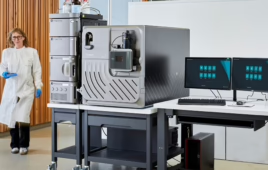
Orbitrap Astral Zoom mass spectrometer
Seer and Precision Health Research, Singapore (PRECISE) are teaming up to run deep, unbiased plasma proteomics on 10,000 samples from the PRECISE-SG100K cohort, using Seer’s Proteograph Product Suite paired with Thermo Fisher Scientific’s Orbitrap Astral Zoom mass spectrometer. Thermo Fisher issued a parallel announcement framing the work as a strategic collaboration combining its Olink Proximity Extension Assay platforms with Orbitrap Astral mass spectrometry, with Novogene providing sample processing and data generation services.
The 10,000-sample mass spectrometry layer sits alongside a previously announced effort using Standard BioTools’ SomaScan 11K assay across 100,000 PRECISE-SG100K plasma samples, giving the cohort an unusually rich three-platform proteomics setup in a large Asian population and helping fill a gap left by earlier population proteomics studies built largely on European biobanks.
Depth expectations from the Proteograph plus Astral workflow

Seer’s Proteograph Product Suite
Dr. Serafim Batzoglou, chief science and chief data officer at Seer, said the company expects to quantify 6,000 to 8,000 proteins and 70,000 to 90,000 peptides per sample, with cumulative cohort coverage reaching 8,000 to more than 10,000 proteins and well over 120,000 peptides. “This level of depth and throughput at population scale is what the Proteograph was built to deliver, and PRECISE-SG100K is further evidence that we are already there,” he said.
A paired comparison with Olink Reveal
On running Proteograph alongside Olink Reveal on the same samples, Batzoglou said publication plans rest with PRECISE but argued the paired design should highlight strengths of the mass spectrometry approach. “The data consistently demonstrates the depth advantage of the Proteograph,” he said, adding that peptide-level resolution “allows researchers to identify and adjudicate potential epitope artifacts in affinity-based measurements, which is something no affinity platform can do for itself.”
Olink, now part of Thermo Fisher, and Seer are both pursuing large-scale proteomics programs, even as Thermo Fisher also supplies the Orbitrap Astral instrument used in the Seer workflow.
Disease focus areas
Batzoglou said the proteomic dataset is intended to support research in cardiometabolic, ophthalmic, neurologic and other complex diseases, “areas of particular relevance to Asian populations that have historically been underrepresented in large-scale biomarker datasets.” He said the project is meant to support biomarker and drug target discovery as well as predictive risk modeling, and that Proteograph’s peptide-level readout can help connect genetic variation to protein networks and clinical outcomes.
John Chambers, chief scientific officer at PRECISE and lead PI of the PRECISE-SG100K study, framed the Seer addition in similar terms in the announcement, saying that adding deep, unbiased plasma proteomics will help link genomic variation to protein networks and health outcomes in ways “critical to ensuring precision medicine reflects the diversity of Asian populations.”