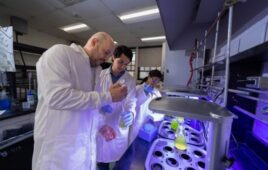
MICREAgent lablets equipped with autonomous electronics will self-assemble to form microscopic chemical reactors as pairs (gemlabs) or exchange information and chemicals on a docking surface. Credit: John McCaskill |

First
place in an European Union competitive call for “unconventional
computing” solutions was awarded to a collaborative proposal coordinated
by Prof. John McCaskill from the RUB Faculty of Chemistry and
Biochemistry. The project, called MICREAgents, has a goal to build
autonomous self-assembling electronic microreagents that are almost as
small as cells. They will exchange chemical and electronic information
to jointly direct complex chemical reactions and analyses in the
solutions they are poured into. This is a form of embedded
computation—“to compute is to construct”—in which, for example, the
output is a particular catalyst or coating needed in the (input) local
chemical environment. The EU has supported the project within the FP7
program with 3.4 million Euros for three years. Four research groups at
RUB will join forces with top teams across Europe, from Israel and New
Zealand.
Self-assembling electronic agents
In
order to create this programmable microscale electronic chemistry,
MICREAgents (Microscopic Chemically Reactive Electronic Agents) will
contain electronic circuits on 3D microchips, called lablets. The
lablets have a diameter of less than 100 µm and self-assemble in pairs
or like dominos to enclose transient reaction compartments. They can
selectively concentrate, process, and release chemicals into the
surrounding solution, under local electronic control, in a similar way
to which the genetic information in cells controls local chemical
processes. The reversible pairwise association allows the lablets to
transfer information from one to another.
Translating electronic signals into chemical processes
The
lablet devices will integrate transistors, supercapacitors, energy
transducers, sensors and actuators, and will translate electronic
signals into constructive chemical processing as well as record the
results of this processing. Instead of making chemical reactors to
contain chemicals, the smart MICREAgents will be poured into chemical
mixtures, to organize the chemistry from within. Ultimately, such
microreactors, like cells in the bloodstream, will open up the
possibility of controlling complex chemistry from the inside out.
Computation intertwined with construction
The
self-assembling smart micro reactors can be programmed for molecular
amplification and other chemical processing pathways that start from
complex mixtures, concentrate and purify chemicals, perform reactions in
programmed cascades, sense reaction completion, and transport and
release products to defined locations. MICREAgents represent a novel
form of computation intertwined with construction. By embracing
self-assembly and evolution, they are a step towards a robust and
evolvable realization of John von Neumann’s universal construction
machine vision. Although these nanoscale structures will soon be
sufficiently complex to allow self-replication of their chemical and
electronic information, they will not present a proliferative threat to
the environment, because they depend for their function on the
electronic circuit layer that is fabricated as part of their substrate.
RUB collaborators
For
the project, Prof. Dr. John S. McCaskill (Microsystems Chemistry and
Biological Information Technology) collaborates with Prof. Dr. Günter
von Kiedrowski (Bioorganic Chemistry), Prof. Dr. Jürgen Oehm (Analog
Integrated Circuits) and Dr. Pierre Mayr (Integrated Digital Circuits).
McCaskill’s and von Kiedrowski’s labs at RUB have already joined forces
in previous European Projects forging a path towards artificial cells.
The ECCell project, for example, that finished in February this year,
has laid the foundation for an electronic chemical cell. There, the
electronics and microfluidics were exterior to the chemistry: in
MICREAgents this is being turned inside out.
Source: Ruhr University Bochum