Research & Development World

  • R&D World Home
  • Topics
    • Aerospace
    • Automotive
    • Biotech
    • Careers
    • Chemistry
    • Environment
    • Energy
    • Life Science
    • Material Science
    • R&D Management
    • Physics
  • Technology
    • 3D Printing
    • A.I./Robotics
    • Software
    • Battery Technology
    • Controlled Environments
      • Cleanrooms
      • Graphene
      • Lasers
      • Regulations/Standards
      • Sensors
    • Imaging
    • Nanotechnology
    • Scientific Computing
      • Big Data
      • HPC/Supercomputing
      • Informatics
      • Security
    • Semiconductors
  • R&D Market Pulse
  • R&D 100
    • 2025 R&D 100 Award Winners
    • 2025 Professional Award Winners
    • 2025 Special Recognition Winners
    • R&D 100 Awards Event
    • R&D 100 Submissions
    • Winner Archive
  • Resources
    • Research Reports
    • Digital Issues
    • Educational Assets
    • R&D Index
    • Subscribe
    • Video
    • Webinars
    • Content submission guidelines for R&D World
  • Global Funding Forecast
  • Top Labs
  • Advertise
  • SUBSCRIBE

Silicon Radiation Damage Revealed in Pulsed-Ion Beam Experiments

By Lawrence Livermore National Laboratory | January 25, 2017

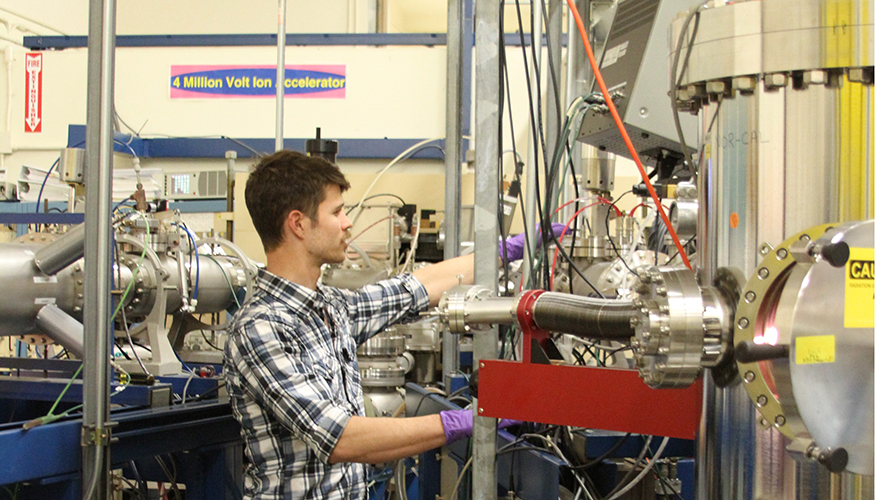
Lawrence Livermore scientist Joseph Wallace adjusts the microbeam aperture on the Rutherford backscattering spectrometry system, which is used to characterize radiation damage as a function of depth in the samples.

Materials scientists at Lawrence Livermore National Laboratory (LLNL) have used a novel pulsed-ion-beam method to identify mechanisms of radiation defect formation in silicon.

The research could have implications for improvements in modern electronics performance.

Understanding radiation defects in crystals has been a major materials physics challenge for decades. Stable defect formation often involves dynamic processes of migration and interaction of point defects generated by energetic particles. The exact pathways of defect formation, however, have remained elusive, and most current predictions of radiation damage are essentially empirical fits to experimental data. This applies even to the best studied and arguably simplest material, crystalline silicon, which is the backbone of modern electronics. Until recently, scientists lacked experimental methods that could directly probe the dynamics of defect creation and annealing.

In an article published in the Jan. 6 edition of Scientific Reports, the team from LLNL and Texas A&M University used a novel experimental method to study thermally activated defect interaction processes in silicon. The method exploits pulsed, rather than continuous, ion beams capable of probing defect interaction dynamics. By measuring temperature dependencies of the dynamic annealing rate of defects, the team found two distinct regimes of defect interaction, at temperatures above and below 60 degrees Celsius, respectively.

The rate theory modeling, benchmarked against pulsed-beam data, pointed to a crucial role of both vacancy and interstitial diffusion, with the defect production rate limited by the migration and interaction of vacancies.

“Direct measurements of the activation energies of the dominant dynamic annealing processes is key to understanding the formation of stable radiation damage in materials,” says LLNL scientist Joseph Wallace, the lead author of the paper.

“This work provides a blueprint for future pulsed-beam studies of radiation defect dynamics in other technologically relevant materials,” says Sergei Kucheyev, the LLNL project lead.

This research was funded by the Nuclear Energy Enabling Technologies (link is external) (NEET) Program of the Department of Energy, Office of Nuclear Energy. The other researchers contributing to this work are L. Bimo Bayu Aji, Swanee Shin, and Alden Martin from LLNL, and Lin Shao from Texas A&M University.

Source: Lawrence Livermore National Laboratory

Related Articles Read More >

This pocket-sized “laboratory” can detect food allergens in minutes
Machine learning model predicts binding of molecules used for bioimaging
FDA approves first non-drug depression treatment
These R&D 100 Finalists are improving pharmaceutical research with their award-winning CyroProbe
rd newsletter
EXPAND YOUR KNOWLEDGE AND STAY CONNECTED
Get the latest info on technologies, trends, and strategies in Research & Development.
RD 25 Power Index

R&D World Digital Issues

Fall 2025 issue

Browse the most current issue of R&D World and back issues in an easy to use high quality format. Clip, share and download with the leading R&D magazine today.

R&D 100 Awards
Research & Development World
  • Subscribe to R&D World Magazine
  • Sign up for R&D World’s newsletter
  • Contact Us
  • About Us
  • Drug Discovery & Development
  • Pharmaceutical Processing
  • Global Funding Forecast

Copyright © 2026 WTWH Media LLC. All Rights Reserved. The material on this site may not be reproduced, distributed, transmitted, cached or otherwise used, except with the prior written permission of WTWH Media
Privacy Policy | Advertising | About Us

Search R&D World

  • R&D World Home
  • Topics
    • Aerospace
    • Automotive
    • Biotech
    • Careers
    • Chemistry
    • Environment
    • Energy
    • Life Science
    • Material Science
    • R&D Management
    • Physics
  • Technology
    • 3D Printing
    • A.I./Robotics
    • Software
    • Battery Technology
    • Controlled Environments
      • Cleanrooms
      • Graphene
      • Lasers
      • Regulations/Standards
      • Sensors
    • Imaging
    • Nanotechnology
    • Scientific Computing
      • Big Data
      • HPC/Supercomputing
      • Informatics
      • Security
    • Semiconductors
  • R&D Market Pulse
  • R&D 100
    • 2025 R&D 100 Award Winners
    • 2025 Professional Award Winners
    • 2025 Special Recognition Winners
    • R&D 100 Awards Event
    • R&D 100 Submissions
    • Winner Archive
  • Resources
    • Research Reports
    • Digital Issues
    • Educational Assets
    • R&D Index
    • Subscribe
    • Video
    • Webinars
    • Content submission guidelines for R&D World
  • Global Funding Forecast
  • Top Labs
  • Advertise
  • SUBSCRIBE