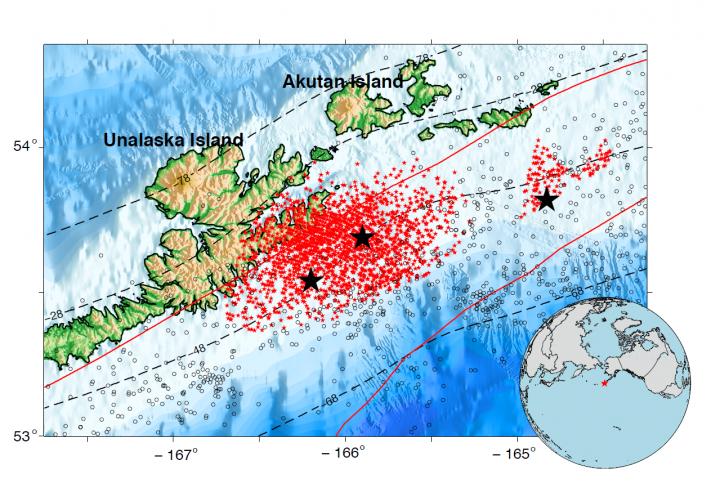
Image shows tremor sources and low frequency earthquake distribution in the study region and historic large earthquakes in the Alaska-Aleutian subduction zone. Each red star represents the location of 1 min tremor signal determined by the beam back projection method, and the black stars show three visually detected low frequency earthquakes located using arrival times of body waves. Source: Ghosh lab, UC Riverside.
Seismologists at the University of California, Riverside studying earthquakes in the seismically and volcanically active Alaska-Aleutian subduction zone have found that “slow earthquakes” are occurring continuously, and could encourage damaging earthquakes.
Slow earthquakes are quiet, can be as large as magnitude 7, and last days to years. Taking place mainly at the boundary between tectonic plates, they happen so slowly that people don’t feel them. A large slow earthquake is typically associated with abundant seismic tremor–a continuous weak seismic chatter–and low frequency (small and repeating) earthquakes.
“In the Alaska-Aleutian subduction zone, we found seismic tremor, and visually identified three low frequency earthquakes,” said Abhijit Ghosh, an assistant professor of Earth sciences, who led the research published recently in Geophysical Research Letters. “Using them as templates, we detected nearly 1,300 additional low frequency earthquakes. Slow earthquakes may play an important role in the earthquake cycles in this subduction zone.”
The Alaska-Aleutian subduction zone, which stretches from the Gulf of Alaska to the Kamchatka Peninsula in the Russian Far East, is one of the most active plate boundaries in the world. It is 3800 km long and forms the plate boundary between the Pacific and North American plates. In the last 80 years, four massive earthquakes (greater than magnitude 8) have occurred here.
Ghosh explained that tectonic tremor–which causes a weak vibration of the ground–and low frequency earthquakes are poorly studied in the Alaska-Aleutian subduction zone due to limited data availability, difficult logistics, and rugged terrain.
But using two months of high-quality continuous seismic data recorded from early July-September 2012 at 11 stations in the Akutan Island, Ghosh and his graduate student, Bo Li, detected near-continuous tremor activity with an average of 1.3?hours of tectonic tremor per day using a “beam back projection” method–an innovative array-based method Ghosh developed to automatically detect and locate seismic tremor. Using the seismic arrays the method continuously scans the subsurface for any seismic activity. Just like a radar antenna, it determines from which direction the seismic signal originates and uses that information to locate it. Practically, it can track slow earthquakes minute-by-minute.
Ghosh and Li found that tremor sources were clustered in two patches with a nearly 25?km gap in between them, possibly indicating that frictional properties determining earthquake activities change laterally along this area. Ghosh explained that this gap impacts the region’s overall stress pattern and can affect earthquake activity nearby.
“In addition, slow earthquakes seem to have ‘sweet spots’ along the subduction fault that produces majority of the tremor activity,” he said. “We found that the western patch has a larger depth range and shows higher tremor source propagation velocities. More frequent tremor events and low frequency earthquakes in the western patch may be a result of higher fluid activity in the region and indicate a higher seismic slip rate than the eastern region.”
Ghosh, Li, and their collaborators in multiple institutions in the United States have taken the next step by installing three additional seismic arrays in a nearby island to simultaneously image the subduction fault and volcanic system.
“This ambitious experiment will provide new insights into the seismic activity and subduction processes in this region,” Ghosh said.