Research & Development World

  • R&D World Home
  • Topics
    • Aerospace
    • Automotive
    • Biotech
    • Careers
    • Chemistry
    • Environment
    • Energy
    • Life Science
    • Material Science
    • R&D Management
    • Physics
  • Technology
    • 3D Printing
    • A.I./Robotics
    • Software
    • Battery Technology
    • Controlled Environments
      • Cleanrooms
      • Graphene
      • Lasers
      • Regulations/Standards
      • Sensors
    • Imaging
    • Nanotechnology
    • Scientific Computing
      • Big Data
      • HPC/Supercomputing
      • Informatics
      • Security
    • Semiconductors
  • R&D Market Pulse
  • R&D 100
    • 2025 R&D 100 Award Winners
    • 2025 Professional Award Winners
    • 2025 Special Recognition Winners
    • R&D 100 Awards Event
    • R&D 100 Submissions
    • Winner Archive
  • Resources
    • Research Reports
    • Digital Issues
    • Educational Assets
    • Subscribe
    • Video
    • Webinars
    • Content submission guidelines for R&D World
  • Global Funding Forecast
  • Top Labs
  • Advertise
  • SUBSCRIBE

Solar Cells Improved by Slow, Hot Electrons

By University of Groningen | January 16, 2018

Photons with energy higher than the “band gap” of the semiconductor absorbing them give rise to what are known as hot electrons. The extra energy in respect to the band gap is lost very fast, as it is converted into heat so it does not contribute to the voltage. University of Groningen Professor of Photophysics and Optoelectronics Maria Antonietta Loi has now found a material in which these hot electrons retain their high energy levels for much longer. This might make it possible to use more of their energy to obtain a higher voltage. Her results were published in Nature Communications.

The efficiency of solar panels is hampered by a Goldilocks problem: photons need to have just the right amount of energy to be converted into free electrons, which contribute to the voltage. Too little energy, and the photons pass right through the solar panel. Too much, and the excess energy disappears as heat.

The latter is due to the creation of hot (high-energy) electrons. Before they can be extracted from the solar cells, these hot electrons first give off their excess energy by causing vibrations in the crystalline material of the solar panel. “This energy loss puts a limit to the maximum efficiency of solar cells,” explains Loi.

She is working on a special type of solar cell that is made of organic-inorganic hybrid perovskites. Perovskites are named after a mineral that has the chemical formula ABX3. In the X position, anions form an octahedron, while in the A position cations form a cube around them, while a central cation takes the B position. Many materials in the perovskite family adopt this crystal structure. Hybrid perovskites contain organic cations in the A position.
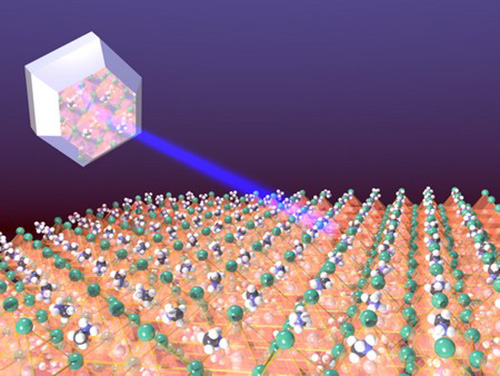
Laserlight exciting the hybrid perovskite. Image: Illustration by Arjen Kamp

Most hybrid-perovskite solar cells contain lead, which is toxic. Loi’s group recently published a paper describing a record-breaking nine-percent efficiency in a hybrid-perovskite solar cell containing harmless tin instead of lead. “When we studied this material further, we observed something strange,” she continues. The results could only mean that the hot electrons produced in the tin-based solar cells took about a thousand times longer than usual to dissipate their excess energy.

“The hot electrons gave off their energy after several nanoseconds instead of some hundred femtoseconds. Finding such long-lived hot electrons is what everybody in this field is hoping for,” says Loi. Their longer lifespan makes it possible to harvest these electrons’ energy before it turns into heat. “This means we could harvest electrons with a higher energy and thus create a higher voltage in the solar cell.” Theoretical calculations show that by harvesting the hot electrons, the maximum efficiency for hybrid-perovskite solar cells could increase from 33 to 66 percent.

The next step is to find out why the tin-based hybrid perovskite slows down the decay of hot electrons. Then new perovskite materials could be designed with even slower hot electrons. “These tin-based perovskites could be a game changer, and could ultimately make a big contribution to providing clean and sustainable energy in the future.”

Source: University of Groningen
Related Articles Read More >

DOE announces first selections for nuclear energy DOME program
Five key trends that defined the show floor at Interphex 2026 
NANO Nuclear could have a reactor on the Moon by 2030 CEO says
DOE to award $100 million in grants amid science funding cuts
rd newsletter
EXPAND YOUR KNOWLEDGE AND STAY CONNECTED
Get the latest info on technologies, trends, and strategies in Research & Development.

R&D World Digital Issues

Fall 2025 issue

Browse the most current issue of R&D World and back issues in an easy to use high quality format. Clip, share and download with the leading R&D magazine today.

R&D 100 Awards
Research & Development World
  • Subscribe to R&D World Magazine
  • Sign up for R&D World’s newsletter
  • Contact Us
  • About Us
  • Drug Discovery & Development
  • Pharmaceutical Processing
  • Global Funding Forecast

Copyright © 2026 WTWH Media LLC. All Rights Reserved. The material on this site may not be reproduced, distributed, transmitted, cached or otherwise used, except with the prior written permission of WTWH Media
Privacy Policy | Advertising | About Us

Search R&D World

  • R&D World Home
  • Topics
    • Aerospace
    • Automotive
    • Biotech
    • Careers
    • Chemistry
    • Environment
    • Energy
    • Life Science
    • Material Science
    • R&D Management
    • Physics
  • Technology
    • 3D Printing
    • A.I./Robotics
    • Software
    • Battery Technology
    • Controlled Environments
      • Cleanrooms
      • Graphene
      • Lasers
      • Regulations/Standards
      • Sensors
    • Imaging
    • Nanotechnology
    • Scientific Computing
      • Big Data
      • HPC/Supercomputing
      • Informatics
      • Security
    • Semiconductors
  • R&D Market Pulse
  • R&D 100
    • 2025 R&D 100 Award Winners
    • 2025 Professional Award Winners
    • 2025 Special Recognition Winners
    • R&D 100 Awards Event
    • R&D 100 Submissions
    • Winner Archive
  • Resources
    • Research Reports
    • Digital Issues
    • Educational Assets
    • Subscribe
    • Video
    • Webinars
    • Content submission guidelines for R&D World
  • Global Funding Forecast
  • Top Labs
  • Advertise
  • SUBSCRIBE