Research & Development World

  • R&D World Home
  • Topics
    • Aerospace
    • Automotive
    • Biotech
    • Careers
    • Chemistry
    • Environment
    • Energy
    • Life Science
    • Material Science
    • R&D Management
    • Physics
  • Technology
    • 3D Printing
    • A.I./Robotics
    • Software
    • Battery Technology
    • Controlled Environments
      • Cleanrooms
      • Graphene
      • Lasers
      • Regulations/Standards
      • Sensors
    • Imaging
    • Nanotechnology
    • Scientific Computing
      • Big Data
      • HPC/Supercomputing
      • Informatics
      • Security
    • Semiconductors
  • R&D Market Pulse
  • R&D 100
    • 2025 R&D 100 Award Winners
    • 2025 Professional Award Winners
    • 2025 Special Recognition Winners
    • R&D 100 Awards Event
    • R&D 100 Submissions
    • Winner Archive
  • Resources
    • Research Reports
    • Digital Issues
    • Educational Assets
    • R&D Index
    • Subscribe
    • Video
    • Webinars
    • Content submission guidelines for R&D World
  • Global Funding Forecast
  • Top Labs
  • Advertise
  • SUBSCRIBE

Sound on a Silicon Chip Can Amplify Light

By Jim Shelton, Yale University | June 14, 2016

Yale scientists have found a way to greatly boost the intensity of light waves on a silicon microchip using the power of sound.

Writing in the journal Nature Photonics, a team led by Peter Rakich describes a new waveguide system that harnesses the ability to precisely control the interaction of light and sound waves. This work solves a long-standing problem of how to utilize this interaction in a robust manner on a silicon chip as the basis for powerful new signal-processing technologies.

The prevalence of silicon chips in today’s technology makes the new system particularly advantageous, the researchers note. “Silicon is the basis for practically all microchip technologies,” said Rakich, who is an assistant professor of applied physics and physics at Yale. “The ability to combine both light and sound in silicon permits us to control and process information in new ways that weren’t otherwise possible.”

Rakich said combining the two capabilities “is like giving a UPS driver an amphibious vehicle — you can find a much more efficient route for delivery when traveling by land or water.”

These opportunities have motivated numerous groups around the world to explore such hybrid technologies on a silicon chip. However, progress was stifled because those devices weren’t efficient enough for practical applications. The Yale group lifted this roadblock using new device designs that prevent light and sound from escaping the circuits.
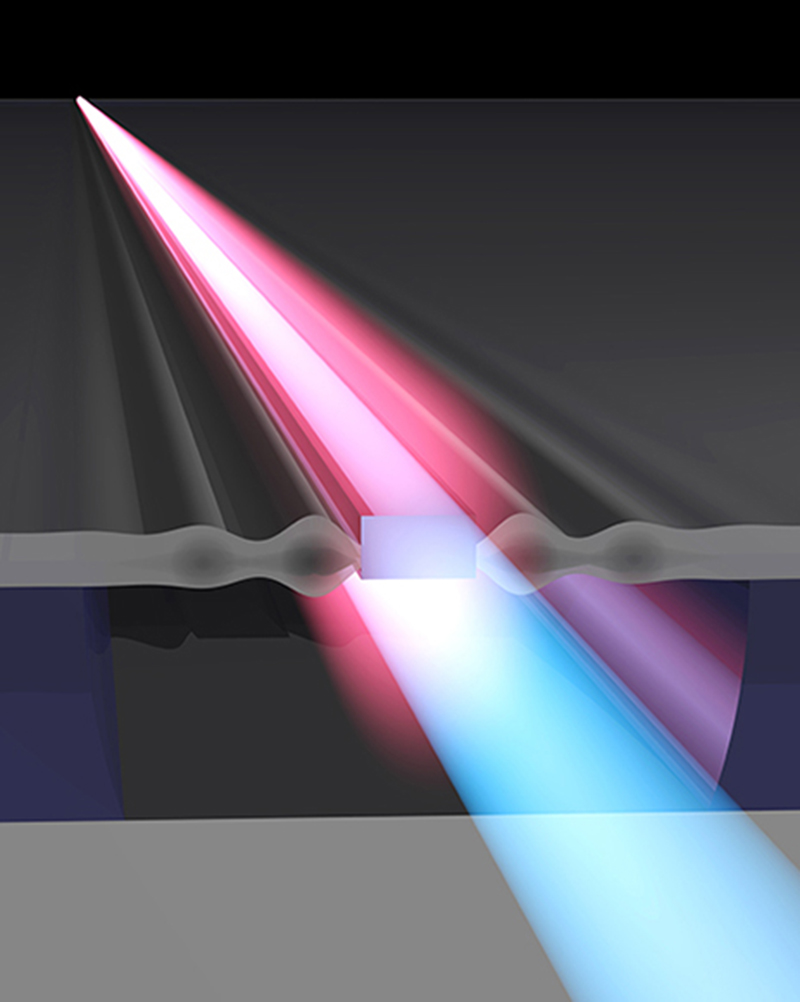
“Figuring out how to shape this interaction without losing amplification was the real challenge,” said Eric Kittlaus, a graduate student in Rakich’s lab and the study’s first author. “With precise control over the light-sound interaction, we will be able to create devices with immediate practical uses, including new types of lasers.”

The researchers said there are commercial applications for the technology in a number of areas, including fiber-optic communications and signal processing. The system is part of a larger body of research the Rakich lab has conducted for the past five years, focused on designing new microchip technologies for light.

Heedeuk Shin, a former member of the Rakich lab who is now a professor at the Pohang University of Science and Technology in Korea, is the study’s other co-author. “We’re glad to help advance these new technologies, and are very excited to see what the future holds,” Shin said.

The work was supported by the MesoDynamic Architectures program at the U.S. Department of Defense’s Defense Advanced Research Projects Agency (DARPA).

Source: Yale University

Related Articles Read More >

CEA-Leti achieves 400°C CMOS fabrication milestone for 3D chip stacking
Materials driving the next phase in semiconductor performance
NVIDIA becomes major Intel CPU buyer in $5B collaboration
TOKYO, JAPAN - OCTOBER 2, 2016: Detail from Apple shop in Tokyo, Japan. Apple is American multinational corporation founded at 1976 at Cupertino, California.
iPhone 17 Pro, rumored to add vapor-chamber cooling and a 48MP telephoto, is tracking a September launch
rd newsletter
EXPAND YOUR KNOWLEDGE AND STAY CONNECTED
Get the latest info on technologies, trends, and strategies in Research & Development.
RD 25 Power Index

R&D World Digital Issues

Fall 2025 issue

Browse the most current issue of R&D World and back issues in an easy to use high quality format. Clip, share and download with the leading R&D magazine today.

Research & Development World
  • Subscribe to R&D World Magazine
  • Sign up for R&D World’s newsletter
  • Contact Us
  • About Us
  • Drug Discovery & Development
  • Pharmaceutical Processing
  • Global Funding Forecast

Copyright © 2025 WTWH Media LLC. All Rights Reserved. The material on this site may not be reproduced, distributed, transmitted, cached or otherwise used, except with the prior written permission of WTWH Media
Privacy Policy | Advertising | About Us

Search R&D World

  • R&D World Home
  • Topics
    • Aerospace
    • Automotive
    • Biotech
    • Careers
    • Chemistry
    • Environment
    • Energy
    • Life Science
    • Material Science
    • R&D Management
    • Physics
  • Technology
    • 3D Printing
    • A.I./Robotics
    • Software
    • Battery Technology
    • Controlled Environments
      • Cleanrooms
      • Graphene
      • Lasers
      • Regulations/Standards
      • Sensors
    • Imaging
    • Nanotechnology
    • Scientific Computing
      • Big Data
      • HPC/Supercomputing
      • Informatics
      • Security
    • Semiconductors
  • R&D Market Pulse
  • R&D 100
    • 2025 R&D 100 Award Winners
    • 2025 Professional Award Winners
    • 2025 Special Recognition Winners
    • R&D 100 Awards Event
    • R&D 100 Submissions
    • Winner Archive
  • Resources
    • Research Reports
    • Digital Issues
    • Educational Assets
    • R&D Index
    • Subscribe
    • Video
    • Webinars
    • Content submission guidelines for R&D World
  • Global Funding Forecast
  • Top Labs
  • Advertise
  • SUBSCRIBE