Astronomers using the Atacama Large Millimeter/submillimeter Array (ALMA) have revealed that comet 3I/ATLAS is packed with an unusually large amount of the organic molecule methanol.
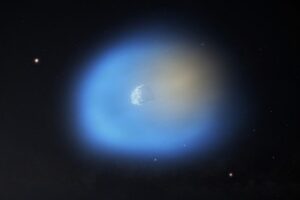
An artist’s impression of 3I/ATLAS is shown as it passes near the Sun, illuminating one side of the comet. On the side of the comet closer to the sun, the methanol gas is shown in blue, with icy dust grains still present in the gas. On the dark side of the comet, the hydrogen cyanide is shown in orange. Credit: NSF/AUI/NSF NRAO/M.Weiss
“Observing 3I/ATLAS is like taking a fingerprint from another solar system,” shares Nathan Roth, lead author on this research, and a professor with American University, “The details reveal what it’s made of, and it’s bursting with methanol in a way we just don’t usually see in comets in our own solar system.”
Molecular analysis reveals CH3OH and HCN
The team focused on the faint submillimeter fingerprints of two molecules: methanol (CH3OH) and hydrogen cyanide (HCN), a nitrogen-bearing organic molecule commonly found in comets. The data showed that 3I/ATLAS is heavily enriched in methanol compared to hydrogen cyanide.
On observations, the team measured the methanol to HCN ratio to be between 70 and 120 to one, making 3I/ATLAS one of the most methanol-rich comets ever studied.
Using ALMA’s Atacama Compact Array in Chile, the team observed 3I/ATLAS as it approached the sun. As the comet was warmed by sunlight, it released gas and dust, forming a glowing halo around its core. By analyzing this halo, called a coma, astronomers revealed the chemical fingerprint of 3I/ATLAS, allowing them to study how objects might form in another planetary system. Utilizing the high-sensitivity submillimeter receivers of the ALMA array, researchers were able to resolve the spatial distribution of molecular emission within the coma, distinguishing between parent volatiles and those released via grain sublimation.
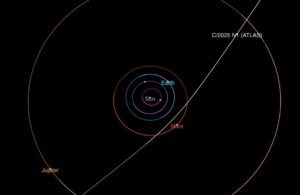
This diagram shows the trajectory of interstellar comet 3I/ATLAS as it passes through the solar system. It will make its closest approach to the Sun in October. Credit: NASA/JPL-Caltech
The measurements suggest that the icy material from 3I/ATLAS was formed by, or experienced, very different conditions than those that shape most comets in our solar system. Previous work with the James Webb Space Telescope has shown that 3I/ATLAS had a coma dominated by carbon dioxide when it was far from the sun. The new results from ALMA add methanol as another unusual member of its chemical inventory.
Thermal dynamics and outgassing
ALMA’s high resolution also allowed the team to see how different molecules move away from the comet, revealing surprising differences between methanol and hydrogen cyanide. Hydrogen cyanide appeared to come directly from the comet’s core, which is typical for comets in our solar system. The methanol appeared to come both from the nucleus of the comet and from the ice particles in the coma. The tiny ice grains act like mini-comets: as the comet moves closer to the sun and ice turns to gas, they also release methanol. Similar behavior has been observed in some solar system comets, but this is the first time the physics of this process, called outgassing, has been traced in an interstellar object.
3I/ATLAS is the third confirmed object ever seen passing through our solar system from interstellar space, after 1I/’Oumuamua and 2I/Borisov. As astronomers continue to discover and study more interstellar objects, our understanding of planet formation in other planetary systems continues to grow more interesting.
Why this matters for planetary science
This chemical characterization provides the first high-fidelity chemical inventory of a planetary system other than our own. While previous interstellar objects remained enigmatic due to a lack of outgassing, 3I/ATLAS’s composition allows researchers to reverse-engineer the thermal and chemical conditions of its formation.
The extreme methanol to HCN ratio, nearly two orders of magnitude higher than local comets, suggests that it formed in an environment with significantly different radiation processing or temperature gradients, likely near the carbon monoxide snowline of a distant protoplanetary disk. The data challenges current universal models of cometary formation and suggests that theories about icy bodies in our solar system may be regional outliers.
From an R&D and technical perspective, this research demonstrates the unprecedented power of submillimeter interferometry to resolve complex molecular dynamics at interstellar distances. By distinguishing between species sublimating directly from the nucleus and those released by drifting ice grains, astronomers have successfully mapped the mass-transfer physics of an extrasolar object in real-time. This level of granular detail is critical fro the development of future intercept missions, such as the ESA’s comet interceptor. Understanding the mechanical and chemical structural integrity of interstellar ice grains informs the sensor requirements and shielding paradoxes for the next generation of deep-space probes.