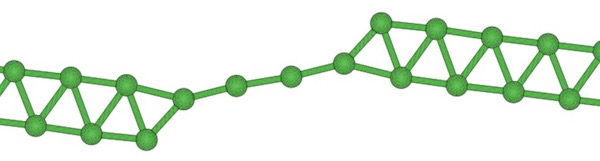
One-dimensional boron, investigated by theoretical physicists at Rice University, could be a unique material that incorporates both a semiconductor (the ribbon portion) and a metallic conductor (the single-atom chain). Because it can transform from one form to the other under stress, the material could form an adjustable Schottky junction. Image: Courtesy of the Yakobson Research Group
Hold on, there, graphene. You might think you’re the most interesting new nanomaterial of the century, but boron might already have you beat, according to scientists at Rice University.
A Rice team that simulated one-dimensional forms of boron — both two-atom-wide ribbons and single-atom chains — found they possess unique properties. The new findings appear in the Journal of the American Chemical Society.
For example, if metallic ribbons of boron are stretched, they morph into antiferromagnetic semiconducting chains, and when released they fold back into ribbons.
The 1D boron materials also have mechanical stiffness on a par with the highest-performing known nanomaterials.
And they can act as nanoscale, constant-force springs.
Experimental labs are making progress in synthesizing atom-thin and fullerene-type boron, which led Rice researcher Boris Yakobson to think 1D boron may eventually become real as well.
Yakobson’s lab creates atom-level computer simulations of materials that do not necessarily exist — yet. Simulating and testing their energetic properties helps guide experimentalists working to create real-world materials. Carbon-atom chains known as carbyne, boron fullerenes and two-dimensional films called borophene, all predicted by the Rice group, have since been created by labs.
“Our work on carbyne and with planar boron got us thinking that a one-dimensional chain of boron atoms is also a possible and intriguing structure,” Yakobson says. “We wanted to know if it is stable and what the properties would be. That’s where modern theoretical-computational methods are impressive, because one can do pretty realistic assessments of non-existing structures.
“Even if they never exist, they’re still important since we’re probing the limits of possibility, sort of the final frontier,” he says.
One-dimensional boron forms two well-defined phases — chains and ribbons — which are linked by a “reversible phase transition,” meaning they can turn from one form to the other and back.
To demonstrate these interesting chemomechanics, the researchers used a computer to “pull” the ends of a simulated boron ribbon with 64 atoms. This forced the atoms to rearrange into a single carbyne-like chain. In their simulation, the researchers left a fragment of the ribbon to serve as a seed, and when they released the tension, the atoms from the chain neatly returned to ribbon form.
“Boron is very different from carbon,” Yakobson says. “It prefers to form a double row of atoms, like a truss used in bridge construction. This appears to be the most stable, lowest-energy state.
“If you pull on it, it starts unfolding; the atoms yield to this monatomic thread. And if you release the force, it folds back,” he says. “That’s quite fun, structurally, and at the same time it changes the electronic properties.
“That makes it an interesting combination: When you stretch it halfway, you may have a portion of ribbon and a portion of chain. Because one of them is metal and the other is a semiconductor, this becomes a one-dimensional, adjustable Schottky junction.” A Schottky junction is a barrier to electrons at a metal-semiconductor junction and is commonly used in diodes that allow current to flow in only one direction.
As a ribbon, boron is “a true 1D metal robust to distortion of its crystalline lattice (a property known as Peierls distortion),” the researchers wrote. That truss-like construct gives the material extraordinary stiffness, a measure of its ability to resist deformation from an applied force.
As a chain of atoms, the material is also a strain-tunable, wide-gap antiferromagnetic semiconductor. In an antiferromagnet, the atomic moments — the direction of the atoms’ “up” or “down” spin states — align in opposite directions. This coupling of magnetic state and electronic transport may be of great interest to researchers studying spintronics, in which spin states may be manipulated to create high-performance electronic devices. “It may be very useful because instead of charge transport, you can have spin transport. That’s considered an important direction for devices that make use of spintronics,” he said.
One-dimensional boron’s springiness is also interesting, Yakobson says. “It’s also a special spring, a constant-force spring,” he said. “The more you stretch a mechanical spring, the more the force goes up. But in the case of 1D boron, the same force is required until the spring becomes fully stretched. If you keep pulling, it will break. But if you release the force, it completely folds back into a ribbon. It’s a mechanically nice structure.” That property could be useful in nanoscale sensors to gauge very small forces, he said.
Rice alumna Mingjie Liu, now a research associate at Brookhaven National Laboratory, is lead author of the paper. Vasilii Artyukhov, also a Rice alumnus and now a research scientist at Quantlab Financial, is co-author. Yakobson is the Karl F. Hasselmann Professor of Materials Science and NanoEngineering and a professor of chemistry.
The Office of Naval Research and the Robert Welch Foundation supported the research. Calculations were performed on Rice’s National Science Foundation-supported DAVinCI supercomputer, which was administered by Rice’s Center for Research Computing and procured in partnership with the Ken Kennedy Institute for Information Technology.
Source: Rice University