Research & Development World

  • R&D World Home
  • Topics
    • Aerospace
    • Automotive
    • Biotech
    • Careers
    • Chemistry
    • Environment
    • Energy
    • Life Science
    • Material Science
    • R&D Management
    • Physics
  • Technology
    • 3D Printing
    • A.I./Robotics
    • Software
    • Battery Technology
    • Controlled Environments
      • Cleanrooms
      • Graphene
      • Lasers
      • Regulations/Standards
      • Sensors
    • Imaging
    • Nanotechnology
    • Scientific Computing
      • Big Data
      • HPC/Supercomputing
      • Informatics
      • Security
    • Semiconductors
  • R&D Market Pulse
  • R&D 100
    • 2025 R&D 100 Award Winners
    • 2025 Professional Award Winners
    • 2025 Special Recognition Winners
    • R&D 100 Awards Event
    • R&D 100 Submissions
    • Winner Archive
  • Resources
    • Research Reports
    • Digital Issues
    • Educational Assets
    • Subscribe
    • Video
    • Webinars
    • Content submission guidelines for R&D World
  • Global Funding Forecast
  • Top Labs
  • Advertise
  • SUBSCRIBE

Study Reveals Small Group of Cells Within a Plant Embryo Operate in Similar Way to the Human Brain

By University of Birmingham | June 5, 2017

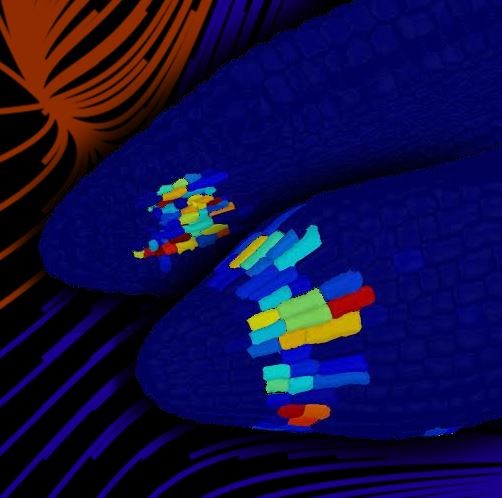
3D digital reconstructions of plant embryos where the components that make the decision in these are located. Credit: University of Birmingham

A plant’s decision about when to germinate is one of the most important it will make during its life. Too soon, and the plant may be damaged by harsh winter conditions; too late, and it may be outcompeted by other, more precocious plants.

In a study published today in Proceedings of the National Academy of Sciences (PNAS), scientists from the University of Birmingham have shown that this trade-off between speed and accuracy is controlled by a small group of cells within the plant embryo that operate in similar way to the human brain.

The scientists showed that the ‘decision-making centre’ in a plant called Arabidopsis, or thale cress, contains two types of cell – one that promotes seed dormancy, and one that promotes germination. These two groups of cells communicate with each other by moving hormones, an analogous mechanism to that employed by our own brains when we decide whether or not to move.

The scientists used mathematical modelling to show that communication between the separated elements controls the plant’s sensitivity to its environment. Following this theory, they used a mutant plant where cells were more chemically linked – essentially enhancing communication between circuit elements – to show that germination timing depends on these intra-region signals.

Lead author of the study, Professor George Bassel from the School of Biosciences at the University of Birmingham, said: “Our work reveals a crucial separation between the components within a plant decision-making centre.

“In the human brain, this separation is thought to introduce a time delay, smoothing out noisy signals from the environment and increasing the accuracy with which we make decisions.

“The separation of these parts in the seed ‘brain’ also appears to be central to how it functions.”

Dr Iain Johnston, a University of Birmingham bio-mathematician involved in the study, added: “The separation of circuit elements allows a wider palette of responses to environmental stimuli.

“It’s like the difference between reading one critic’s review of a film four times over, or amalgamating four different critics’ views before deciding to go to the cinema.”

The mathematical theory describing the brain’s function predicted that more seeds would germinate when exposed to varying environments – such as fluctuating temperatures – than constant environments, such as constant temperatures. The scientists tested this theory in the lab and found exactly this behaviour.

“Our work has important implications for understanding how crops and weeds grow,” added Professor Bassel.

“There is now potential to apply this knowledge to commercial plants in order to enhance and synchronise germination, increasing crop yields and decreasing herbicide use.”

Related Articles Read More >

Trump administration to dismantle ocean observatories that provide data freely to researchers
Atmospheric carbon dioxide hits record 431 ppm as Mauna Loa Observatory faces funding cuts
Microplastics may contribute to global warming new research indicates
Researchers use CRISPR to engineer plastic eating microbe
rd newsletter
EXPAND YOUR KNOWLEDGE AND STAY CONNECTED
Get the latest info on technologies, trends, and strategies in Research & Development.

R&D World Digital Issues

Fall 2025 issue

Browse the most current issue of R&D World and back issues in an easy to use high quality format. Clip, share and download with the leading R&D magazine today.

R&D 100 Awards
Research & Development World
  • Subscribe to R&D World Magazine
  • Sign up for R&D World’s newsletter
  • Contact Us
  • About Us
  • Drug Discovery & Development
  • Pharmaceutical Processing
  • Global Funding Forecast

Copyright © 2026 WTWH Media LLC. All Rights Reserved. The material on this site may not be reproduced, distributed, transmitted, cached or otherwise used, except with the prior written permission of WTWH Media
Privacy Policy | Advertising | About Us

Search R&D World

  • R&D World Home
  • Topics
    • Aerospace
    • Automotive
    • Biotech
    • Careers
    • Chemistry
    • Environment
    • Energy
    • Life Science
    • Material Science
    • R&D Management
    • Physics
  • Technology
    • 3D Printing
    • A.I./Robotics
    • Software
    • Battery Technology
    • Controlled Environments
      • Cleanrooms
      • Graphene
      • Lasers
      • Regulations/Standards
      • Sensors
    • Imaging
    • Nanotechnology
    • Scientific Computing
      • Big Data
      • HPC/Supercomputing
      • Informatics
      • Security
    • Semiconductors
  • R&D Market Pulse
  • R&D 100
    • 2025 R&D 100 Award Winners
    • 2025 Professional Award Winners
    • 2025 Special Recognition Winners
    • R&D 100 Awards Event
    • R&D 100 Submissions
    • Winner Archive
  • Resources
    • Research Reports
    • Digital Issues
    • Educational Assets
    • Subscribe
    • Video
    • Webinars
    • Content submission guidelines for R&D World
  • Global Funding Forecast
  • Top Labs
  • Advertise
  • SUBSCRIBE