A research team at the University of Rochester’s Institute of Optics has developed aluminum tubes that will not sink, even when damaged, using a technique learned from observing spiders. Their work was published in Advanced Functional Materials.
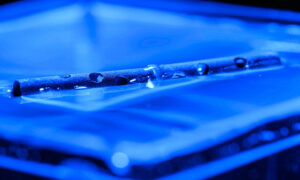
Credit: University of Rochester photo / J. Adam Fenster
The team created buoyancy by chemically etching micro- and nanoscale pits into the aluminum tubes to capture air, similar to how diving bell spiders trap air bubbles to stay buoyant. These spiders have fine hairs that trap air bubbles against their skin, allowing them to live almost entirely underwater.
The metal tubes mimic this method, trapping small air bubbles and creating a superhydrophobic surface. Surface tension prevents the water from entering the tube, so the air stays inside and the tube floats. The tubes also feature an internal divider that helps trap the air in a confined chamber, so even if the tubes are pushed vertically into the water, they retain their buoyancy. The team tested the tubes in rough conditions and punctured them, finding that their buoyancy did not degrade.
Creating superhydrophobicity
In order to etch the pits, the tubes were immersed in a 5% copper chloride solution for 15 minutes. During etching, ultrasonic agitation was used to remove copper particles that accumulated on the tube surfaces. Then, the tubes were rinsed with deionized water and cleaned ultrasonically with ethanol.
After etching, a second step made the surface superhydrophobic. The team immersed the etched tubes in a stearic acid solution for 10 minutes, rinsed them and baked them at 60 °C for 30 minutes. For more durable applications, the stearic acid treatment was replaced with PDMS, which was maintained at 300 °C for 30 minutes to evaporate onto the surface.
The tubes could be linked to create rafts or ships, potentially making it possible to create boats that stay afloat even with water in their hulls. The team also demonstrated that rafts made of the tubes could harvest waves to generate electricity.
The tubes were tested at several sizes, up to about half a meter in length, but Chunlei Guo, a professor of optics and physics at the University of Rochester and a senior scientist at its Laboratory for Laser Energetics, who led the research team, said the method could be easily scaled up.
Guo’s team first demonstrated superhydrophobic floating devices in 2019, with two parallel metallic superhydrophobic plates. However, at extreme angles, the plates tipped, and the air escaped. Placing a divider in the center of the tubes solved this problem.
The project was supported by the National Science Foundation, the Bill & Melinda Gates Foundation and the University of Rochester’s Goergen Institute for Data Science and Artificial Intelligence.