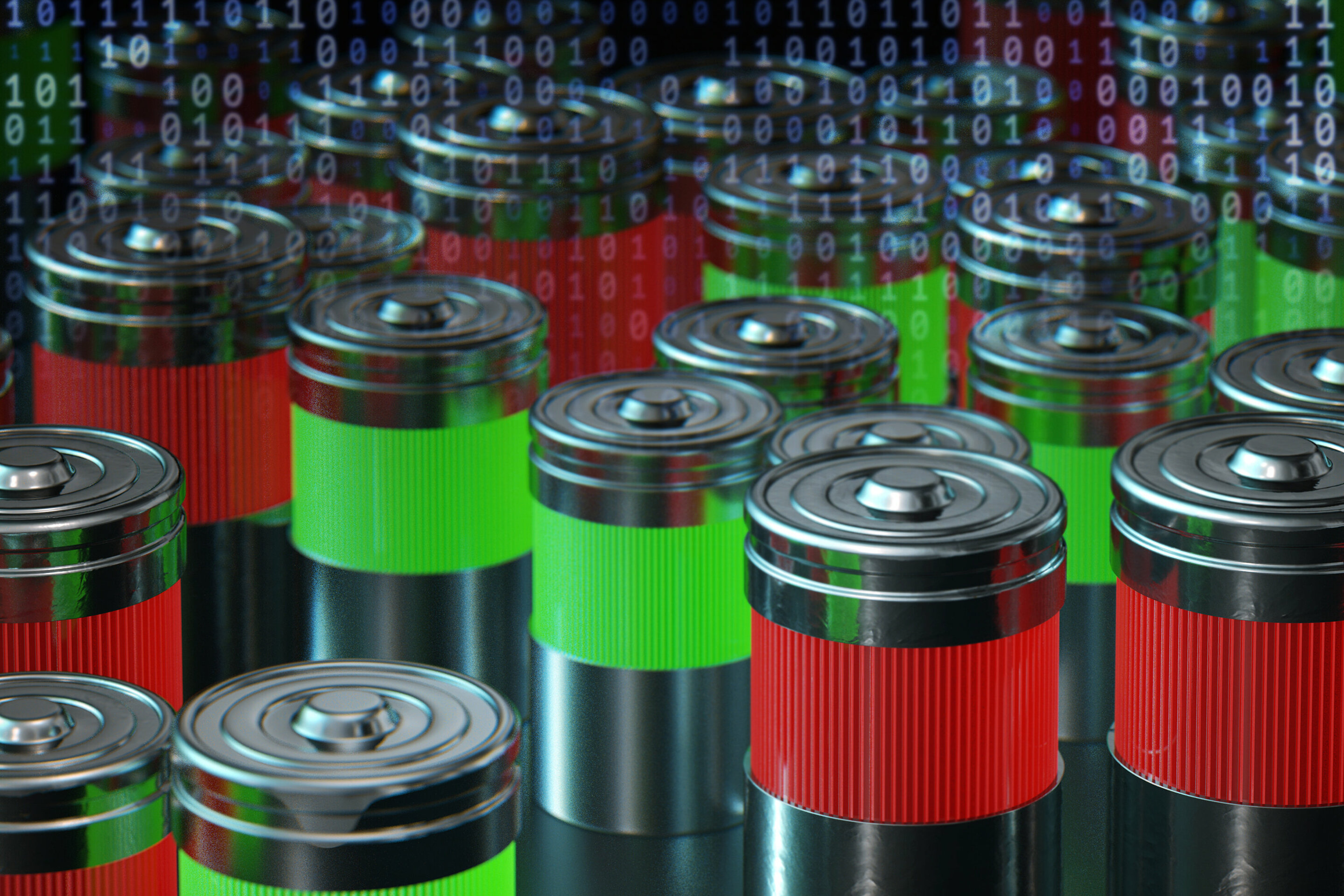
New batteries can be sorted by predicted cycle life accurately with new technique based on five test charge/discharge cycles. Credit: Younghee Lee/CUBE3D Graphic
If manufacturers of cell-phone batteries could tell which cells will last at least two years, then they could sell only those to phone makers and send the rest to makers of less demanding devices. New research shows how manufacturers could do this. The technique could be used not only to sort manufactured cells but to help new battery designs reach the market more quickly.
Combining comprehensive experimental data and artificial intelligence revealed the key for accurately predicting the useful life of lithium-ion batteries before their capacities start to wane, scientists at Stanford University, the Massachusetts Institute of Technology and the Toyota Research Institute discovered. After the researchers trained their machine learning model with a few hundred million data points of batteries charging and discharging, the algorithm predicted how many more cycles each battery would last, based on voltage declines and a few other factors among the early cycles.
The predictions were within 9 percent of the number of cycles the cells actually lasted. Separately, the algorithm categorized batteries as either long or short life expectancy based on just the first five charge/discharge cycles. Here, the predictions were correct 95 percent of the time.
Published March 25 in Nature Energy, this machine learning method could accelerate research and development of new battery designs and reduce the time and cost of production, among other applications. The researchers have made the dataset – the largest of its kind—publicly available.
“The standard way to test new battery designs is to charge and discharge the cells until they fail. Since batteries have a long lifetime, this process can take many months and even years,” said co-lead author Peter Attia, Stanford doctoral candidate in materials science and engineering. “It’s an expensive bottleneck in battery research.”
The work was carried out at the Center for Data-Driven Design of Batteries, an academic-industrial collaboration that integrates theory, experiments and data science. The Stanford researchers, led by William Chueh, assistant professor in materials science and engineering, conducted the battery experiments. MIT’s team, led by Richard Braatz, professor in chemical engineering, performed the machine learning work. Kristen Severson, co-lead author of the research, completed her doctorate in chemical engineering at MIT last spring.
Optimizing fast charging
One focus in the project was to find a better way to charge batteries in 10 minutes, a feature that could accelerate the mass adoption of electric vehicles. To generate the training dataset, the team charged and discharged the batteries until each one reached the end of its useful life, which they defined as capacity loss of 20 percent. En route to optimizing fast charging, the researchers wanted to find out whether it was necessary to run their batteries into the ground. Can the answer to a battery question be found in the information from just the early cycles?
“Advances in computational power and data generation have recently enabled machine learning to accelerate progress for a variety of tasks. These include prediction of material properties,” Braatz said. “Our results here show how we can predict the behavior of complex systems far into the future.”
Generally, the capacity of a lithium-ion battery is stable for a while. Then it takes a sharp turn downward. The plummet point varies widely, as most 21st-century consumers know. In this project, the batteries lasted anywhere from 150 to 2,300 cycles. That variation was partly the result of testing different methods of fast charging but also due to manufacturing variability among batteries.
“For all of the time and money that gets spent on battery development, progress is still measured in decades,” said study co-author Patrick Herring, a scientist at the Toyota Research Institute. “In this work, we are reducing one of the most time-consuming steps—battery testing—by an order of magnitude.”
Possible uses
The new method has many potential applications, Attia said. For example, it can shorten the time for validating new types of batteries, which is especially important given rapid advances in materials. With the sorting technique, electric vehicle batteries determined to have short lifespans—too short for cars—could be used instead to power street lights or back up data centers. Recyclers could find cells from used EV battery packs with enough capacity left for a second life.
Yet another possibility is optimizing battery manufacturing. “The last step in manufacturing batteries is called ‘formation,’ which can take days to weeks,” Attia said. “Using our approach could shorten that significantly and lower the production cost.”
The researchers are now using their model to optimize ways of charging batteries in just 10 minutes, which they say will cut the process by more than a factor of 10.