Research & Development World

  • R&D World Home
  • Topics
    • Aerospace
    • Automotive
    • Biotech
    • Careers
    • Chemistry
    • Environment
    • Energy
    • Life Science
    • Material Science
    • R&D Management
    • Physics
  • Technology
    • 3D Printing
    • A.I./Robotics
    • Software
    • Battery Technology
    • Controlled Environments
      • Cleanrooms
      • Graphene
      • Lasers
      • Regulations/Standards
      • Sensors
    • Imaging
    • Nanotechnology
    • Scientific Computing
      • Big Data
      • HPC/Supercomputing
      • Informatics
      • Security
    • Semiconductors
  • R&D Market Pulse
  • R&D 100
    • 2025 R&D 100 Award Winners
    • 2025 Professional Award Winners
    • 2025 Special Recognition Winners
    • R&D 100 Awards Event
    • R&D 100 Submissions
    • Winner Archive
  • Resources
    • Research Reports
    • Digital Issues
    • Educational Assets
    • Subscribe
    • Video
    • Webinars
    • PharmSci360
    • Content submission guidelines for R&D World
  • Global Funding Forecast
  • Top Labs
  • Advertise
  • SUBSCRIBE

These ants convert atmospheric carbon dioxide into mineral armor

By Julia Rock-Torcivia | March 3, 2026

Researchers found that a species of ant called Sericomyrmex amabilis directly converts atmospheric carbon dioxide into a mineral armor that coats their exoskeletons. This species is the first known animal to produce partially ordered dolomite. 
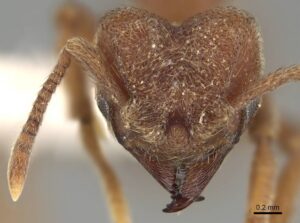
Sericomyrmex amabilis. AntWeb. Version 8.114. California Academy of Science, online at https://www.antweb.org.

The mineral layer is 7 to 20 micrometers thick and covers almost the entire body of mature worker ants, except their antennae, mandibles, the centers of the eye facets and leg tips. The mineral is partially ordered dolomite, a form never before reported in any animal. 

The dolomite problemcan 

Dolomite is one of the most abundant minerals in ancient rock formations, but it is very difficult to produce in the laboratory. At room temperature, the magnesium ions required to form dolomite are surrounded by a tightly bound shell of water molecules that must be displaced before the mineral can crystallize. Synthesizing it artificially typically requires temperatures exceeding 100 °C. In geology, this is known as the ‘dolomite problem’. Identifying the proteins involved in the process in S. amabilis could open a pathway toward biomimetic synthesis of high-magnesium carbonate materials, potentially enabling the engineering of harder, more stable materials or informing low-energy industrial processes for carbon mineralization.  

To prove that the ants were converting CO2, the researchers exposed them to isotopically labeled 13CO2. This allowed them to trace the carbon directly to the mineral layer on the ants’ exoskeletons, showing that the carbon in the exoskeletons came from the air, not from the ants’ food. 

The mineral armor is physically harder than that of related ant species, providing better protection against predators and fungal pathogens. Additionally, the process removes toxic CO2 from the ants’ underground nests, which can often reach dangerously high levels due to the metabolic activity of dense populations and fungus. 

A similar process is also seen in geological carbon mineralization, where carbon is sequestered in rocks over millions of years. Understanding how these ants rapidly form dolomite at ambient temperatures, something that normally requires extreme heat in the lab, could offer clues for engineering better carbon capture and storage technologies. 

Related Articles Read More >

Elkem Silicones rebrands as Bluestar Silicones after ownership change
Martian chemistry: how the Curiosity rover detected organic compounds on Mars
Sandia scientists develop rapid PFAS test using desorption electrospray ionization 
MXenes, the family of 2D transition metal carbides, get a clean surface, and a 160-fold conductivity jump
rd newsletter
EXPAND YOUR KNOWLEDGE AND STAY CONNECTED
Get the latest info on technologies, trends, and strategies in Research & Development.

R&D World Digital Issues

Fall 2025 issue

Browse the most current issue of R&D World and back issues in an easy to use high quality format. Clip, share and download with the leading R&D magazine today.

R&D 100 Awards
Research & Development World
  • Subscribe to R&D World Magazine
  • Sign up for R&D World’s newsletter
  • Contact Us
  • About Us
  • Drug Discovery & Development
  • Pharmaceutical Processing
  • Global Funding Forecast

Copyright © 2026 WTWH Media LLC. All Rights Reserved. The material on this site may not be reproduced, distributed, transmitted, cached or otherwise used, except with the prior written permission of WTWH Media
Privacy Policy | Advertising | About Us

Search R&D World

  • R&D World Home
  • Topics
    • Aerospace
    • Automotive
    • Biotech
    • Careers
    • Chemistry
    • Environment
    • Energy
    • Life Science
    • Material Science
    • R&D Management
    • Physics
  • Technology
    • 3D Printing
    • A.I./Robotics
    • Software
    • Battery Technology
    • Controlled Environments
      • Cleanrooms
      • Graphene
      • Lasers
      • Regulations/Standards
      • Sensors
    • Imaging
    • Nanotechnology
    • Scientific Computing
      • Big Data
      • HPC/Supercomputing
      • Informatics
      • Security
    • Semiconductors
  • R&D Market Pulse
  • R&D 100
    • 2025 R&D 100 Award Winners
    • 2025 Professional Award Winners
    • 2025 Special Recognition Winners
    • R&D 100 Awards Event
    • R&D 100 Submissions
    • Winner Archive
  • Resources
    • Research Reports
    • Digital Issues
    • Educational Assets
    • Subscribe
    • Video
    • Webinars
    • PharmSci360
    • Content submission guidelines for R&D World
  • Global Funding Forecast
  • Top Labs
  • Advertise
  • SUBSCRIBE