Research & Development World

  • R&D World Home
  • Topics
    • Aerospace
    • Automotive
    • Biotech
    • Careers
    • Chemistry
    • Environment
    • Energy
    • Life Science
    • Material Science
    • R&D Management
    • Physics
  • Technology
    • 3D Printing
    • A.I./Robotics
    • Software
    • Battery Technology
    • Controlled Environments
      • Cleanrooms
      • Graphene
      • Lasers
      • Regulations/Standards
      • Sensors
    • Imaging
    • Nanotechnology
    • Scientific Computing
      • Big Data
      • HPC/Supercomputing
      • Informatics
      • Security
    • Semiconductors
  • R&D Market Pulse
  • R&D 100
    • 2025 R&D 100 Award Winners
    • 2025 Professional Award Winners
    • 2025 Special Recognition Winners
    • R&D 100 Awards Event
    • R&D 100 Submissions
    • Winner Archive
  • Resources
    • Research Reports
    • Digital Issues
    • Educational Assets
    • R&D Index
    • Subscribe
    • Video
    • Webinars
    • Content submission guidelines for R&D World
  • Global Funding Forecast
  • Top Labs
  • Advertise
  • SUBSCRIBE

TUM researchers report record-setting battery electrolyte, topping prior speed by 30%

By Brian Buntz | May 15, 2025

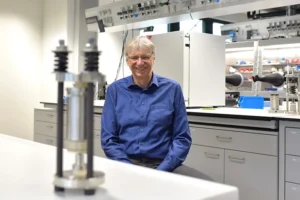
Prof. Thomas F. Fässler in his TUM lab, where his team set a new speed record for lithium-ion conductivity in solid-state battery materials.

Prof. Thomas F. Fässler in his TUM lab, where his team set a new speed record for lithium-ion conductivity in solid-state battery materials. [Image courtesy of TUM]

Researchers at the Technical University of Munich (TUM), in collaboration with TUMint.Energy Research, have set a new benchmark for solid-state battery electrolytes, introducing a lithium-antimony-scandium compound that shuttles lithium ions at 42 mS/cm.

The breakthrough is detailed in a research article published April 28, 2025, in Advanced Energy Materials and a news announcement. In the study, Fässler’s team describes how substituting a portion of lithium in Li₃Sb with scandium created a compound, Li₂.₅₅Sc₀.₁₅Sb, that achieved lithium-ion conductivity of 42 mS/cm at room temperature (298 K). That’s more than 30% faster than any previously reported solid electrolyte, with a record-low activation energy of 17.6 kJ/mol.

What’s different

While many solid electrolytes rely on complex, often seven-element, material “cocktails,” the new TUM material from Professor Fässler’s group achieves its conductivity with just three core ingredients: lithium, scandium, and antimony. One factor driving the development was the substitution of a small amount of scandium for lithium in the parent compound Li₃Sb, resulting in the optimal formula Li₂.₅₅Sc₀.₁₅Sb. This targeted substitution engineers specific, intentionally created vacancies within the crystal lattice.

Our result currently represents a significant advance in basic research. By incorporating small amounts of scandium, we have uncovered a new principle that could prove to be a blueprint for other elemental combinations. —Fässler

These vacancies function as ‘express lanes,’ providing ions more room to move and allowing them to zip through nearly a third faster than in the previous leading material. This streamlined, three-element chemistry not only avoids the need for rare chalcogenides and potentially exotic processing steps but also hints at pathways for easier and less expensive scaling compared to more complex alternatives.

Matching liquid-electrolyte conductivity without the flammable solvent removes the main knock on solid-state batteries: sluggish power. If the material holds up inside a full cell, EV makers could chase higher energy density without adding elaborate cooling hardware.

What’s next

Building on this initial success, the team plans further research, as detailed in their Advanced Energy Materials publication, where they state, “A detailed investigation into the mechanism for lithium-ion diffusion of this compound is on-going and will be presented elsewhere.” Their “Future work will [also] focus on probing the electrochemical properties of the entire compound series… assessing electrochemical stability, and evaluating the performance in ASSBs using half-cell or full-cell setups.“

First author Jingwen Jiang elaborated that “the same concept can easily be applied to lithium-phosphorus systems” and “could have broader implications for enhancing conductivity in a wide range of other materials.
Related Articles Read More >

Solving the EV charger problem with streetlights
New scalable supercapacitors store more energy using graphene
Probiotics power a bioresorbable battery that can run from 4 to 100+ minutes
MIT’s new sodium fuel cell beats lithium three-to-one for regional aviation
rd newsletter
EXPAND YOUR KNOWLEDGE AND STAY CONNECTED
Get the latest info on technologies, trends, and strategies in Research & Development.
RD 25 Power Index

R&D World Digital Issues

Fall 2024 issue

Browse the most current issue of R&D World and back issues in an easy to use high quality format. Clip, share and download with the leading R&D magazine today.

Research & Development World
  • Subscribe to R&D World Magazine
  • Sign up for R&D World’s newsletter
  • Contact Us
  • About Us
  • Drug Discovery & Development
  • Pharmaceutical Processing
  • Global Funding Forecast

Copyright © 2025 WTWH Media LLC. All Rights Reserved. The material on this site may not be reproduced, distributed, transmitted, cached or otherwise used, except with the prior written permission of WTWH Media
Privacy Policy | Advertising | About Us

Search R&D World

  • R&D World Home
  • Topics
    • Aerospace
    • Automotive
    • Biotech
    • Careers
    • Chemistry
    • Environment
    • Energy
    • Life Science
    • Material Science
    • R&D Management
    • Physics
  • Technology
    • 3D Printing
    • A.I./Robotics
    • Software
    • Battery Technology
    • Controlled Environments
      • Cleanrooms
      • Graphene
      • Lasers
      • Regulations/Standards
      • Sensors
    • Imaging
    • Nanotechnology
    • Scientific Computing
      • Big Data
      • HPC/Supercomputing
      • Informatics
      • Security
    • Semiconductors
  • R&D Market Pulse
  • R&D 100
    • 2025 R&D 100 Award Winners
    • 2025 Professional Award Winners
    • 2025 Special Recognition Winners
    • R&D 100 Awards Event
    • R&D 100 Submissions
    • Winner Archive
  • Resources
    • Research Reports
    • Digital Issues
    • Educational Assets
    • R&D Index
    • Subscribe
    • Video
    • Webinars
    • Content submission guidelines for R&D World
  • Global Funding Forecast
  • Top Labs
  • Advertise
  • SUBSCRIBE