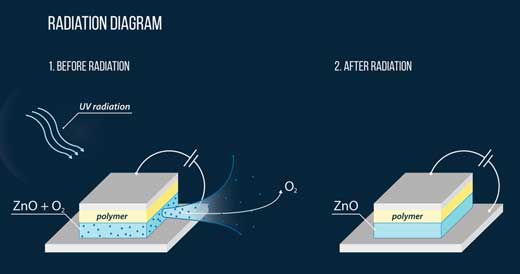
Desorption of oxygen under the influence of UV radiation.
Photodetectors, which are used in a wide range of systems and devices — from smartphones to space stations — are typically only sensitive to light within a certain narrow bandwidth, which causes numerous problems to product developers. Together with their colleagues from China and Saudi Arabia, scientists at Moscow Institute of Physics and Technology (MIPT) have found a way to address this. According to their study, published in Advanced Functional Materials (“Ultrahigh Gain Polymer Photodetectors with Spectral Response from UV to Near-Infrared Using ZnO Nanoparticles as Anode Interfacial Layer”), treating an ordinary photodetector with UV light can turn it into a high bandwidth device.
“There is a lot of demand for photodetectors that are sensitive to a wide range of frequencies, but they are difficult to design. It’s hard to find the right materials, because the substances that permit ultraviolet light tend to be nontransparent to infrared radiation, and vice versa. We found a way to ‘broaden’ the spectral response of photodetectors,” says Vadim Agafonov, head of the Molecular Electronics Center at MIPT, a coauthor of the paper.
The research team that also includes his colleagues from the Changchun Institute of Applied Chemistry and King Saud University studied polymer photodetectors based on the internal photoelectric effect, i.e., the redistribution of electrons within a polymer under the influence of light, resulting in electrical conductivity. Photodetectors based on organic materials have a number of advantages over their conventional inorganic counterparts, including their low cost, easier manufacturing, and physical flexibility. It turned out that by interacting with the surfaces of certain elements of the device, UV radiation can alter its sensitivity.
The researchers conducted an experiment whereby a polymer-based photodetector incorporating zinc oxide (ZnO) nanoparticles was exposed to UV light for 30 seconds. As a result of this, they achieved a high-performance photodetector with a much broader spectral response and a maximum external quantum efficiency (EQE) of 140,000 percent, as compared to the 30 percent measured before UV treatment. The EQE of a photodetector is an important figure of merit defined as the ratio between the number of “dislodged” electrons and the number of incident photons.
To put that in perspective, whereas before irradiation 10 photons generated just three electrons, after UV treatment the same number of photons produced 14,000 photoelectrons. However, the amount of noise experienced by the device was also greater due to an increased dark current, which is generated in the detector even when no photons are entering the device.
The researchers attribute the dramatic effect of UV light on detectors to the detachment of oxygen atoms from the zinc oxide molecules. During the manufacturing of a photodetector, oxygen molecules are adsorbed onto the surface of the semiconductor particles, whereby oxygen captures electrons from the conduction band. As a result, the captured electrons can no longer act as charge carriers. This means that the zinc oxide layer becomes a barrier that affects electron transport.
UV light treatment causes some of the valence electrons to migrate into the conduction band, driven by the radiation absorbed by the ZnO particles. The freed up electrons can then act as charge carriers, generating photocurrent even at the minimal measurable optical power intensity of 60 pW x cmv-2 (picowatts per cm2) under the bias voltage of -0.5 V.
“You can thus convert a polymer-based photodetector into a highly sensitive broadband device. The process itself is quick, cheap, and efficient, which is important for practical applications,” says Agafonov.
According to the paper, it is sufficient to treat a photodetector with UV light once during its manufacturing in order to achieve the broad spectral response. Moreover, the newly acquired properties of the device will remain unchanged after the manufacturing process is over, as the semiconductor layer will be sealed by a layer of aluminum protecting it from oxygen.
The researchers hope to eliminate the “side effects” that arise after irradiating the detector with UV light (e.g., a sharp increase in dark current), without sacrificing the high performance and wide spectral range of the device. Photodetectors that have been treated in the proposed way could be used anywhere from imaging to atmospheric sensing.