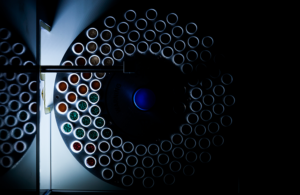
A top-down shot of the EMA 402XL’s 100-position autosampler carousel.
Velp Scientifica, better known for Kjeldahl digestion and solvent extraction than for elemental analyzers, is arriving at Analytica 2026 with three new products and a signal that the company is moving up the analytical workflow. The centerpiece is the EMA 402XL, a world-premiere CHNS macro elemental analyzer that swaps tin foil capsules for reusable ceramic crucibles. That represents a fundamental change to how samples enter the combustion furnace. Rounding out the launch: the ECODryBlock modular dry block heater and the Advance Series of connected heating magnetic stirrers.
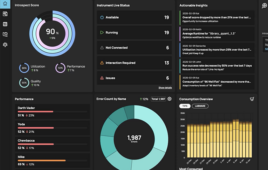
The EMA 402XL is the headline, but the three-product slate tells a broader story about where Velp is headed, from sample preparation into direct analytical measurement and from standalone bench instruments into an expanding connected-lab strategy. The EMA 402XL and the Advance Series stirrers connect to Velp’s ERMES cloud platform; the ECODryBlock emphasizes modularity and wireless bench control but has not been confirmed as ERMES-enabled. All three share a common design language: modular, automated, and digitally controlled.
The macro elemental-analysis field already includes established platforms from vendors such as Elementar, LECO, and Thermo Fisher, which means Velp will be entering a mature market with entrenched workflows.
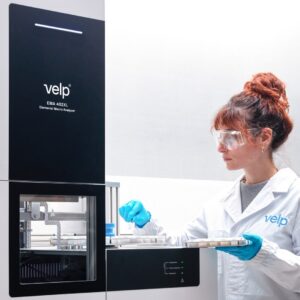
A tray of crucibles about to be loaded into the EMA 402XL.
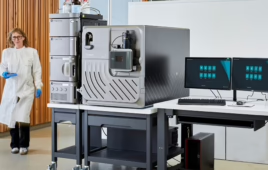
Velp is using Analytica 2026 to push beyond its traditional sample-prep strongholds and into higher-value elemental analysis, while extending the company’s broader connected-instrument strategy across parts of its portfolio. The EMA 402XL, a confirmed world premiere at the show (booth A1.304, with live demonstrations at Hall B2.333), is the company’s new entry in CHNS macro elemental analysis. Velp says the EMA 402XL is the world’s first CHNS macro elemental analyzer built around crucible technology.
What crucible technology actually means
In conventional CHNS analysis, a weighed sample is wrapped in a tin or silver foil capsule, dropped into a high-temperature combustion tube, and flash-combusted. The resulting gases, CO₂, H₂O, N₂ and SO₂, are separated and quantified by detectors. The system works well for small, homogeneous samples. It struggles with large, heterogeneous materials, which are the kind of samples common in environmental, agricultural and waste characterization work.
Velp’s EMA 402XL replaces the foil capsules with reusable ceramic crucibles, enabling direct analysis of significantly larger sample quantities. The crucibles are loaded into a 100-position autosampler that handles both sequential and non-sequential analyses with minimal operator intervention, from sample loading through ash removal.
The combustion itself uses a vertical furnace system reaching up to 1,350°C. That is high enough to ensure complete oxidation of even difficult matrices like coal, coke, and solid mineral materials. Velp says the system delivers results in compliance with ISO and ASTM standards for CHNS analysis. Dual dedicated detectors handle the CHNS quantification.
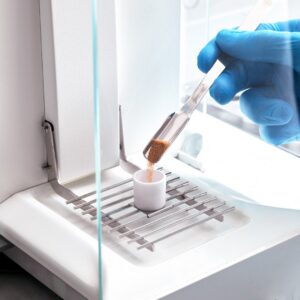
A sample being scooped directly into a ceramic crucible sitting on a balance
The competitive challenge
For Velp, part of the aim is to displace entrenched workflows. Velp’s potential advantage lies in two directions. First, existing relationships with food and environmental labs through its established product lines in digestion (for Kjeldahl nitrogen), solvent extraction (for fat content), and fiber analysis. Labs already using Velp’s sample preparation instruments have a natural pathway to a Velp elemental analyzer, particularly if the EMA 402XL integrates with existing Velp workflows. Second, the cloud connectivity angle: the EMA 402XL connects to Velp’s ERMES cloud platform, which the company launched in 2018 for real-time monitoring, remote supervision, and centralized data management across connected instruments. For multi-site laboratories or organizations managing fleets of analyzers, that connectivity layer could help Velp differentiate itself from incumbent elemental-analysis platforms.
Also at the booth: ECODryBlock and the Advance Series
The EMA 402XL may be the world premiere, but the other two launches fill gaps closer to Velp’s traditional territory.
ECODryBlock: Replacing water baths with modular dry heating
The ECODryBlock is a modular dry block heater designed to replace water and oil baths for sample preparation, incubation, and COD analysis. Water baths are a known pain point in labs: they require regular cleaning, breed contamination and the liquid medium is a spill hazard around electronics. Dry block heaters eliminate those problems by transferring heat directly through aluminum blocks, but most existing dry block heaters are single-purpose: one block, one format, one temperature.
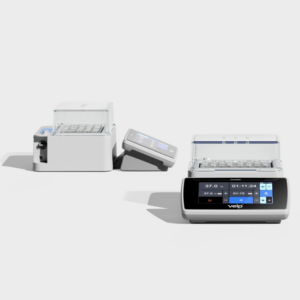 Velp’s approach is modular. A single ControlPad manages up to two independent heating modules, each holding two interchangeable aluminum blocks. The two modules can run at different temperatures simultaneously, effectively functioning as two independent dry baths in one footprint. The temperature range extends to 165°C, high enough for COD analysis in environmental labs, not just life science incubation, with stability of ±0.2°C and uniformity of ±0.2°C at 37°C.
The interchangeable block format supports vials, microcentrifuge tubes, PCR tubes, PCR strips, Greiner tubes, microplates, and cuvettes. The ControlPad connects wirelessly, keeping the bench clear of cables.
Advance Series: Connected heating stirrers
The Advance Series, AREX 5 Advance, AREC 7 Advance and AREC 10 Advance, is a top-to-bottom refresh of Velp’s heating magnetic stirrer line. Heating stirrers are commodity instruments in most labs, but Velp is pushing them toward the connected-lab model it’s building around the ERMES cloud platform.
The hardware upgrades include brushless motors with SpeedServo torque compensation (maintains constant speed as viscosity changes), capacitive-button interfaces with tempered glass control panels, and CerAlTop ceramic-coated aluminum plates. The AREX 5 Advance handles volumes up to 20 liters at 30–1,700 rpm with plate temperatures to 310°C. The AREC 10 Advance scales up to a 10-inch ceramic plate reaching 550°C, stirring up to 25 liters, with programmable temperature and speed ramps for complex reaction profiles.
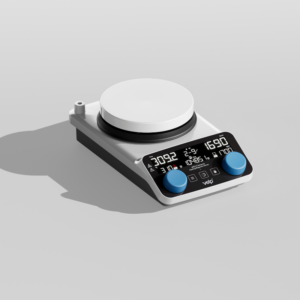 All three Advance models connect to ERMES for remote monitoring and parameter adjustment from any mobile device. For labs running multiple stirrers across benches or sites, that means centralized oversight of temperature and speed profiles, data logging without USB transfers, and the ability to spot excursions earlier without standing at the instrument. Velp also offers ControllerSoft software for labs that prefer local data management over cloud.
The products are positioned against IKA’s RCT digital series and Heidolph’s Hei-PLATE lines, established competitors in the premium heating stirrer segment. The Advance Series bet is that cloud connectivity and programmable ramps will matter enough to justify the price point.